LC-MS chromatographic fingerprinting as a tool for medicinal plant standardization (Hypericum perforatum L. as a case study)
DOI:
https://doi.org/10.15587/2519-8025.2026.362775Keywords:
Hypericum perforatum, St. John's wort, LC-MS, chromatographic fingerprint, metabolite profiling, medicinal plant standardization, phenolic acids, flavonoid glycosides, chlorogenic acid, herbal medicine authenticationAbstract
Aim. To evaluate the applicability of LC-MS chromatographic fingerprinting as a tool for standardization and authenticity verification of medicinal plant material using Hypericum perforatum L. as a model object.
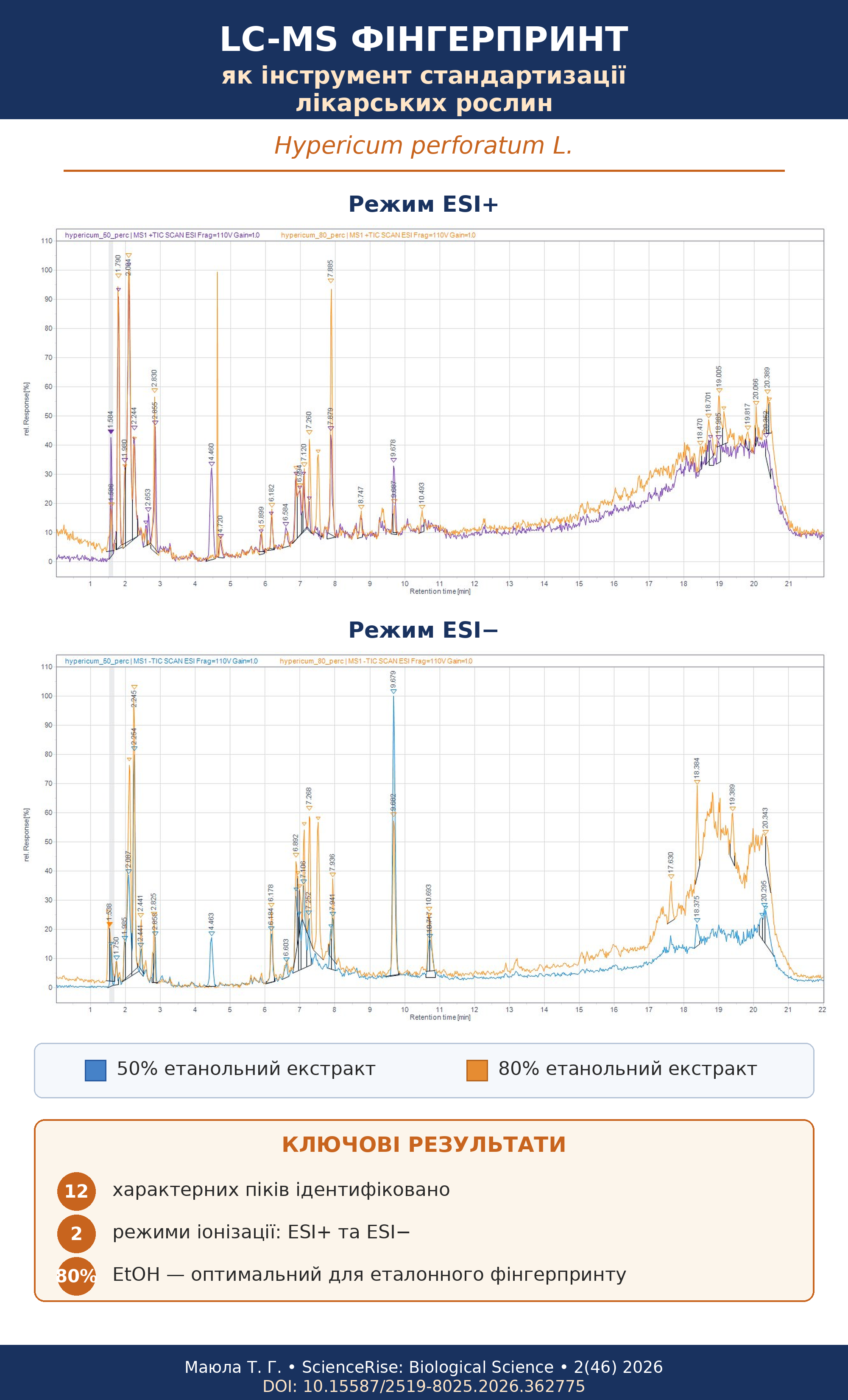
Materials and methods. 50% and 80% hydroethanol extracts of dried aerial parts of H. perforatum were prepared by ultrasonic extraction (30 min, sample weights 504 mg and 516 mg). Analysis was performed by LC-MS on an Agilent 1260 Infinity II / LC/MSD iQ system; Gemini NX-C18 column (150 × 4.6 mm, 5 μm), gradient elution (0.1% formic acid\acetonitrile), flow rate 0.7 mL/min. Detection was carried out in ESI+ and ESI− modes over the m/z range 100–1000. Total ion current (TIC) chromatograms were recorded and compared by overlay profiling.
Results. 12 characteristic peaks were identified in both extracts: phenolic acids (chlorogenic, neochlorogenic, caffeic), flavonoid glycosides (rutin, hyperoside, isoquercitrin), flavan-3-ols (catechin, epicatechin), and quercetin aglycone. Identification was performed at MSI level 2 (tentative annotation). TIC profiles were qualitatively similar (phytoequivalence), with the 80% extract yielding higher signal intensities for key marker compounds.
Conclusions. LC-MS fingerprint analysis provides a reproducible chemical profile suitable as a reference standard for batch verification and detection of compositional deviations. The 80% hydroethanol extract is recommended as the optimal system for generating a reference fingerprint of H. Perforatum
Supporting Agency
- Інститут молекулярної біології і генетики Національної академії наук України в рамках гранту Simons Foundation для українських установ № SFI-PD-Ukraine-00017453. Хроматографічний аналіз виконано на базі Науково-виробничого центру фітопрепаратів
References
- Wang, H., Chen, Y., Wang, L., Liu, Q., Yang, S., Wang, C. (2023). Advancing herbal medicine: enhancing product quality and safety through robust quality control practices. Frontiers in Pharmacology, 14. https://doi.org/10.3389/fphar.2023.1265178
- Noviana, E., Indrayanto, G., Rohman, A. (2022). Advances in Fingerprint Analysis for Standardization and Quality Control of Herbal Medicines. Frontiers in Pharmacology, 13. https://doi.org/10.3389/fphar.2022.853023
- Zhang, J., Liu, S., Sun, L., Liu, C., Chen, Y., Liu, Y. (2026). Application of mass spectrometry in the study of the material basis of Chinese herbal decoctions. Results in Chemistry, 21, 103100. https://doi.org/10.1016/j.rechem.2026.103100
- Wolfender, J.-L., Marti, G., Thomas, A., Bertrand, S. (2015). Current approaches and challenges for the metabolite profiling of complex natural extracts. Journal of Chromatography A, 1382, 136–164. https://doi.org/10.1016/j.chroma.2014.10.091
- Assessment report on Hypericum perforatum L., herba Final – Revision 1. European Medicines Agency. EMA/HMPC/244315/2016 (2022). Committee on Herbal Medicinal Products. Available at: https://www.ema.europa.eu/en/documents/herbal-report/final-assessment-report-hypericum-perforatum-l-herba-revision-1_en.pdf
- Heinrich, M., Jalil, B., Abdel-Tawab, M., Echeverria, J., Kulić, Ž., McGaw, L. J. et al. (2022). Best Practice in the chemical characterisation of extracts used in pharmacological and toxicological research – The ConPhyMP – Guidelines12. Frontiers in Pharmacology, 13. https://doi.org/10.3389/fphar.2022.953205
- Riswanto, F. D. O., Windarsih, A., Lukitaningsih, E., Rafi, M., Fadzilah, N. A., Rohman, A. (2022). Metabolite Fingerprinting Based on 1H-NMR Spectroscopy and Liquid Chromatography for the Authentication of Herbal Products. Molecules, 27 (4), 1198. https://doi.org/10.3390/molecules27041198
- Sima, I. A., Andrási, M., Sârbu, C. (2017). Chemometric Assessment of Chromatographic Methods for Herbal Medicines Authentication and Fingerprinting. Journal of Chromatographic Science, 56 (1), 49–55. https://doi.org/10.1093/chromsci/bmx080
- Bārzdiņa, A., Paulausks, A., Bandere, D., Brangule, A. (2022). The Potential Use of Herbal Fingerprints by Means of HPLC and TLC for Characterization and Identification of Herbal Extracts and the Distinction of Latvian Native Medicinal Plants. Molecules, 27 (8), 2555. https://doi.org/10.3390/molecules27082555
- Ion, V., Ielciu, I., Cârje, A.-G., Muntean, D. L., Crişan, G., Păltinean, R. (2022). Hypericum spp. – An Overview of the Extraction Methods and Analysis of Compounds. Separations, 9 (1), 17. https://doi.org/10.3390/separations9010017
- Sumner, L. W., Amberg, A., Barrett, D., Beale, M. H., Beger, R., Daykin, C. A. et al. (2007). Proposed minimum reporting standards for chemical analysis. Metabolomics, 3 (3), 211–221. https://doi.org/10.1007/s11306-007-0082-2
- Nobakht, S. Z., Akaberi, M., Mohammadpour, A. H., Tafazoli Moghadam, A., Emami, S. A. (2022). Hypericum perforatum: Traditional uses, clinical trials, and drug interactions. Iranian Journal of Basic Medical Sciences, 25 (9), 1045–1058. https://doi.org/10.22038/IJBMS.2022.65112.14338
- Kilibarda, S., Jović, M. D., Milinčić, D. D., Vuković, S., Trifković, J. Đ., Pešić, M. B., Kostić, A. Ž. (2025). Phytochemical Profile and Biological Activities of Rtanj’s Hypericum perforatum Infusion Tea and Methanolic Extracts: Insights from LC-MS/MS and HPTLC–Bioautography. Plants, 14 (9), 1377. https://doi.org/10.3390/plants14091377
- Güzel, M. A., Kolaç, T., Menevşe, İ. N., Dündar, M., Zengin, R., Güzel, A., Uğur, Y. (2026). Integrated chemical and biological characterization of Hypericum perforatum extract using LC-MS/MS and in vitro functional assays. Scientific Reports, 16 (1). https://doi.org/10.1038/s41598-026-36793-8
- Maiula, T. G., Bieda, O. A., Pylaieva, T. V., Yarmoluk, S. M. (2025). In silico modeling and prediction of antidiabetic potential of bioactive compounds from Galega officinalis L. non-alkaloid extract. Biopolymers and Cell, 41 (4), 309–317. https://doi.org/10.7124/bc.000b29
Downloads
Published
How to Cite
Issue
Section
License
Copyright (c) 2026 Taras Maiula

This work is licensed under a Creative Commons Attribution 4.0 International License.
Our journal abides by the Creative Commons Attribution 4.0 International License copyright rights and permissions for open access journals.
Authors, who are published in this journal, agree to the following conditions:
1. The authors reserve the right to authorship of the work and pass the first publication right of this work to the journal under the terms of a Creative Commons Attribution 4.0 International License, which allows others to freely distribute the published research with the obligatory reference to the authors of the original work and the first publication of the work in this journal.
2. The authors have the right to conclude separate supplement agreements that relate to non-exclusive work distribution in the form in which it has been published by the journal (for example, to upload the work to the online storage of the journal or publish it as part of a monograph), provided that the reference to the first publication of the work in this journal is included.
3. Authors have the right to store the final accepted version of the article in an institutional, thematic, or any other repository to ensure visibility and accessibility.


