Estimation of the world market and application of nanomaterials in the aerospace industry
DOI:
https://doi.org/10.15587/2706-5448.2024.312875Keywords:
aerospace market, aerospace materials market, market segmentation, market trends, market limitations, market development directions, nanomaterialsAbstract
The object of the study is the global aerospace market status, segment analysis, dynamics, competition, and prospects. The methods of searching and analyzing literature data, summarizing, systematizing, and visualizing data with diagrams are used.
The aerospace industry is at the forefront of technological innovation and is constantly searching for new advanced materials to improve productivity, efficiency, and safety. The aerospace market encompassing the design, manufacture, and maintenance of aircrafts, space vehicles, and related systems. It includes the commercial and military sectors, as well as the space exploration field.
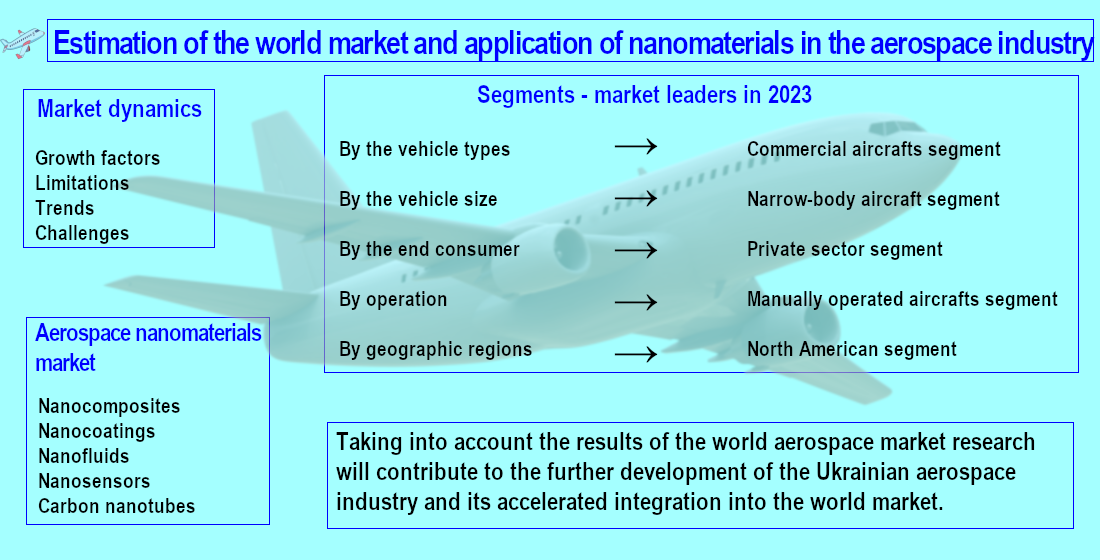
The world market of the aerospace industry was studied. Factors affecting the market positively and negatively were identified. According to the global aerospace market segmentation by vehicle types, the leading position in 2023 was occupied by the commercial aircrafts segment with a share of 63.4 %; by the vehicle size – by the narrow-body aircraft segment (72.4 %); by the end consumer – by the private sector segment (65.4 %); by operation – by manually operated aircrafts segment (79.4 %); and by geographic regions – by the North American segment (47.3 %). The main strategic trends and directions of the further aerospace market development are presented.
The world market of aerospace materials was studied. Factors affecting market dynamics are identified, and market challenges are highlighted. According to the world aerospace market segmentation by the materials types, the leading place in 2022 belonged to the composite materials segment with a share of 69 %; by the aircraft type – to the commercial aircrafts segment (51 %); and by geographical regions – to the European segment (35.0 %).
The trends of the sustainable aerospace industry development are summarized: modern aircraft design, use of sustainable aviation fuel, urban air mobility, modern traffic technology, and air transportation management optimization. For each trend, possible actions leading to changes in the aerospace industry are considered.
The question of the nanomaterials use in the space industry is considered. Some characteristics and possibilities of application of nanocomposite materials, nanocoatings, nanofluids, nanosensors, and carbon nanotubes, as well as examples of the nanomaterials application in aircraft components are given. The industry problems are identified, and their possible solutions are given.
References
- Yang, P. (2023). Nanomaterials in Aerospace: Advancements, Applications, and the Path Forward. Highlights in Science, Engineering and Technology, 73, 116–121. https://doi.org/10.54097/hset.v73i.12847
- Baig, N., Kammakakam, I., Falath, W. (2021). Nanomaterials: a review of synthesis methods, properties, recent progress, and challenges. Materials Advances, 2 (6), 1821–1871. https://doi.org/10.1039/d0ma00807a
- Malyshev, V., Gab, A., Kovalenko, V., Pryshedko, O., Shakhnin, D. (2024). Estimation of global nanomedicine market: status, segment analysis, dynamics, competition and prospects. Technology Audit and Production Reserves, 1 (4 (75)), 48–59. https://doi.org/10.15587/2706-5448.2024.299271
- Udovytska, Ye. A. (2017). Mizhnarodne spivrobitnytstvo v aerokosmichnii sferi. Naukovyi ohliad, 5 (37), 38–47. Available at: https://naukajournal.org/index.php/naukajournal/article/view/1210
- Aerospace Global Market Opportunities and Strategies to 2033 (2024). The Business Research Company, 367. Available at: https://www.researchandmarkets.com/report/commercial-aerospace
- Aerospace Market Size, Share, and Trends 2024 to 2034 (2024). Available at: https://www.precedenceresearch.com/aerospace-market
- Aerospace Materials Market Size, Share, and Trends 2024 to 2034 (2023). Available at: https://www.precedenceresearch.com/aerospace-materials-market
- Pandian, G., Pecht, M., Zio, E., Hodkiewicz, M. (2020). Data-driven reliability analysis of Boeing 787 Dreamliner. Chinese Journal of Aeronautics, 33 (7), 1969–1979. https://doi.org/10.1016/j.cja.2020.02.003
- Hussain, M. S., Swailem, S. A., Hala, A. (2009). Advanced nanocomposites for high temperature aero-engine/turbine components. International Journal of Nanomanufacturing, 4 (1-4), 248–256. https://doi.org/10.1504/ijnm.2009.028132
- Liang, F., Tang, Y., Gou, J., Gu, H. C., Song, G. (2009). Multifunctional Nanocomposites With High Damping Performance for Aerospace Structures. Volume 11: Mechanics of Solids, Structures and Fluids, 267–273. https://doi.org/10.1115/imece2009-12542
- Pavlenko, V. I., Cherkashina, N. I., Zaitsev, S. V. (2019). Fabrication and characterization of nanocomposite films Al, Cu/Al and Cr/Al formed on polyimide substrate. Acta Astronautica, 160, 489–498. https://doi.org/10.1016/j.actaastro.2019.02.025
- Bhat, A., Budholiya, S., Aravind Raj, S., Sultan, M. T. H., Hui, D., Md Shah, A. U., Safri, S. N. A. (2021). Review on nanocomposites based on aerospace applications. Nanotechnology Reviews, 10 (1), 237–253. https://doi.org/10.1515/ntrev-2021-0018
- Xu, Y., Hoa, S. V. (2008). Mechanical properties of carbon fiber reinforced epoxy/clay nanocomposites. Composites Science and Technology, 68 (3-4), 854–861. https://doi.org/10.1016/j.compscitech.2007.08.013
- Mostafa, N. H., Ismarrubie, Z. N., Sapuan, S. M., Sultan, M. T. H. (2017). Fibre prestressed composites: Theoretical and numerical modelling of unidirectional and plain-weave fibre reinforcement forms. Composite Structures, 159, 410–423. https://doi.org/10.1016/j.compstruct.2016.09.090
- Heidari, M., Thangavel, S., Ghafri, K. A., Kumar, A. (2024). Future trends and emerging research in nanofluids for aerospace applications. Nanofluids Technology for Thermal Sciences and Engineering. Boca Raton: CRC Press, 272–291. https://doi.org/10.1201/9781003494454-15
- Kostopoulos, V., Masouras, A., Baltopoulos, A., Vavouliotis, A., Sotiriadis, G., Pambaguian, L. (2016). A critical review of nanotechnologies for composite aerospace structures. CEAS Space Journal, 9 (1), 35–57. https://doi.org/10.1007/s12567-016-0123-7
- Gohardani, O., Elola, M. C., Elizetxea, C. (2014). Potential and prospective implementation of carbon nanotubes on next generation aircraft and space vehicles: A review of current and expected applications in aerospace sciences. Progress in Aerospace Sciences, 70, 42–68. https://doi.org/10.1016/j.paerosci.2014.05.002
- Baughman, R. H., Zakhidov, A. A., de Heer, W. A. (2002). Carbon Nanotubes--the Route Toward Applications. Science, 297 (5582), 787–792. https://doi.org/10.1126/science.1060928
Downloads
Published
How to Cite
Issue
Section
License
Copyright (c) 2024 Viktor Malyshev, Angelina Gab, Viktoriia Kovalenko, Yurii Lipskyi, Dmytro Shakhnin

This work is licensed under a Creative Commons Attribution 4.0 International License.
The consolidation and conditions for the transfer of copyright (identification of authorship) is carried out in the License Agreement. In particular, the authors reserve the right to the authorship of their manuscript and transfer the first publication of this work to the journal under the terms of the Creative Commons CC BY license. At the same time, they have the right to conclude on their own additional agreements concerning the non-exclusive distribution of the work in the form in which it was published by this journal, but provided that the link to the first publication of the article in this journal is preserved.