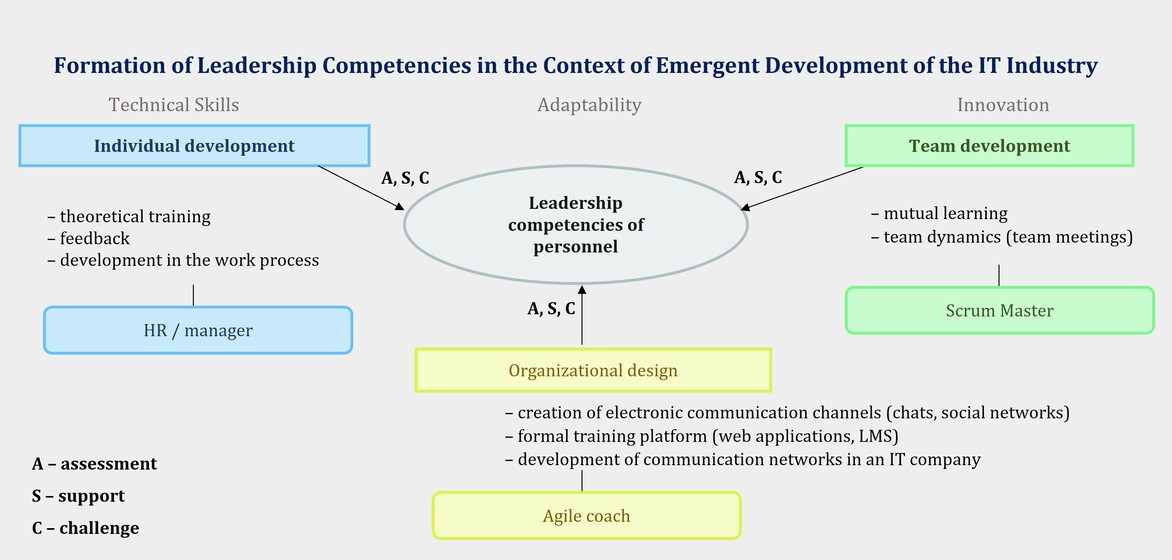
Formation of leadership competences in the context of emergent development of the IT industry
DOI:
https://doi.org/10.15587/2706-5448.2024.314344Keywords:
leadership competencies, IT industry, emergentity, leadership development, adaptive leadership, technical competence, personnel development programsAbstract
The object of research is processes and approaches to the development of leadership competencies of personnel in IT organizations.
The research is devoted to the analysis of the features of the formation of leadership competencies in the context of the emergent development of the IT industry. The work examines the evolution of concepts of corporate training and their adaptation to the specifics of the IT sphere, which is characterized by a high rate of technological changes and innovation. Traditional and innovative forms of personnel development are analyzed, with a special emphasis on their effectiveness in the context of the IT industry.
A survey was conducted among employees of IT companies, which revealed high leadership potential and willingness to accept responsibility among industry specialists. At the same time, certain gaps in the development of certain competencies have been identified, in particular, regarding the ability to effectively delegate tasks and make risky decisions. The results of the study emphasize the need to adapt traditional leadership models to the unique requirements of the IT industry, with a focus on the development of technical competence, innovative thinking and adaptability.
The paper offers recommendations for improving leadership development programs in IT companies. These recommendations include the implementation of flexible learning formats that combine online and offline components, as well as the use of modern technologies, such as virtual and augmented reality, to develop leadership skills. Special attention is paid to the development of such competencies as managing virtual teams and cross-cultural leadership, which are becoming more and more relevant in the context of the globalization of the IT industry.
The paper outlines directions for further research, in particular the study of the impact of artificial intelligence and machine learning on the formation of leadership competencies in the IT sphere. The results of the study have both theoretical and practical value for the development of effective strategies for the development of leadership potential in IT companies, which will contribute to increasing their competitiveness on the global market.
References
- Geseleva, N. V., Zaritskaya, N. N. (2013). Emergent Properties of the System. BiznesInform, 7, 93–97. Available at: https://business-inform.net/export_pdf/business-inform-2013-7_0-pages-93_97.pdf Last accessed: 18.09.2024
- Kalashnikova, S. (2016). Rozvytok liderskoho potentsialu suchasnoho universytetu: osnovy ta instrumenty. Kyiv: DP «NVTs «Priorytety», 44.
- Kalashnikova, S. A. (2010). Sutnist liderstva yak vyshchoho evoliutsiinoho rivnia upravlinnia. Nauka i osvita, 4-5, 101–104. Available at: https://scienceandeducation.pdpu.edu.ua/doc/2010/4_5_2010/23.pdf Last accessed: 18.09.2024
- Romanovskyi, O. H., Rieznik, S. M., Hura, T. V., Panfilov, Yu. I., Holoveshko, B. R., Bondarenko, V. V.; Romanovskyi, O. H. (Ed.) (2017). Liderski yakosti v profesiinii diialnosti. Kharkiv: FOP Panov A.M., 144.
- Lutsenko, B. (2020). Essence and nature of leadership qualities. Pedagogy of the Formation of a Creative Person in Higher and Secondary Schools, 1 (68), 90–93. https://doi.org/10.32840/1992-5786.2020.68-1.18
- Iatsenko, O. M., Horbunov, M. P. (2018). Formuvannia liderskykh yakostei maibutnikh menedzheriv u protsesi profesiinoi pidhotovky. Kharkiv, 250.
- HR4.0: Shaping People Strategies in the Fourth Industrial Revolution (2019). World Economic Forum, 38. Available at: https://www.weforum.org/reports/hr4-0-shaping-people-strategies-in-the-fourth-industrial-revolution/ Last accessed: 18.09.2024
- The Business Return on Learning and Development (2022). DeakinCo, 51. Available at: https://www2.deloitte.com/content/dam/Deloitte/au/Documents/Economics/deloitte-au-dae-business-return-learning-development-070922.pdf Last accessed: 18.09.2024
- Rudska, A. I. (2013). Psykholohichni osoblyvosti liderstva v umovakh realizatsii sotsialnykh proektiv. Extended abstract of PhD thesis.
- Jacobsen, C. B., Bøgh Andersen, L. (2015). Is Leadership in the Eye of the Beholder? A Study of Intended and Perceived Leadership Practices and Organizational Performance. Public Administration Review, 75 (6), 829–841. https://doi.org/10.1111/puar.12380
- Kize, K. (2023). 36 powerful leadership statistics [2022]: things all aspiring leaders should know. Available at: https://www.zippia.com/advice/leadership-statistics/ Last accessed: 18.09.2024
- Kellis, D. S., Ran, B. (2012). Modern leadership principles for public administration: time to move forward. Journal of Public Affairs, 13 (1), 130–141. Portico. https://doi.org/10.1002/pa.1453
- Janinks, D. (1995). On Becoming a Leader. Cambridge, 12–18.
- Miliaieva, V. R. (2014). Leadership potential’s development during the formation of managerial competence of the heads of educational institutions. Visnyk Natsionalnoi akademii Derzhavnoi prykordonnoi sluzhby Ukrainy. Pedahohichni nauky, 1, 34–40.
- 28 Leadership Stats 2024 [about Business and the Workplace]. Available at: https://thrivemyway.com/leadership-stats/ Last accessed: 18.09.2024
- Shtyfurak, V. S., Kyrylenko, V. V., Loiko, L. S. (2008). Osnovy uspishnoi upravlinskoi diialnosti: (psykhohihiienichnyi aspekt). Vinnytsia, 194.
- Ivanova, V. (2014). Problema liderstva v kolektyvi ditei doshkilnoho viku. Naukovyi visnyk Uzhhorodskoho natsionalnoho universytetu. Seriia: Pedahohika. Sotsialna robota, 32, 78–81. Available at: http://nbuv.gov.ua/UJRN/Nvuuped_2014_32_28 Last accessed: 18.09.2024
Downloads
Published
How to Cite
Issue
Section
License
Copyright (c) 2024 Oksana Zhylinska, Anzhela Tyshchenko

This work is licensed under a Creative Commons Attribution 4.0 International License.
The consolidation and conditions for the transfer of copyright (identification of authorship) is carried out in the License Agreement. In particular, the authors reserve the right to the authorship of their manuscript and transfer the first publication of this work to the journal under the terms of the Creative Commons CC BY license. At the same time, they have the right to conclude on their own additional agreements concerning the non-exclusive distribution of the work in the form in which it was published by this journal, but provided that the link to the first publication of the article in this journal is preserved.