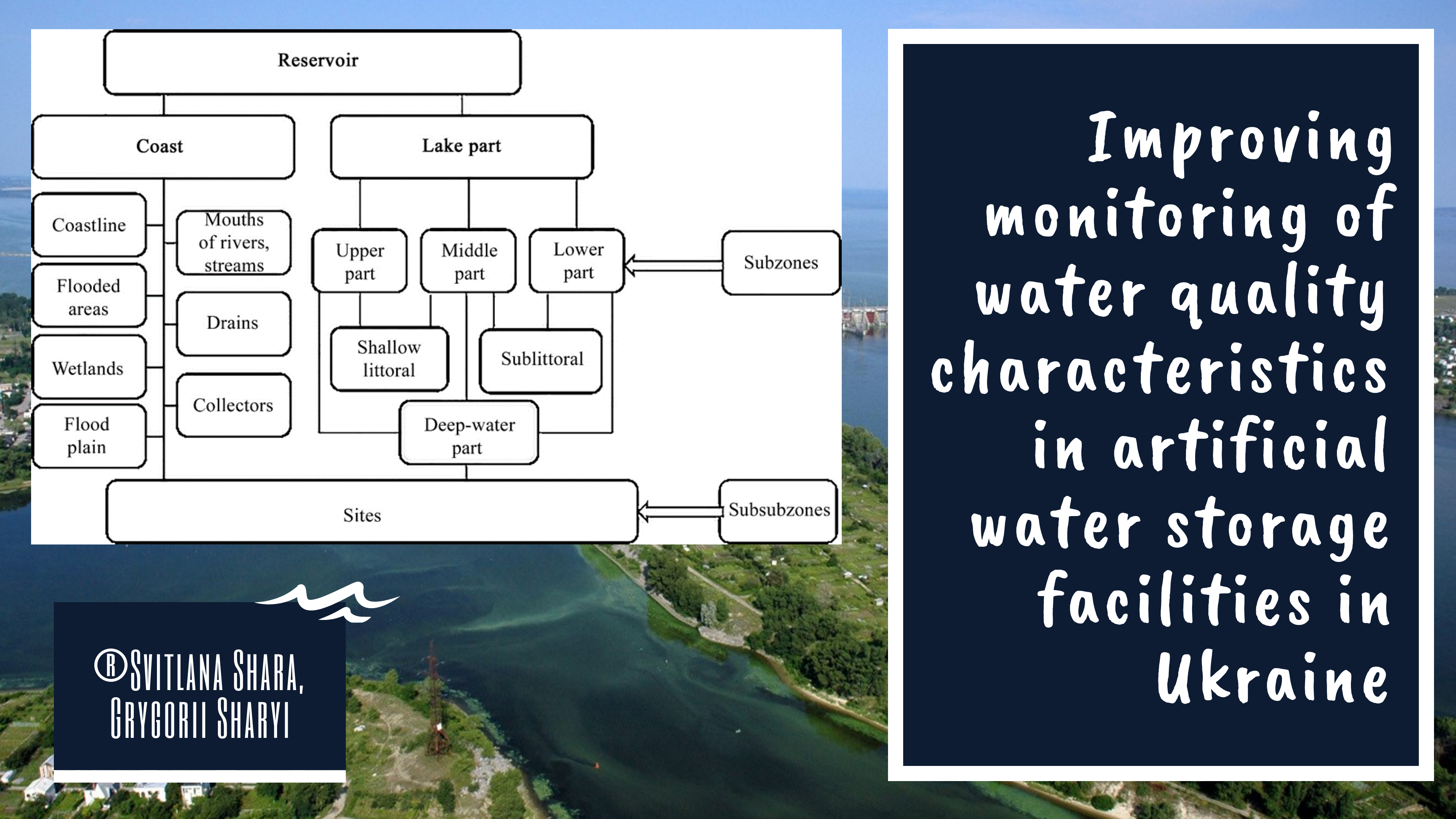
Improving monitoring of water quality characteristics in artificial water storage facilities in Ukraine
DOI:
https://doi.org/10.15587/2706-5448.2024.318925Keywords:
hydroecological situation, surface waters, artificial water storage facilities, water directives, Kremenchuk ReservoirAbstract
The object of research is the hydroecological situation in the surface waters of Ukraine, indicated by the data of modern monitoring of surface waters, especially in the part of the Dnipro basin that forms the Kremenchuk Reservoir. Ukraine has not formed a holistic system of measures for monitoring and maintaining the quality of surface waters and state supervision over diseases associated with drinking water. The qualitative characteristics of drinking water are determined by the ecological state of the surface water bodies that are sources of drinking water. Therefore, this work is devoted to determining the need and ways to improve the state monitoring of the qualitative characteristics of waters in artificial water-accumulating objects and parts of the river basins that form them.
The work uses scientific methods of systemic analysis, generalization and systematization, takes into account synergistic approaches in hydroecology and consideration of possible development scenarios based on the autopsy method. It is shown that diagnostic water monitoring covers only a small part of water bodies in Ukraine, and the modern hydrological monitoring network of Ukraine has up to 400 posts, including chemical pollution in half of the points, which is not enough. The state of the legal field of development of the water strategy of Ukraine, the monitoring mission of the state and the implementation of the legislative framework of Ukraine to EU requirements are analyzed, but the state of surface waters in Ukraine encourages to study the experience of water protection in European and world countries. This experience indicates that in the field of monitoring and protection of surface waters in Ukraine, a much higher and more accurate level of monitoring and a more stringent level of state regulation of water relations towards greening are needed.
The work develops a structural and logical scheme of factor analysis, including systems of hydro-ecological monitoring of the formation of the aquatic environment of part of the Dnipro basin in the Kremenchuk Reservoir area. The need for systematic improvement of monitoring of water quality characteristics in artificial water storage facilities, which is the Kremenchuk Reservoir, and the need for a significant concentration of monitoring points, both in the reservoir and in the Dnipro basin that forms it, has been identified. A change in monitoring points and systematic diagnostics of reservoirs using modern capabilities of satellite sounding of water bodies within the framework of the greening of water relations in Ukraine has been proposed.
References
- Bates, B. C., Kundzewics, Z. W., Wu, S., Palutukof, J. P. (2008). Climate Change and Water. Technical Paper of the Intergovernment Panel on Climate Change. IPCC Secretariat. Geneva, 210.
- Wang, H., Chen, L., Yu, X. (2016). Distinguishing human and climate influences on streamflow changes in Luan River basin in China. CATENA, 136, 182–188. https://doi.org/10.1016/j.catena.2015.02.013
- Pronevych, O. S. (2017). Implementation of European Standards for the Quality of Drinking Water: The Institutional and Legal Aspect. Forum prava, 3, 182–189. Available at: http://nbuv.gov.ua/UJRN/FP_index.htm_2017_3_33
- Klymenko, M. O., Klymenko, O. M., Petruk, A. M. (2013). Hidrolohichnyi monitorynh vodnykh ekosystem z ohliadu na suchasni Yevropeiski napriamy u pryrodookhoronnii diialnosti. Visnyk Poltavskoi derzhavnoi akademii, 3, 22–27.
- Pinchuk, O. L., Herasimov, Ye. H., Kunytskyi, S. O. (2019). Dyrektyvy YeS u sferi upravlinnia vodnymy resursamy. Rivne “Volynski berehy”, 224.
- Dubniak, S. S. (2006). Metodolohiia doslidzhennia strukturno-funktsionalnykh osoblyvostei rivnynnykh vodoskhovyshch. Hidrolohiia, hidrokhimiia i hidroekolohiia, 10, 20–35.
- Kampa, E., Ward, J. G., Leipprand, A. (2007). Convergences with EU Water Policies. Available at: https://www.ecologic.eu/2652
- Klymenko, M. O., Vozniuk, H. I., Verbetska, K. Yu. (2012). Porivnialnyi analiz normatyviv yakosti poverkhnevykh vod. Naukovi dopovidi NUBi P, 8 (30).
- Dani derzhavnoho monitorynhu poverkhnevykh vod. Derzhavne ahenstvo vodnykh resursiv Ukrainy. Available at: https://data.gov.ua/dataset/surface-water-monitoring
- Vodna initsiatyva YeS plius dlia krain Skhidnoho partnerstva (2021). Available at: https://www.euwipluseast.eu/images/2021/07/PDF/EUWI_UA_PublicConsultation_Toolkit_Ukr.pdf
- Poriadok zdiisnennia derzhavnoho monitorynhu vod (2018). Postanova Kabinetu Ministriv Ukrainy No. 758. 19.09.2018. Available at: https://zakon.rada.gov.ua/laws/show/758-2018-%D0%BF#Text
- Pro zatverdzhennia derzhavnykh sanitarnykh norm ta pravyl « Hihiienichni vymohy do vody pytnoi, pryznachenoiu dlia spozhyvannia liudynoiu» (2010). Nakaz Ministerstva okhorony zdorovia No. 400. 12.05.2010. Available at: https://zakon.rada.gov.ua/laws/show/z0452-10#Text
- Prohrama derzhavnoho monitorynhu poverkhnevykh vod na 2022 rik (2023). Nakaz Ministerstva zakhystu dovkillia ta pryrodnykh resursiv No. 1. 05.01.2023. Available at: https://online.budstandart.com/ua/catalog/doc-page.html?id_doc=97103
- Perelik zabrudniuiuchykh rechovyn dlia vyznachennia khimichnoho stanu masyviv poverkhnevykh i pidzemnykh vod ta ekonomichnoho potentsialu shtuchnoho abo istotno znyzhenoho masyvu poverkhnevykh vod (2017). Nakaz Ministerstva ekolohii ta pryrodnikh resursiv Ukrainy No. 45. 06.02.2017. Available at: https://zakon.rada.gov.ua/laws/show/z0235-17#Text
- Pro zatverdzhennia prohram derzhavnoho monitorynhu vod (2020). Nakaz Ministerstvo zakhystu dovkillia ta pryrodnykh resursiv No. 410. 31.12.2020. Available at: https://mepr.gov.ua/nakaz-mindovkillya-410-vid-31-12-2020/
- Natsionalna dopovid pro yakist pytnoi vody ta stan pytnoho vodopostachannia v Ukraini u 2022 r. Available at: https://mtu.gov.ua/content/nacionalna-dopovid-pro-yakist-pitnoi-vodi-ta-stan-pitnogo-vodopostachannya-v-ukraini.html
- Safe Drinking Water Act, 42 U.S.C.&& 300f-300-f-26.
- EU Water Framework Directive 2000/60/EC (2000). Official Journal of the European communities, 22.12.2000. L 327/1, 118.
- Endocrine Disrupting Compounds (2009). National Institutes of Health. U.S.Department of Health and Human Services.
- Uhoda pro Asotsiatsiiu mizh Ukrainoiu, z odniiei storony, ta Yevropeiskym Soiuzom, Yevropeiskym spivtovarystvom z atomnoi enerhii i yikhnimy derzhavamy-chlenamy, z inshoi storony (2023). Verkhovna Rada Ukrainy. Dokument 984_011. 30.11.2023. Available at: https://zakon.rada.gov.ua/laws/show/984_011#Text
- Berezhna, Yu., Kosohina, I. (2024). Bezpechna pytna voda v Ukraini: dostup do informatsii pro yakist vody ta metody vodo pidhotovky. Resursy pryrodnykh vod Karpatskoho rehionu. Lviv.
- Dyrektyva Rady 98/83/IeS vid 3 lystopada 1998 roku pro yakist vody, pryznachenoi dlia spozhyvannia liudynoiu. Available at: https://zakon.rada.gov.ua/laws/show/994_963#Text
- Hafiatulina, O. H., Okhrimenko, O. V. (2018). Monitorynh hidrokhimichnoho stanu richky Dnipro mista Kherson. Tavriiskyi Naukovyi visnyk, 83, 238–243.
- Hofstra, М. (2010). International cooperation on the river Rhine. Unesco‐IHE/Water Governance Centre NL.
- Pro tekhnichni rehlamenty ta otsinky vidpovidnosti (2015). Zakon Ukrainy No. 124-VIII. 15.01.2015. Available at: https://zakon.rada.gov.ua/laws/show/124-19#Text
Downloads
Published
How to Cite
Issue
Section
License
Copyright (c) 2024 Svitlana Shara, Grygorii Sharyi

This work is licensed under a Creative Commons Attribution 4.0 International License.
The consolidation and conditions for the transfer of copyright (identification of authorship) is carried out in the License Agreement. In particular, the authors reserve the right to the authorship of their manuscript and transfer the first publication of this work to the journal under the terms of the Creative Commons CC BY license. At the same time, they have the right to conclude on their own additional agreements concerning the non-exclusive distribution of the work in the form in which it was published by this journal, but provided that the link to the first publication of the article in this journal is preserved.