Study of lyophilic properties of natural clinoptilolite as a sorbent of oil and oil products
DOI:
https://doi.org/10.15587/2706-5448.2024.319850Keywords:
zeolite, clinoptilolite, oil, oil products, natural and wastewater treatment, lyophilic properties, marginal wetting angleAbstract
The object of research is natural clinoptilolite as a potential sorbent in the processes of water and soil purification from oil, petroleum products (A-95 gasoline, kerosene), industrial oil, benzene, toluene, hexane, water-gasoline emulsions, as well as water-organic condensate. It is known that this material has a high adsorption capacity for various organic media. Therefore, the lyophilic properties of different fractions of clinoptilolite in relation to the specified environments were investigated.
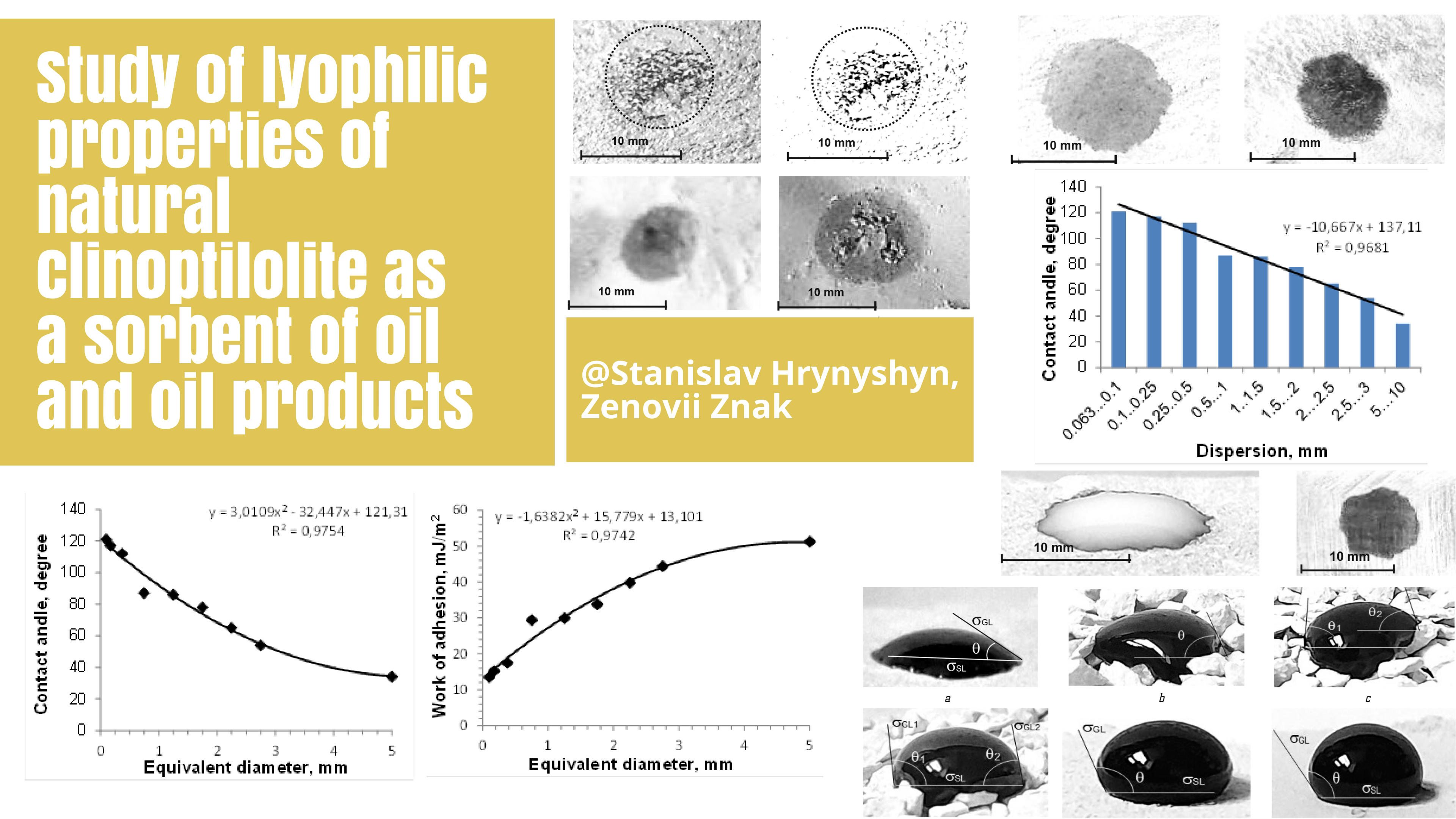
The lyophilic properties of clinoptilolite were studied using the lying drop method to measure the marginal wetting angle of different zeolite fractions using the specified media. The data obtained determined the suitability of clinoptilolite for cleaning soils and waters from these liquids.
The dependence of the wetting of clinoptilolite on the dispersion of clinoptilolite was established. All clinoptilolite fractions are characterized by high lyophilicity in all media except oil. The wettability of clinoptilolite with oil and the corresponding work of adhesion significantly depends on its dispersion. It was established that with an increase in the size of clinoptilolite particles from 0.1 to 2.5–3.0 mm, the work of adhesion increases from 13.5·10-3 to 51.2·10-3 J/m2. The influence of the surface morphology of clinoptilolite may cause this. An increase in temperature in the clinoptilolite-oil system contributes to the wetting of small fractions of zeolite with oil.
The obtained experimental data show that natural clinoptilolite with a wide fractional composition can be used to purify natural and wastewater waters and soils from the indicated organic and water-organic environments. At the same time, only clinoptilolite fractions over 1 mm are suitable for oil sorption.
References
- Pylypchuk, O., Vysotska, T., Pichkur, T. (2020). Modern ways to reduce the impact of railway transport on the environment: the problem of soil cleaning from petroleum products. Ecological Sciences, 3 (30), 113–118. https://doi.org/10.32846/2306-9716/2020.eco.3-30.19
- Krichkovskaya, L., Essam, A. E., Dubonosov, V. L. (2019). Search for sorbents for the elution of petroleum products from water. Bulletin of the National Technical University “KhPI”. Series: Chemistry, Chemical Technology and Ecology, 2, 47–52. https://doi.org/10.20998/2079-0821.2019.02.07
- Qi, P., Lin, N., Liu, Y., Zhao, J. (2013). Improvement of oil/water selectivity by stearic acid modified expanded perlite for oil spill cleanup. Journal of Shanghai Jiaotong University (Science), 18 (4), 500–507. https://doi.org/10.1007/s12204-013-1426-x
- Zadaka-Amir, D., Bleiman, N., Mishael, Y. G. (2013). Sepiolite as an effective natural porous adsorbent for surface oil-spill. Microporous and Mesoporous Materials, 169, 153–159. https://doi.org/10.1016/j.micromeso.2012.11.002
- Znak, Z. О., Мnykh, R. V., Pyrih, М. А., Zhuk, T. V. (2022). Research of oil sorption by natural clinoptylolite. Chemistry, Technology and Application of Substances, 5 (2), 58–64. https://doi.org/10.23939/ctas2022.02.058
- Barry, E., Mane, A. U., Libera, J. A., Elam, J. W., Darling, S. B. (2017). Advanced oil sorbents using sequential infiltration synthesis. Journal of Materials Chemistry A, 5 (6), 2929–2935. https://doi.org/10.1039/c6ta09014a
- Bayraktaroglu, S., Kizil, S., Bulbul Sonmez, H. (2021). A highly reusable polydimethylsiloxane sorbents for oil/organic solvent clean-up from water. Journal of Environmental Chemical Engineering, 9 (5), 106002. https://doi.org/10.1016/j.jece.2021.106002
- Wang, J., Wang, H., Geng, G. (2018). Highly efficient oil-in-water emulsion and oil layer/water mixture separation based on durably superhydrophobic sponge prepared via a facile route. Marine Pollution Bulletin, 127, 108–116. https://doi.org/10.1016/j.marpolbul.2017.11.060
- Narayanan, P., Ravirajan, A., Umasankaran, A., Prakash, D. G., Kumar, P. S. (2018). Theoretical and experimental investigation on the removal of oil spill by selective sorbents. Journal of Industrial and Engineering Chemistry, 63, 1–11. https://doi.org/10.1016/j.jiec.2018.01.031
- Zhu, H., Qiu, S., Jiang, W., Wu, D., Zhang, C. (2011). Evaluation of Electrospun Polyvinyl Chloride/Polystyrene Fibers As Sorbent Materials for Oil Spill Cleanup. Environmental Science & Technology, 45 (10), 4527–4531. https://doi.org/10.1021/es2002343
- Piperopoulos, E., Calabrese, L., Khaskhoussi, A., Proverbio, E., Milone, C. (2020). Thermo-Physical Characterization of Carbon Nanotube Composite Foam for Oil Recovery Applications. Nanomaterials, 10 (1), 86. https://doi.org/10.3390/nano10010086
- Tang, C., Guan, J., Xie, S. (2020). Study on Reutilization of Pyrolytic Residues of Oily Sludge. International Journal of Analytical Chemistry, 2020, 1–7. https://doi.org/10.1155/2020/8858022
- Hrynyshyn, S. О., Znak, Z. О., Hrynyshyn, K. О., Skorohoda, V. Y. (2023). Use of pyrocarbon obtained in the process of pyrolysis of rubber waste for absorption of oil and Petroleum products. Chemistry, Technology and Application of Substances, 6 (1), 27–31. https://doi.org/10.23939/ctas2023.01.027
- Sukhatskyi, Yu. V., Sozanskyi, M. A., Shepida, M. V., Znak, Z. O., Khomyak, S. V. (2024). Synthesis of spinel МgМn2О4 nanoparticles by the co-precipitation method in an ultrasonic field. Chemistry, Technology and Application of Substances, 7 (1), 52–59. https://doi.org/10.23939/ctas2024.01.052
- Bonn, D., Eggers, J., Indekeu, J., Meunier, J., Rolley, E. (2009). Wetting and spreading. Reviews of Modern Physics, 81 (2), 739–805. https://doi.org/10.1103/revmodphys.81.739
Downloads
Published
How to Cite
Issue
Section
License
Copyright (c) 2024 Stanislav Hrynyshyn, Zenovii Znak

This work is licensed under a Creative Commons Attribution 4.0 International License.
The consolidation and conditions for the transfer of copyright (identification of authorship) is carried out in the License Agreement. In particular, the authors reserve the right to the authorship of their manuscript and transfer the first publication of this work to the journal under the terms of the Creative Commons CC BY license. At the same time, they have the right to conclude on their own additional agreements concerning the non-exclusive distribution of the work in the form in which it was published by this journal, but provided that the link to the first publication of the article in this journal is preserved.