Integration of energy independence into marketing strategies of small and medium-sized enterprises: state support and profitability analysis
DOI:
https://doi.org/10.15587/2706-5448.2025.326703Keywords:
energy sustainability, business, green marketing, marketing strategies, government assistance, cost reduction, profitabilityAbstract
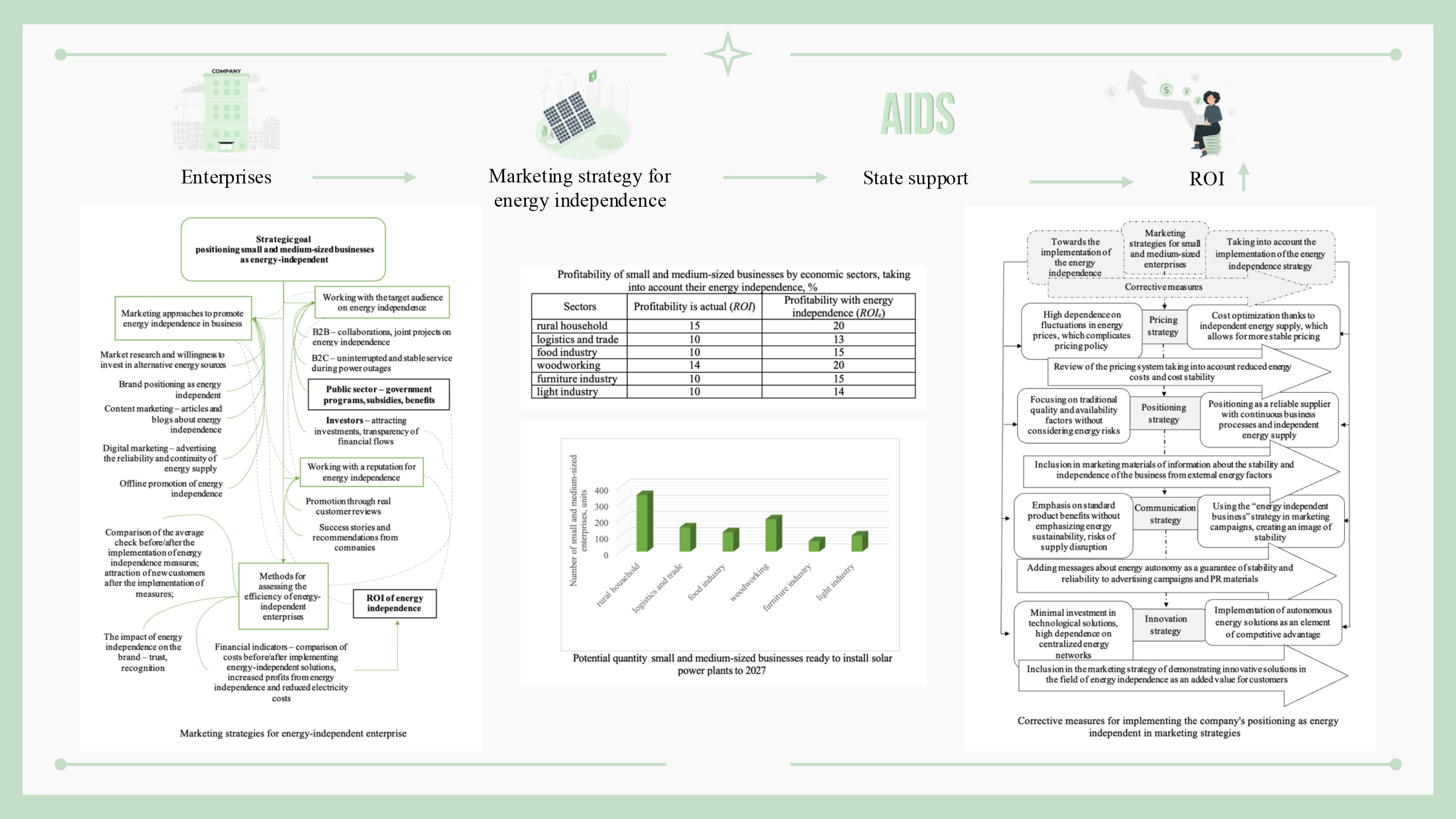
The object of research is the marketing strategy of energy independence of enterprises. One of the most problematic areas is determining the effectiveness of energy independence marketing strategies and their profitability due to limited access to official data, investment statistics, and reports on state programs for calculations.
The research used various methods. The logical method was used to justify the feasibility of energy independence, system analysis helped to assess its benefits and risks. Systematization and generalization methods were used to identify the main components of the concept, expert assessments were used to collect information, and statistical methods were used to assess the profitability of the activity.
The research results confirm that the implementation of a marketing strategy for energy independence of small and medium-sized enterprises, taking into account state support, can reduce electricity costs. Savings can range from 20 to 40 % over 5–7 years. The implementation of energy-efficient solutions contributes to an increase in the profitability of the activity by 3–5 %, which in the long term will lead to an increase in profit by up to 50 %. This is due to the fact that the proposed model of the marketing strategy for energy independence is to attract investment and state aid.
This provides the opportunity to reduce costs for alternative energy, increase profits due to business sustainability and increase the attractiveness of enterprises for environmentally conscious consumers and investors.
Compared to similar well-known traditional approaches to the so-called “green marketing”, the implementation of the concept of energy independence provides significant advantages. The application of this concept in the marketing communications system of small and medium-sized businesses contributes to an increase in the level of trust from stakeholders. In particular, it ensures an increase in profitability due to state support and attraction of investments in energy-efficient technologies and alternative energy sources.
References
- Pimonenko, T., Liulov, O., Us, Ya. (2019). Stratehii marketynhu “zelenykh” investytsii: osnovni polozhennia ta osoblyvosti. Visnyk Ternopilskoho natsionalnoho ekonomichnoho universytetu, 1, 177–185.
- Kambur, O. L., Petryschenko, N. A. (2018). Marketing of energy savings on enterprises. Efektyvna ekonomika, 9. Available at: http://www.economy.nayka.com.ua/?op=1&z=6534
- Orsato, R. J. (2006). Competitive Environmental Strategies: When Does it Pay to Be Green? California Management Review, 48 (2), 127–143. https://doi.org/10.2307/41166341
- Padilla-Rivera, A., Russo-Garrido, S., Merveille, N. (2020). Addressing the Social Aspects of a Circular Economy: A Systematic Literature Review. Sustainability, 12 (19), 7912. https://doi.org/10.3390/su12197912
- Roh, T., Noh, J., Oh, Y., Park, K.-S. (2022). Structural relationships of a firm’s green strategies for environmental performance: The roles of green supply chain management and green marketing innovation. Journal of Cleaner Production, 356, 131877. https://doi.org/10.1016/j.jclepro.2022.131877
- The State of Sustainable Supply Chains: Building Responsible and Resilient Supply Chains (2016). Ernst & Young United Nations Global Compact, 48.
- Derevetska, A. O., Rehan, Yu. M. (2018). “Zelenyi marketynh” yak innovatsiina kontseptsiia u prosuvanni orhanichnoi produktsii. Pidpryiemnytstvo, torhivlia, marketynh: stratehii, tekhnolohii ta innovatsii. Kyiv: Kyivskyi natsionalnyi torhovelno-ekonomichnyi universytet, 26–28.
- Zelenko, O. O. (2009). Sotsialno-vidpovidalnyi marketynh yak nevidiemna skladova sotsialnoi vidpovidalnosti biznesu. Ekonomichnyi prostir, 19, 118–123.
- Amosov, O. Yu., Havkalova, N. L. (2011). Problema resursozberezhennia v Ukraini ta shliakhy yii vyrishennia. Teoriia ta praktyka derzhavnoho upravlinnia, 3, 3–7. Available at: http://nbuv.gov.ua/UJRN/Tpdu_2011_3_3
- Aparashyna, O. I. (2011). Metodolohichni pidkhody do tlumachennia poniattia “resursozberezhennia”. Teoretychni ta praktychni aspekty ekonomiky ta intelektualnoi vlasnosti, 1, 112–120.
- Bukreieva, D., Kovalenko, T., Manukian, A. (2023). “Green” strategies for the sustainable development of the enterprise and increase in the efficiency of its activities. Economy and Society, 56. https://doi.org/10.32782/2524-0072/2023-56-121
- Ashton, W., Russell, S., Futch, E. (2017). The adoption of green business practices among small US Midwestern manufacturing enterprises. Journal of Environmental Planning and Management, 60 (12), 2133–2149. https://doi.org/10.1080/09640568.2017.1281107
- Solaiman, M., Osman, A., Halim, M. S. (2015). Green marketing: A marketing mix point of view. International Journal of Business and Technopreneurship, 5 (1), 87–98.
- Hayu Agustini, M., Suciarto Athanasius, S., Bekti Retnawati, B. (2019). Identification of green marketing strategies: perspective of a developing country. Innovative Marketing, 15 (4), 42–56. https://doi.org/10.21511/im.15(4).2019.04
- Yazdanifard, R., Mercy, I. E. (2011). The impact of green marketing on customer satisfaction and environmental safety. International Conference on Computer Communication and Management (ICCCM 2011). Sydney. Available at: https://www.researchgate.net/publication/268502673_The_impact_of_Green_Marketing_on_Customer_satisfaction_and_Environmental_safety
- Kaur, B., Gangwar, V. P., Dash, G. (2022). Green Marketing Strategies, Environmental Attitude, and Green Buying Intention: A Multi-Group Analysis in an Emerging Economy Context. Sustainability, 14 (10), 6107. https://doi.org/10.3390/su14106107
- Ismail, I. J. (2022). The role of technological absorption capacity, enviropreneurial orientation, and green marketing in enhancing business’ sustainability: evidence from fast-moving consumer goods in Tanzania. Technological Sustainability, 2 (2), 121–141. https://doi.org/10.1108/techs-04-2022-0018
- Nguyen-Viet, B. (2022). The impact of green marketing mix elements on green customer based brand equity in an emerging market. Asia-Pacific Journal of Business Administration, 15 (1), 96–116. https://doi.org/10.1108/apjba-08-2021-0398
- Stan ta potreby biznesu v umovakh viiny: rezultaty opytuvannia v sichni 2023 roku (2023). Diia.Biznes. Available at: https://business.diia.gov.ua/analytics/research/stan-ta-potreby-biznesu-v-umovakh-viiny-rezultaty-opytuvannia-v-sichni-2023-roku
- Kobelia-Zvir, M., Vovchak, O. (2023). Grant financing of the usaid program “Competitive economy of Ukraine” for entrepreneurship development organizations in Ukraine in the conditions of war. SWorld-Ger Conference Proceedings, 1, 58–63. https://doi.org/10.30890/2709-1783.2023-29-01-017
- Hranty na vlasnu spravu. Ministerstvo ekonomiky Ukrainy. Available at: https://vlasnaspravagrant.com.ua
- Prohrama YeRobota. Diia.Biznes. Available at: https://erobota.diia.gov.ua/#start
- Babych, T. (2024). Role of Grants in Ensuring Socio-Economic Stability in the Conditions of War in Ukraine. Acta Academiae Beregsasiensis. Economics, 7, 64–78. https://doi.org/10.58423/2786-6742/2024-7-64-78
- Kobelya-Zvir, M., Zvir, Y. (2023). Grant support of the eu4business program for micro, small and medium-sized businesses in ukraine during the war. Scientific Opinion: Economics and Management, 3 (83). https://doi.org/10.32782/2521-666x/2023-83-12
- Kredyt dlia enerhonezalezhnosti (2024). PryvatBank. Available at: https://privatbank.ua/business/credit-for-business-continuity
- Minfin: Za chas dii viiskovoho stanu v mezhakh Derzhavnoi prohramy “Dostupni kredyty 5–7–9 %” vydano 22610 pilhovykh kredytiv na sumu bilshe 90 mlrd. hrn. hrn. Ofitsiinyi sait Ministerstva finansiv Ukrainy. Available at: https://mof.gov.ua/uk/news/minfin_za_chas_dii_voiennogo_stanu_v_mezhakh_derzhavnoi_programi_dostupni_krediti_5-7-9_vidano_22_610_pilgovikh_kreditiv_na_sumu_bilshe_90_mlrd_grn-3869
- Samozabezpechenist elektroenerhiieiu v sektori MSP v Ukraini: Tendentsii 2020–2023 rr., pereshkody ta potentsial rozvytku (2024). DP “Ukrpromzovnishekspertyza”. Available at: https://www.expert.kiev.ua/docs/SME_prosumer_restyled_B.pdf
- Ukrainian Renewable Energy Association. Available at: https://uare.com.ua/?utm_source
- International Renewable Energy Agency. Available at: https://www.irena.org
- Zvit pro rezultaty diialnosti Derzhavnoi sluzhby statystyky Ukrainy za 2023 rik. Derzhavna sluzhba statystyky Ukrainy. Available at: https://www.ukrstat.gov.ua/zvit/2024/zvit_rd_2023.htm
Downloads
Published
How to Cite
Issue
Section
License
Copyright (c) 2025 Viktoriіa Adamovska, Ievgeniia Mishchuk, Diana Denysenko, Polina Porosla, Iryna Dashko

This work is licensed under a Creative Commons Attribution 4.0 International License.
The consolidation and conditions for the transfer of copyright (identification of authorship) is carried out in the License Agreement. In particular, the authors reserve the right to the authorship of their manuscript and transfer the first publication of this work to the journal under the terms of the Creative Commons CC BY license. At the same time, they have the right to conclude on their own additional agreements concerning the non-exclusive distribution of the work in the form in which it was published by this journal, but provided that the link to the first publication of the article in this journal is preserved.





