Determination of the role of innovation management in ensuring sustainable growth of enterprises
DOI:
https://doi.org/10.15587/2706-5448.2025.326751Keywords:
innovation management, innovation strategies, management support, innovation funding, digital technologies, innovation implementation barriersAbstract
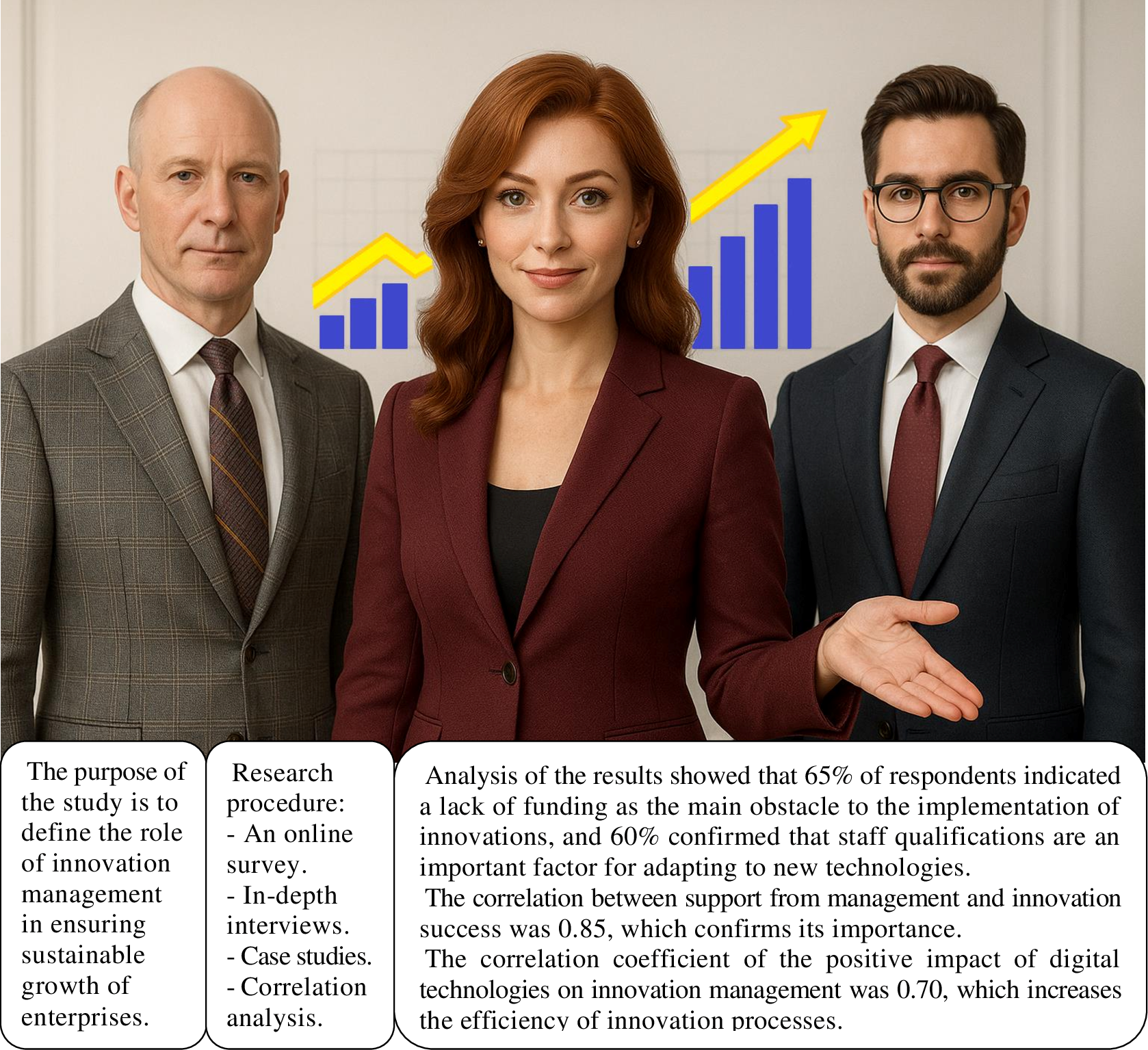
The object of research is the processes of innovation management in enterprises. One of the most problematic areas is the lack of proper funding, resistance from employees, and insufficient qualification of staff, which complicates the implementation of innovations. The research utilized methods such as surveys, interviews, case studies, and correlation analysis. This allowed for the identification of key factors influencing the success and effectiveness of innovation in enterprises under conditions of sustainable growth. In particular, the correlation analysis showed a significant relationship between the level of funding and the success of innovation processes (correlation coefficient 0.80), which confirms the importance of having sufficient resources for the implementation of innovations.
In addition to financing, the qualification of personnel plays a major role in the implementation of innovations. 60 % of respondents indicated that the level of training of employees is an important factor for effective adaptation to technological changes. In particular, the ability of personnel to adapt determines the speed of innovation implementation and reduces barriers in the change process. It was also found that support from management is critically important for the successful implementation of innovations (correlation coefficient 0.85), since it is managers who determine development strategies and provide the necessary conditions for their implementation.
The results obtained confirm that the proposed approach to innovation management, which includes the integration of modern digital technologies and the development of an innovation culture in the organization, allows significantly increasing the efficiency of innovation processes and ensuring sustainable development.
This provides the opportunity to obtain high indicators in such areas as innovative development and adaptation to change. Compared with similar known approaches, this provides such advantages as more effective management of financing and human resources. The study allows to formulate recommendations for improving innovation management processes in organizations, in particular, regarding the need to increase investment in innovative projects and improve the skills of personnel to adapt to technological changes.
References
- Endres, H., Huesig, S., Pesch, R. (2021). Digital innovation management for entrepreneurial ecosystems: services and functionalities as drivers of innovation management software adoption. Review of Managerial Science, 16 (1), 135–156. https://doi.org/10.1007/s11846-021-00441-4
- Aslam, F., Aimin, W., Li, M., Ur Rehman, K. (2020). Innovation in the Era of IoT and Industry 5.0: Absolute Innovation Management (AIM) Framework. Information, 11 (2), 124. https://doi.org/10.3390/info11020124
- Nambisan, S., Lyytinen, K., Majchrzak, A., Song, M. (2017). Digital Innovation Management: Reinventing Innovation Management Research in a Digital World. MIS Quarterly, 41 (1), 223–238. https://doi.org/10.25300/misq/2017/41:1.03
- Weiss, M., Baer, M., Hoegl, M. (2022). The human side of innovation management: Bridging the divide between the fields of innovation management and organizational behavior. Journal of Product Innovation Management, 39 (3), 283–291. https://doi.org/10.1111/jpim.12624
- Robbins, P., O’Connor, G. C. (2023). The professionalization of innovation management: Evolution and implications. Journal of Product Innovation Management, 40 (5), 593–609. https://doi.org/10.1111/jpim.12670
- Kihlander, I., Magnusson, M., Karlsson, M. (2022). Certification of Innovation Management Professionals: Reasons for and Results from Acquiring Certification. Journal of Innovation Management, 10 (1), 58–75. https://doi.org/10.24840/2183-0606_010.001_0004
- Frishammar, J., Richtnér, A., Brattström, A., Magnusson, M., Björk, J. (2019). Opportunities and challenges in the new innovation landscape: Implications for innovation auditing and innovation management. European Management Journal, 37 (2), 151–164. https://doi.org/10.1016/j.emj.2018.05.002
- Bamel, N., Kumar, S., Bamel, U., Lim, W. M., Sureka, R. (2022). The state of the art of innovation management: insights from a retrospective review of the European Journal of Innovation Management. European Journal of Innovation Management, 27 (3), 825–850. https://doi.org/10.1108/ejim-07-2022-0361
- Appio, F. P., Frattini, F., Petruzzelli, A. M., Neirotti, P. (2021). Digital Transformation and Innovation Management: A Synthesis of Existing Research and an Agenda for Future Studies. Journal of Product Innovation Management, 38 (1), 4–20. https://doi.org/10.1111/jpim.12562
- Naeini, A. B., Zamani, M., Daim, T. U., Sharma, M., Yalcin, H. (2022). Conceptual structure and perspectives on “innovation management”: A bibliometric review. Technological Forecasting and Social Change, 185, 122052. https://doi.org/10.1016/j.techfore.2022.122052
- Cappa, F., Oriani, R., Peruffo, E., McCarthy, I. (2020). Big Data for Creating and Capturing Value in the Digitalized Environment: Unpacking the Effects of Volume, Variety, and Veracity on Firm Performance*. Journal of Product Innovation Management, 38 (1), 49–67. https://doi.org/10.1111/jpim.12545
- Melendez, K., Dávila, A., Melgar, A. (2019). Literature Review of the Measurement in the Innovation Management. Journal of Technology Management & Innovation, 14 (2), 81–87. https://doi.org/10.4067/s0718-27242019000200081
- Trantopoulos, K., von Krogh, G., Wallin, M. W., Woerter, M. (2017). External Knowledge and Information Technology: Implications for Process Innovation Performance. MIS Quarterly, 41 (1), 287–300. https://doi.org/10.25300/misq/2017/41.1.15
- Svahn, F., Mathiassen, L., Lindgren, R. (2017). Embracing Digital Innovation in Incumbent Firms: How Volvo Cars Managed Competing Concerns. MIS Quarterly, 41 (1), 239–253. https://doi.org/10.25300/misq/2017/41.1.12
- Becker, L., Coussement, K., Büttgen, M., Weber, E. (2021). Leadership in innovation communities: The impact of transformational leadership language on member participation. Journal of Product Innovation Management, 39 (3), 371–393. Portico. https://doi.org/10.1111/jpim.12588
- Ko, Y. J., Choi, J. N. (2023). Collective turnover and firm innovation: Knowledge‐sharing system as a contingency. Journal of Product Innovation Management, 40 (6), 817–835. https://doi.org/10.1111/jpim.12684
Downloads
Published
How to Cite
Issue
Section
License
Copyright (c) 2025 Oleh Chechel, Alla Bashuk, Andriy Nevalov

This work is licensed under a Creative Commons Attribution 4.0 International License.
The consolidation and conditions for the transfer of copyright (identification of authorship) is carried out in the License Agreement. In particular, the authors reserve the right to the authorship of their manuscript and transfer the first publication of this work to the journal under the terms of the Creative Commons CC BY license. At the same time, they have the right to conclude on their own additional agreements concerning the non-exclusive distribution of the work in the form in which it was published by this journal, but provided that the link to the first publication of the article in this journal is preserved.