Development of an approach to chat-bot personalization with generative artificial intelligence when realize an online assistant
DOI:
https://doi.org/10.15587/2706-5448.2025.326914Keywords:
plugin, GOMS model, operator decomposition, cognitive functions, natural user languageAbstract
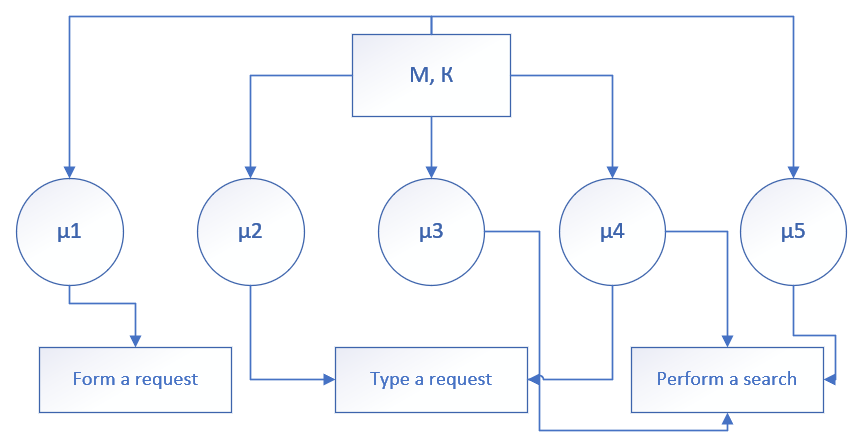
The object of research is the interaction in the “human – machine” system during the user's interaction with generative artificial intelligence. The relevance of the research topic is due to the need to provide assistance to users in a narrow professional topic. To implement the goal set in the work, a model of operator decomposition was developed using the “Goals, Objects, Methods, and Selection rules” GOMS technology, taking into account the multi-level cognitive functions of a person. For this purpose, microoperators were used, which are responsible for combining various actions to find an answer to a question. A model with the decomposition of the operator μ was developed, which is responsible for cognitive functions when creating a request during human interaction with a chatbot based on artificial intelligence. The work used interaction with the ChatGPT chatbot.
The proposed decomposition algorithm was used as the basis for the online assistant plugin. The implementation is made in JavaScript, which allows it to be used on any sites and portals. The main components of the plugin are the interface for entering a query, a multi-level search mechanism on the site and in connected specialized libraries. The API integration of the plugin with ChatGPT was implemented.
As a result of the work, a study was conducted to experimentally determine the values of action and movement operators that are related to human mental activity and algorithmized in the online assistant. According to the results of the experiment, it was taken into account that for a chatbot, queries using foreign language signs and symbols and queries in the user's usual natural language are equivalent. To communicate with ChatGPT using the plugin, it is necessary to adhere to uniqueness and clarity when forming narrowly professional queries. The result was obtained that when querying in natural language on a topic familiar to the user, the online assistant adapts to the requirements more slowly. But at the same time, the speed of finding an answer and its formulation is accelerated. The problem of personalizing the online assistant was solved. This became possible thanks to the analysis of user behavior through the detailing of the query by micro-operators in the GOMS model. This allows to personalize the online assistant without user registration, only based on its behavior when forming a request.
The proposed approach can be used to create online assistants for the implementation of highly specialized complex projects on web platforms.
References
- Lin, J., Sayagh, M., Hassan, A. E. (2023). The Co-evolution of the WordPress Platform and Its Plugins. ACM Transactions on Software Engineering and Methodology, 32 (1), 1–24. https://doi.org/10.1145/3533700
- Mansfield, R. (2025). WordPress power toolkit: harness AI to build next-level websites. Manning Publications. Available at: https://www.oreilly.com/library/view/-/9781633437746/
- Sun, Y., Li, S., Yu, L. (2021). The dark sides of AI personal assistant: effects of service failure on user continuance intention. Electronic Markets, 32 (1), 17–39. https://doi.org/10.1007/s12525-021-00483-2
- Orru, G., Longo, L. (2019). The Evolution of Cognitive Load Theory and the Measurement of Its Intrinsic, Extraneous and Germane Loads: A Review. Human Mental Workload: Models and Applications. Communications in Computer and Information Science, 23–48. https://doi.org/10.1007/978-3-030-14273-5_3
- Jesus, R., Bastião Silva, L., Sousa, V., Carvalho, L., Garcia Gonzalez, D., Carias, J., Costa, C. (2023). Personalizable AI platform for universal access to research and diagnosis in digital pathology. Computer Methods and Programs in Biomedicine, 242, 107787. https://doi.org/10.1016/j.cmpb.2023.107787
- Gohara, D. W. (2018). WPBMB Entrez: An interface to NCBI Entrez for Wordpress. Biophysical Chemistry, 234, 1–5. https://doi.org/10.1016/j.bpc.2017.11.004
- Hadfi, R., Haqbeen, J., Sahab, S., Ito, T. (2021). Argumentative Conversational Agents for Online Discussions. Journal of Systems Science and Systems Engineering, 30 (4), 450–464. https://doi.org/10.1007/s11518-021-5497-1
- Casciato, D., Mateen, S., Cooperman, S., Pesavento, D., Brandao, R. A. (2024). Evaluation of Online AI-Generated Foot and Ankle Surgery Information. The Journal of Foot and Ankle Surgery, 63 (6), 680–683. https://doi.org/10.1053/j.jfas.2024.06.009
- Zhu, Y., Zhang, J., Wu, J., Liu, Y. (2022). AI is better when I’m sure: The influence of certainty of needs on consumers’ acceptance of AI chatbots. Journal of Business Research, 150, 642–652. https://doi.org/10.1016/j.jbusres.2022.06.044
- Rech, A., Goltsev, Y., Samusik, N., Li, H., Nolan, G. P., June, C. H., Jhala, A. (2024). Mapping Path Forward for Using the Generative AI for Comprehension of Prognostic Genesets Implicated in Hematologic Malignancies. Blood, 144 (1), 7521–7521. https://doi.org/10.1182/blood-2024-211865
- Ataii, N., Bakshi, S., Chen, Y., Fernandez, M., Shao, Z., Scheftel, Z. et al. (2023). Enabling AI in synthetic biology through Construction File specification. PLOS ONE, 18 (11), e0294469. https://doi.org/10.1371/journal.pone.0294469
- Fan, H., Gao, W., Han, B. (2023). Are AI chatbots a cure-all? The relative effectiveness of chatbot ambidexterity in crafting hedonic and cognitive smart experiences. Journal of Business Research, 156, 113526. https://doi.org/10.1016/j.jbusres.2022.113526
- Goldfarb, A., Taska, B., Teodoridis, F. (2023). Could machine learning be a general purpose technology? A comparison of emerging technologies using data from online job postings. Research Policy, 52 (1), 104653. https://doi.org/10.1016/j.respol.2022.104653
- Loukides, M. K. (2024). ChatGPT basics: enable third-party plug-ins. O’Reilly Media, Inc. Available at: https://www.oreilly.com/library/view/-/9781098167691/
- Jorritsma, W., Haga, P.-J., Cnossen, F., Dierckx, R. A., Oudkerk, M., van Ooijen, P. M. A. (2015). Predicting Human Performance Differences on Multiple Interface Alternatives: KLM, GOMS and CogTool are Unreliable. Procedia Manufacturing, 3, 3725–3731. https://doi.org/10.1016/j.promfg.2015.07.806
- Iftikhar, S., Gill, S. S., Song, C., Xu, M., Aslanpour, M. S., Toosi, A. N. et al. (2023). AI-based fog and edge computing: A systematic review, taxonomy and future directions. Internet of Things, 21, 100674. https://doi.org/10.1016/j.iot.2022.100674
- Almeida, Y., Albuquerque, D., Filho, E. D., Muniz, F., de Farias Santos, K., Perkusich, M. et al. (2024). AICodeReview: Advancing code quality with AI-enhanced reviews. SoftwareX, 26, 101677. https://doi.org/10.1016/j.softx.2024.101677
- Tomić, B. B., Kijevčanin, A. D., Ševarac, Z. V., Jovanović, J. M. (2023). An AI-based Approach for Grading Students’ Collaboration. IEEE Transactions on Learning Technologies, 16 (3), 292–305. https://doi.org/10.1109/tlt.2022.3225432
- Setthawong, P., Setthawong, R. (2019). Updated Goals, Operators, Methods, and Selection Rules (GOMS) with Touch Screen Operations for Quantitative Analysis of User Interfaces. International Journal on Advanced Science, Engineering and Information Technology, 9 (1), 258–265. https://doi.org/10.18517/ijaseit.9.1.7865
Downloads
Published
How to Cite
Issue
Section
License
Copyright (c) 2025 Olha Kryazhych, Ivan Ivanov, Liudmyla Isak, Oleksandr Babak

This work is licensed under a Creative Commons Attribution 4.0 International License.
The consolidation and conditions for the transfer of copyright (identification of authorship) is carried out in the License Agreement. In particular, the authors reserve the right to the authorship of their manuscript and transfer the first publication of this work to the journal under the terms of the Creative Commons CC BY license. At the same time, they have the right to conclude on their own additional agreements concerning the non-exclusive distribution of the work in the form in which it was published by this journal, but provided that the link to the first publication of the article in this journal is preserved.