Technology transfer in the system of innovation development: challenges and opportunities
DOI:
https://doi.org/10.15587/2706-5448.2025.327378Keywords:
technology transfer, innovative development, science, business, technology, development, projects, implementation, commercialization, innovatorsAbstract
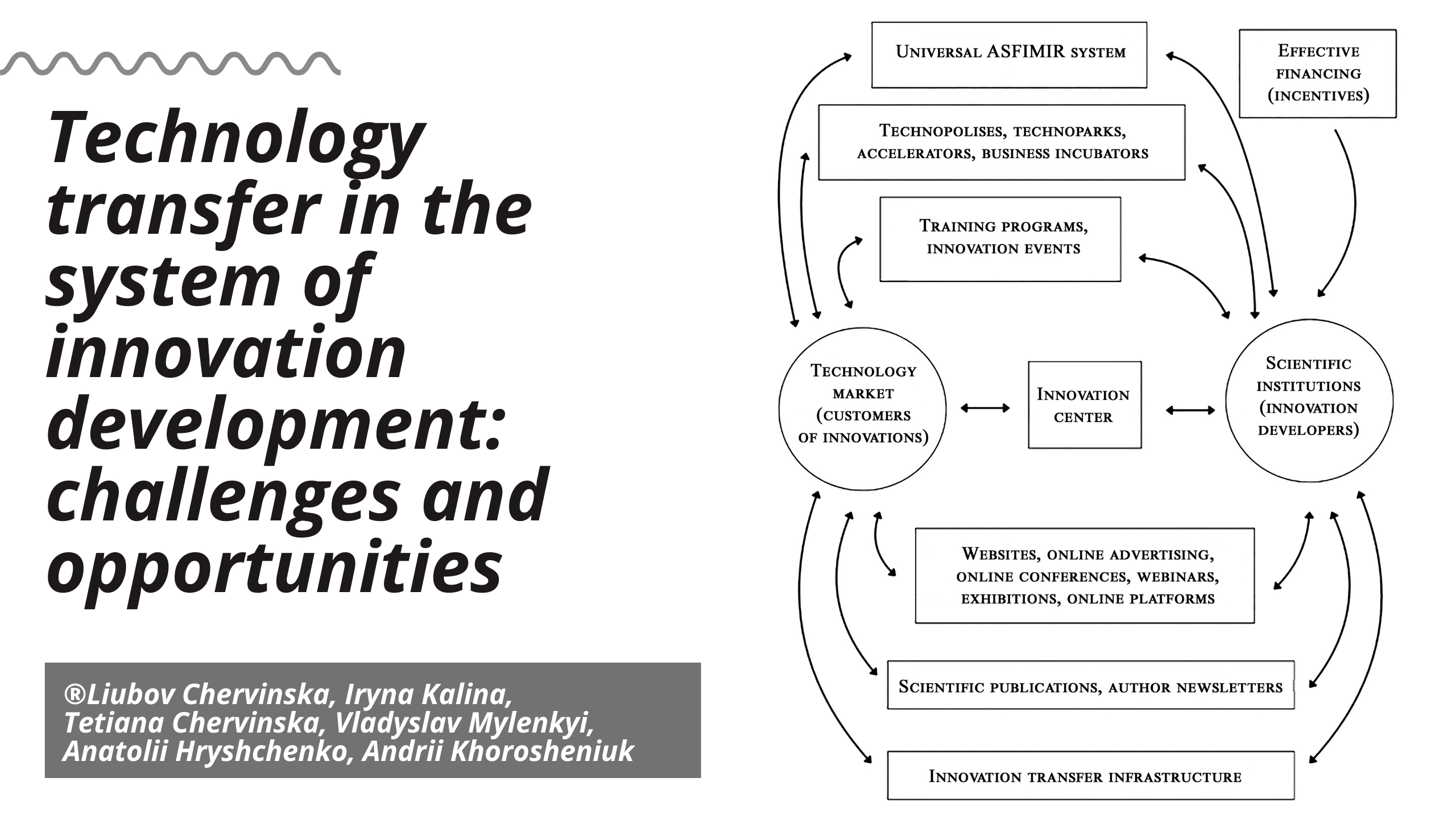
The paper is aimed at assessing the processes of technology transfer in the context of innovative economic development and to develop measures to improve them. The article examines the economic essence, importance of technology transfer, and features of its use. It is found that the most problematic issues in the use of technology transfer in Ukraine are insufficient financing of innovation activities, weak interconnection of scientists and practitioners, lack of interest of researchers in promoting developments, imperfection of state regulation and patent and license support, etc. In order to address these issues, it is proposed to improve funding for researchers at the expense of the state budget, international funds, private capital, investors, grant programs, etc. The attraction of private capital to the implementation of new technologies can also be facilitated by the spread of tax incentives for business entities. This paper presents a new toolkit aimed at enhancing technology transfer in Ukraine. It is focused on building relationships between science and business. Along with solving financial problems, it involves the widespread use of various online and advertising products to ensure the most efficient and rapid information and communication between scientists and representatives of business organizations, and the formation of a modern technology transfer infrastructure. The article outlines the features of effective technology transfer in Ukrainian practice and in developed countries. The proposed approaches to intensifying technology transfer management, unlike the known similar ones, which are mainly characterized by one-sidedness of problem solving, are the most systematic, focused on broad information and communication of participants in the innovation process. The latter can be carried out through the active use of online resources and the latest digital technologies. It is assumed that in the long term, this can provide significant results and create additional opportunities for more effective innovative development of the Ukrainian economy.
References
- Schwab, K. (2015). The Fourth Industrial Revolution: what it means, how to respond. Available at: https://www.foreignaffairs.com/articles/2015-12-12/fourth-industrial-revolution
- Gorecky, D., Schmitt, M., Loskyll, M., Zuhlke, D. (2014). Human-machine-interaction in the industry 4.0 era. 2014 12th IEEE International Conference on Industrial Informatics (INDIN), 289–294. https://doi.org/10.1109/indin.2014.6945523
- Rüßmann, M., Lorenz, M., Gerbert, P., Waldner, M., Engel, P., Harnisch, M., Justus, J. (2015). Industry 4.0: The Future of Productivity and Growth in Manufacturing Industries. Boston Consulting Group, 20. Available at: https://www.bcg.com/publications/2015/engineered_products_project_business_industry_4_future_productivity_growth_manufacturing_industries.aspx
- Rogers, E. M. (2003). Diffusion of innovations. New York: The Free Press.
- Bass Frank, M. (2004). Diffusion Model еstimation using adaptive nonlinear least squares Multiple Generation Algorithm NL2SOL. Bass Economics. Glenmoor Court, Frisco, 214.
- Kagermann, H., Anderl, R., Gausemeier, J., Schuh, G., Wahlster, W. (Eds.) (2016). Industrie 4.0 in a Global Context. Strategies for Cooperating with International Partners. Herbert Utz Verlag GmbH, 74. Available at: https://www.acatech.de/wp-content/uploads/2016/11/acatech_eng_STUDIE_Industrie40_global_Web.pdf
- Hornostai, N. I., Mykhalchenkova, O. Y., Lyubarsky, O. І. (2020). Technology transfer tools and mechanisms. Science, Technologies, Innovation, 4 (16), 87–92. https://doi.org/10.35668/2520-6524-2020-4-09
- Kushnir, H. L. (2018). Transfer tekhnolohii: mekhanizmy ta instrumenty. Kyiv: UkrINTEI, 260. Available at: http://www.uintei.kiev.ua/page/transfer-tehnologiy-mehanizmy-ta-instrumenty
- Melnik, L., Baidak, I. (2024). International transfer of technology and its impact on the organization of production in the agro- industrial complex of Ukraine. Efektyvna ekonomika, 5. https://doi.org/10.32702/2307-2105.2024.5.79
- Soloviov, V. P., Koreniako, H. I., Holovatiuk, V. M. (2008). Innovatsiinyi rozvytok rehioniv: pytannia teorii ta praktyky. Kyiv: Feniks, 224.
- Lysenko, V. S., Yehorov, S. O., Rudnytskyi, Ye. A. (2014). Informatsiino-komunikatsiini instrumenty merezhi transferu tekhnolohii vyshchykh navchalnykh zakladiv Ukrainy. Matematychni mashyny i systemy, 1, 104–107.
- Chervinska, L. P. (2014). Upravlinnia innovatsiinoiu diialnistiu personalu. Kyiv: KNEU, 194.
- Breus, S., Polishchuk, T. (2021). Research of the essence of innovation potential in the context of innovation management at the enterprise. Market Infrastructure, 51, 98–103. https://doi.org/10.32843/infrastruct51-15
- Platforma vidkrytykh innovatsii. Available at: http://technology.ukrintei.ua/
- Mizhrehionalna merezha transferu tekhnolohii. Available at: https://merezha-tt.ukrintei.ua/
- Chervinska, L., Kalina, I., Chervinska, T., Safonov, Y., Lishchenko, A., Shulyar, N. (2024). Forced migration in times of war: challenges, financial and economic risks, and ways to solve them. Financial and Credit Activity Problems of Theory and Practice, 2 (55), 531–545. https://doi.org/10.55643/fcaptp.2.55.2024.4331
- Derzhavna sluzhba statystyky Ukrainy. Available at: https://www.ukrstat.gov.ua/
- Hryhorenko, Yu. (2021). Chastka innovatsiinoi produktsii v Ukraini ne perevyshchuie 2 %–Infohrafika–GMK Center. GMK. Available at: https://gmk.center/ua/infographic/chastka-innovacijnoi-produkcii-v-ukraini-ne-perevishhuie-2/
- Pro derzhavne rehuliuvannia diialnosti u sferi transferu tekhnolohii (2006). Zakon Ukrainy No. 143-V. 14.09.2006. Available at: https://zakon.rada.gov.ua/laws/show/143-16#Text
- Avtomatyzovana systema formuvannia intehrovanykh mizhderzhavnykh informatsiinykh resursiv (ASFIMIR). Available at: http://www.uintei.kiev.ua/transfer/store/index.html
Downloads
Published
How to Cite
Issue
Section
License
Copyright (c) 2025 Liubov Chervinska, Iryna Kalina, Tetiana Chervinska, Vladyslav Milenkyi, Anatolii Grishchenko, Andrii Khorosheniuk

This work is licensed under a Creative Commons Attribution 4.0 International License.
The consolidation and conditions for the transfer of copyright (identification of authorship) is carried out in the License Agreement. In particular, the authors reserve the right to the authorship of their manuscript and transfer the first publication of this work to the journal under the terms of the Creative Commons CC BY license. At the same time, they have the right to conclude on their own additional agreements concerning the non-exclusive distribution of the work in the form in which it was published by this journal, but provided that the link to the first publication of the article in this journal is preserved.





