Use of generative artificial intelligence to improve output message effectiveness in decision support systems for prosumers
DOI:
https://doi.org/10.15587/2706-5448.2025.333726Keywords:
generative artificial intelligence, decision support system, prosumers, user experience, photovoltaicsAbstract
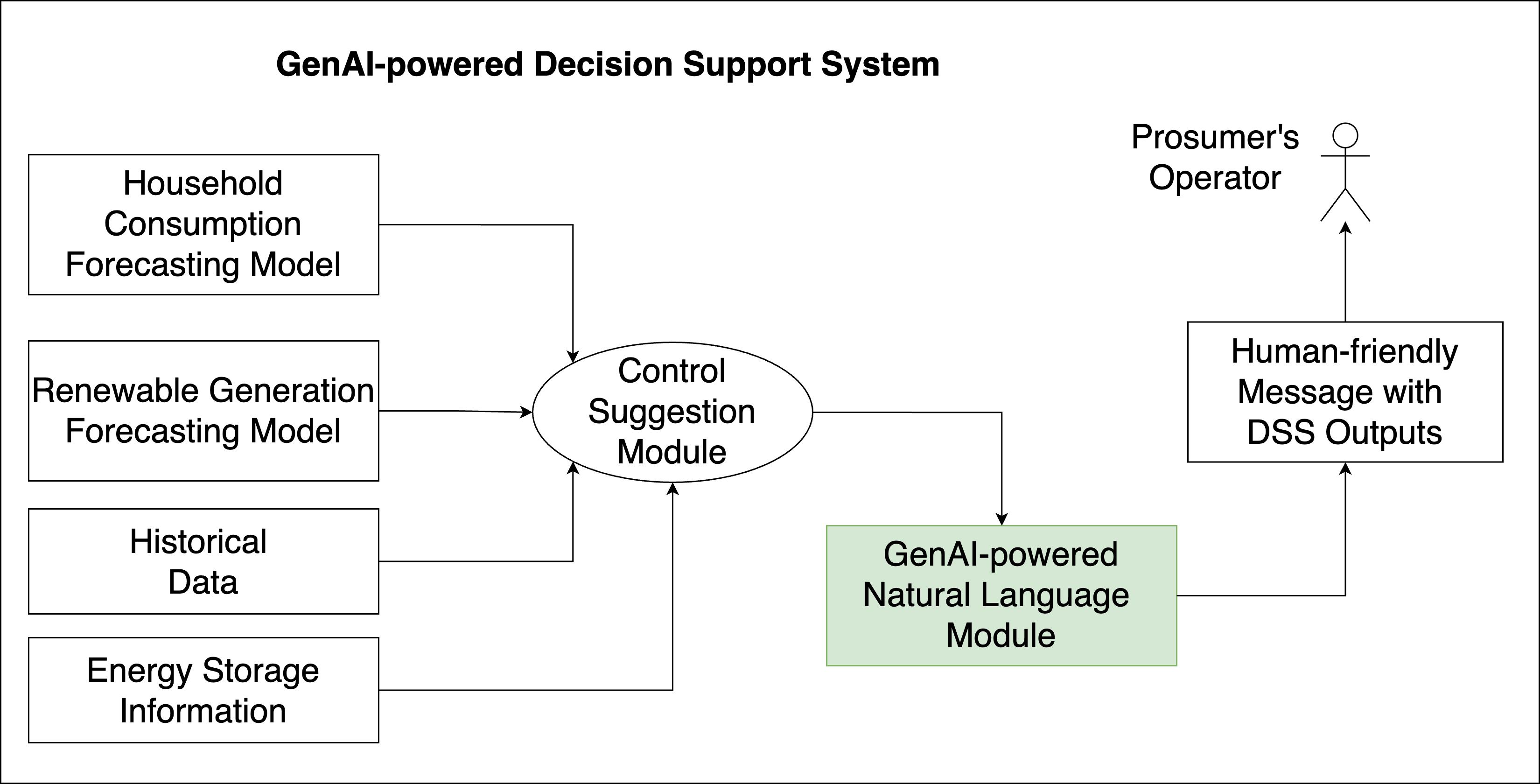
The object of this study is the use of generative artificial intelligence (GenAI) to create output messages in a decision support system (DSS) for prosumers. The research addresses the challenge of improving user experience (UX) by enhancing the effectiveness of DSS messages. A prototype DSS was developed for a specific private household equipped with solar panels. A rule-based message generation system was created as a baseline for comparison. An evaluation was conducted through surveys in Ukrainian and English. GenAI models from OpenAI and Anthropic were compared. Messages were assessed along two key dimensions of UX quality: usefulness and ease of comprehension.
The results indicate that GenAI can enhance the effectiveness of DSS recommendations for specific user groups without adverse effects. The Sonnet 3.5 model (Anthropic) generated messages that were rated as statistically more useful (p < 0.05) by female users in Ukrainian. Users preferred shorter messages in English, and Sonnet 3.5 outperformed GPT-4 (OpenAI) in terms of usefulness in both languages (p < 0.05).
The higher usefulness ratings can be attributed to more detailed recommendations while maintaining natural language. The English-language results were likely influenced by the fact that respondents were not native speakers. Differences between the models are associated with the specifics of their integration into the DSS.
The results prove the hypothesis that GenAI can improve the efficiency of DSSs by generating more useful but not more complex messages. These results also indicate that GenAI’s main advantage is in tailoring the DSS output to the needs of different user groups. The difference in results between the models highlights the need for proper testing of the developed AI solutions in specific contexts. The results will be used to develop a more efficient DSS for electricity prosumers.
Supporting Agency
- The work is supported by the state budget scientific research project of Sumy State University, “Intelligent information technology for proactive management of energy infrastructure in conditions of risk and uncertainty” (state registration number 0123U101852).
References
- Lopes, J. A. P., Madureira, A. G., Matos, M., Bessa, R. J., Monteiro, V., Afonso, J. L. et al. (2020). The future of power systems: Challenges, trends, and upcoming paradigms. WIREs Energy and Environment, 9 (3). https://doi.org/10.1002/wene.368
- Alotaibi, I., Abido, M. A., Khalid, M., Savkin, A. V. (2020). A Comprehensive Review of Recent Advances in Smart Grids: A Sustainable Future with Renewable Energy Resources. Energies, 13 (23), 6269. https://doi.org/10.3390/en13236269
- Peng, F. Z., Liu, C.-C., Li, Y., Jain, A. K., Vinnikov, D. (2024). Envisioning the Future Renewable and Resilient Energy Grids – A Power Grid Revolution Enabled by Renewables, Energy Storage, and Energy Electronics. IEEE Journal of Emerging and Selected Topics in Industrial Electronics, 5 (1), 8–26. https://doi.org/10.1109/jestie.2023.3343291
- Kröger, W., Nan, C.; Büscher, C., Schippl, J., Sumpf, P. (Eds.) (2018). Power systems in transition. Energy as a Sociotechnical Problem. London: Routledge, 41–78. https://doi.org/10.4324/9781315186313-3
- Marot, A., Kelly, A., Naglic, M., Barbesant, V., Cremer, J., Stefanov, A. et al. (2022). Perspectives on Future Power System Control Centers for Energy Transition. Journal of Modern Power Systems and Clean Energy, 10 (2), 328–344. https://doi.org/10.35833/mpce.2021.000673
- Machlev, R., Heistrene, L., Perl, M., Levy, K. Y., Belikov, J., Mannor, S. et al. (2022). Explainable Artificial Intelligence (XAI) techniques for energy and power systems: Review, challenges and opportunities. Energy and AI, 9, 100169. https://doi.org/10.1016/j.egyai.2022.100169
- Shin, D. (2020). User Perceptions of Algorithmic Decisions in the Personalized AI System:Perceptual Evaluation of Fairness, Accountability, Transparency, and Explainability. Journal of Broadcasting & Electronic Media, 64 (4), 541–565. https://doi.org/10.1080/08838151.2020.1843357
- Donida Labati, R., Genovese, A., Piuri, V., Scotti, F., Sforza, G. (2020). A Decision Support System for Wind Power Production. IEEE Transactions on Systems, Man, and Cybernetics: Systems, 50 (1), 290–304. https://doi.org/10.1109/tsmc.2017.2783681
- Sztubecka, M., Skiba, M., Mrówczyńska, M., Bazan-Krzywoszańska, A. (2020). An Innovative Decision Support System to Improve the Energy Efficiency of Buildings in Urban Areas. Remote Sensing, 12 (2), 259. https://doi.org/10.3390/rs12020259
- Badami, M., Fambri, G., Mancò, S., Martino, M., Damousis, I. G., Agtzidis, D. et al. (2019). A Decision Support System Tool to Manage the Flexibility in Renewable Energy-Based Power Systems. Energies, 13 (1), 153. https://doi.org/10.3390/en13010153
- Marot, A., Rozier, A., Dussartre, M., Crochepierre, L., Donnot, B. (2022). Towards an AI Assistant for Power Grid Operators. HHAI2022: Augmenting Human Intellect. IOS Press, 354, 79–95. https://doi.org/10.3233/faia220191
- Lyu, X., Li, Z., Ma, Q., She, M. (2023). Effects of accessible information amount and judgment times on human diagnostic performance of nuclear power plant faults. Ergonomics, 66 (7), 927–938. https://doi.org/10.1080/00140139.2022.2118836
- Fehrenbacher, D. D., Djamasbi, S. (2017). Information systems and task demand: An exploratory pupillometry study of computerized decision making. Decision Support Systems, 97, 1–11. https://doi.org/10.1016/j.dss.2017.02.007
- Allen, P. M., Edwards, J. A., Snyder, F. J., Makinson, K. A., Hamby, D. M. (2014). The Effect of Cognitive Load on Decision Making with Graphically Displayed Uncertainty Information. Risk Analysis, 34 (8), 1495–1505. https://doi.org/10.1111/risa.12161
- Phillips-Wren, G., Adya, M. (2020). Decision making under stress: the role of information overload, time pressure, complexity, and uncertainty. Journal of Decision Systems, 29 (1), 213–225. https://doi.org/10.1080/12460125.2020.1768680
- Afzal, U., Prouzeau, A., Lawrence, L., Dwyer, T., Bichinepally, S., Liebman, A. et al. (2022). Investigating Cognitive Load in Energy Network Control Rooms: Recommendations for Future Designs. Frontiers in Psychology, 13. https://doi.org/10.3389/fpsyg.2022.812677
- Yacob, A., Roslim, A. D., Abdul Wahab, S. F., Abdul Halim, I. I., Baharum, Z., W. Hamzah, W. M. A. F. et al. (2024). Exploring the Landscape of Decision Support Systems: A Comprehensive Review of Implementations and Key Characteristics. Journal of Advanced Research in Applied Sciences and Engineering Technology, 51 (1), 141–149. https://doi.org/10.37934/araset.51.1.141149
- Moncur, B., Galvez Trigo, M. J., Mortara, L.; Schmorrow, D. D., Fidopiastis, C. M. (Eds.) (2023). Augmented Reality to Reduce Cognitive Load in Operational Decision-Making. Augmented cognition. HCII 2023. Lecture Notes in Computer Science. Cham: Springer, 328–346. https://doi.org/10.1007/978-3-031-35017-7_21
- Perry, N. C., Wiggins, M. W., Childs, M., Fogarty, G. (2013). The Application of Reduced-Processing Decision Support Systems to Facilitate the Acquisition of Decision-Making Skills. Human Factors: The Journal of the Human Factors and Ergonomics Society, 55 (3), 535–544. https://doi.org/10.1177/0018720812467367
- Phillips-Wren, G., Daly, M., Burstein, F. (2022). Support for cognition in decision support systems: an exploratory historical review. Journal of Decision Systems, 31 (1), 18–30. https://doi.org/10.1080/12460125.2022.2070946
- Stemmet, L., Ahmed, M. D.; Khosrow-Pour, M. (Ed.) (2014). The Decision Maker’s Cognitive Load. Encyclopedia of Information Science and Technology. IGI Global, 6466–6474. https://doi.org/10.4018/978-1-4666-5888-2.ch635
- Morrison, B. W., Kelson, J. N., Morrison, N. M. V., Innes, J. M., Zelic, G., Al-Saggaf, Y. et al. (2023). You’re Not the Boss of me, Algorithm: Increased User Control and Positive Implicit Attitudes Are Related to Greater Adherence to an Algorithmic Aid. Interacting with Computers, 35 (3), 452–460. https://doi.org/10.1093/iwc/iwad028
- Kanojiya, A., Nagori, V. (2018). Analysis of Architecture and Forms of Outputs of Decision Support Systems implemented for different domains. 2018 Second International Conference on Inventive Communication and Computational Technologies (ICICCT). Coimbatore: IEEE, 346–350. https://doi.org/10.1109/icicct.2018.8472981
- Kelton, A. S., Pennington, R. R., Tuttle, B. M. (2010). The Effects of Information Presentation Format on Judgment and Decision Making: A Review of the Information Systems Research. Journal of Information Systems, 24 (2), 79–105. https://doi.org/10.2308/jis.2010.24.2.79
- Beriro, D., Nathanail, J., Salazar, J., Kingdon, A., Marchant, A., Richardson, S. et al. (2022). A Decision Support System to Assess the Feasibility of Onshore Renewable Energy Infrastructure. SSRN Electronic Journal. https://doi.org/10.2139/ssrn.3986807
- Taik, A., Nour, B., Cherkaoui, S. (2021). Empowering Prosumer Communities in Smart Grid with Wireless Communications and Federated Edge Learning. IEEE Wireless Communications, 28 (6), 26–33. https://doi.org/10.1109/mwc.017.2100187
- Stamatescu, I., Arghira, N., Făgărăşan, I., Stamatescu, G., Iliescu, S., Calofir, V. (2017). Decision Support System for a Low Voltage Renewable Energy System. Energies, 10 (1), 118. https://doi.org/10.3390/en10010118
- Ponraj, P., Murugesan, S. (2024). A Bi-level Decision Support System for Home Energy Management in Smart Homes. 2024 IEEE International Conference on Power Electronics, Drives and Energy Systems (PEDES). Mangalore: IEEE, 1–5. https://doi.org/10.1109/pedes61459.2024.10961886
- Gržanić, M., Capuder, T., Zhang, N., Huang, W. (2022). Prosumers as active market participants: A systematic review of evolution of opportunities, models and challenges. Renewable and Sustainable Energy Reviews, 154, 111859. https://doi.org/10.1016/j.rser.2021.111859
- Vachon, F., Lafond, D., Vallieres, B. R., Rousseau, R., Tremblay, S. (2011). Supporting situation awareness: A tradeoff between benefits and overhead. 2011 IEEE International Multi-Disciplinary Conference on Cognitive Methods in Situation Awareness and Decision Support (CogSIMA). Miami Beach: IEEE. https://doi.org/10.1109/cogsima.2011.5753460
- Lukianykhin, O., Shendryk, V., Shendryk, S., Malekian, R.; Karabegovic, I., Kovačević, A., Mandzuka, S. (Eds.) (2024). Promising AI Applications in Power Systems: Explainable AI (XAI), Transformers, LLMs. New Technologies, Development and Application VII. Cham: Springer, 66–76. https://doi.org/10.1007/978-3-031-66271-3_8
- Huynh, M.-T. (2024). Using generative AI as decision-support tools: unraveling users’ trust and AI appreciation. Journal of Decision Systems, 1–32. https://doi.org/10.1080/12460125.2024.2428166
- Yu, P., Xu, H., Hu, X., Deng, C. (2023). Leveraging Generative AI and Large Language Models: A Comprehensive Roadmap for Healthcare Integration. Healthcare, 11 (20), 2776. https://doi.org/10.3390/healthcare11202776
- Huang, Y., Kanij, T., Madugalla, A., Mahajan, S., Arora, C., Grundy, J. (2024). Unlocking Adaptive User Experience with Generative AI. Proceedings of the 19th International Conference on Evaluation of Novel Approaches to Software Engineering. Angers: SciTePress, 760–768. https://doi.org/10.5220/0012741000003687
- Iovane, G., Chinnici, M. (2024). Decision Support System Driven by Thermo-Complexity: Scenario Analysis and Data Visualization. Applied Sciences, 14 (6), 2387. https://doi.org/10.3390/app14062387
- Choi, S., Jain, R., Emami, P., Wadsack, K., Ding, F., Sun, H. et al. (2024). eGridGPT: Trustworthy AI in the Control Room. Office of Scientific and Technical Information (OSTI). https://doi.org/10.2172/2352232
- Lukianykhin, O., Shendryk, V. (2025). Machine learning-driven photovoltaic generation forecasting for prosumer decision support. Artificial Intelligence, 30 (1), 107–119. https://doi.org/10.15407/jai2025.01.107
- Huld, T., Ruf, H., Heilscher, G. (2014). Self-Consumption of Electricity by Households, Effects of PV System Size and Battery Storage. 29th European Photovoltaic Solar Energy Conference and Exhibition. Amsterdam, 4014–4017. https://doi.org/10.4229/EUPVSEC20142014-7AV.6.8
- Pedregosa, F., Varoquaux, G., Gramfort, A., Michel, V., Thirion, B., Grisel, O. et al. (2011). Scikit-learn: Machine Learning in Python. Journal of Machine Learning Research, 12, 2825–2830.
- GPT-4 is OpenAI’s most advanced system, producing safer and more useful responses. OpenAI. Available at: https://openai.com/gpt-4
- Claude 3.5 Sonnet (2024). Anthropic. Available at: https://www.anthropic.com/news/claude-3-5-sonnet
- Fagbohun, O., Harrison, R. M., Dereventsov, A. (2023). An Empirical Categorization of Prompting Techniques for Large Language Models: A Practitioner’s Guide. Journal of Artificial Intelligence, Machine Learning and Data Science, 1 (4), 1–11. https://doi.org/10.51219/jaimld/oluwole-fagbohun/15
- Beri, G., Srivastava, V. (2024). Advanced Techniques in Prompt Engineering for Large Language Models: A Comprehensive Study. 2024 IEEE 4th International Conference on ICT in Business Industry & Government (ICTBIG). Indore: IEEE, 1–4. https://doi.org/10.1109/ictbig64922.2024.10911672
- Moore, R. J., Arar, R. (2019). Conversational UX Design: A Practitioner’s Guide to the Natural Conversation Framework. ACM Books. https://doi.org/10.1145/3304087
- van Belle, G. (2008). Sample Size. Statistical Rules of Thumb. John Wiley & Sons, 27–51. https://doi.org/10.1002/9780470377963.ch2
- Virtanen, P., Gommers, R., Oliphant, T. E., Haberland, M., Reddy, T., Cournapeau, D. et al. (2020). SciPy 1.0: fundamental algorithms for scientific computing in Python. Nature Methods, 17 (3), 261–272. https://doi.org/10.1038/s41592-019-0686-2
Downloads
Published
How to Cite
Issue
Section
License
Copyright (c) 2025 Oleh Lukianykhin, Vira Shendryk

This work is licensed under a Creative Commons Attribution 4.0 International License.
The consolidation and conditions for the transfer of copyright (identification of authorship) is carried out in the License Agreement. In particular, the authors reserve the right to the authorship of their manuscript and transfer the first publication of this work to the journal under the terms of the Creative Commons CC BY license. At the same time, they have the right to conclude on their own additional agreements concerning the non-exclusive distribution of the work in the form in which it was published by this journal, but provided that the link to the first publication of the article in this journal is preserved.