Characterization and development of beneficiation prospects of sedimentary phosphate ore from the Kef Essenoun deposit (Algeria) by reverse flotation
DOI:
https://doi.org/10.15587/2706-5448.2025.333772Keywords:
particle size analysis, characterization, X-ray diffraction, beneficiation, phosphate, Djebel Onk, flotationAbstract
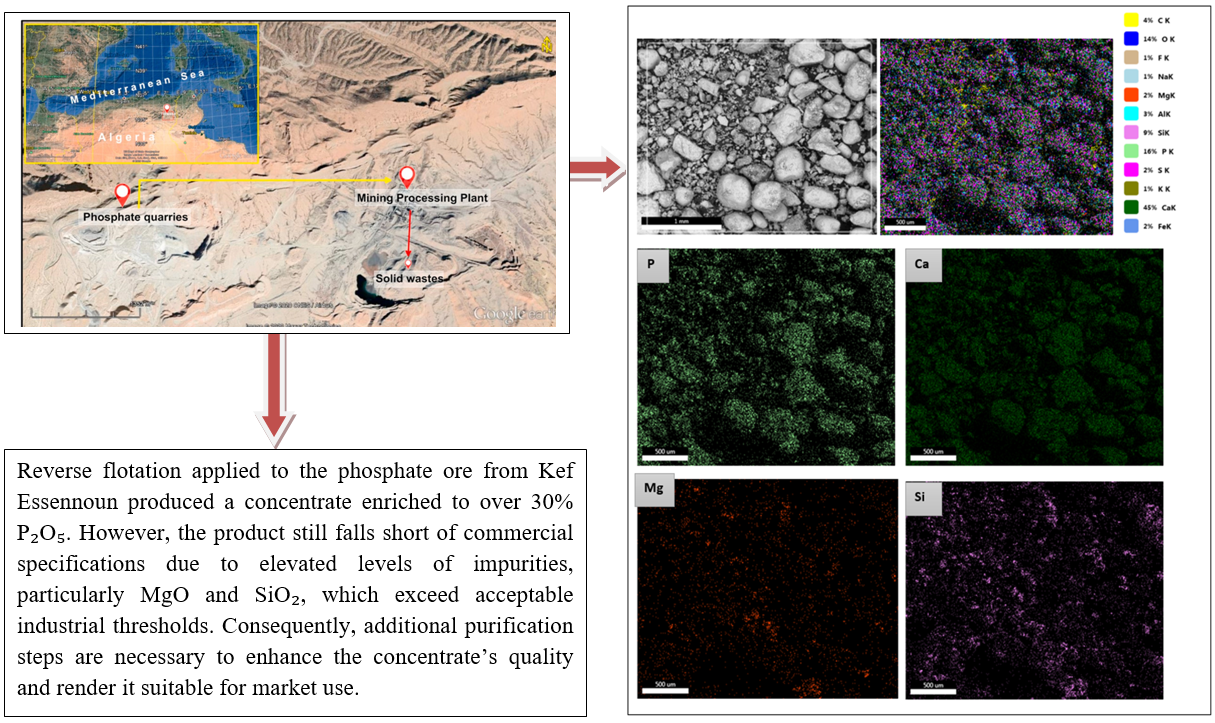
Phosphate is one of the most important natural resources because it is so crucial to the production of fertilizers and phosphoric acid. However, many undesirable elements are present in raw phosphate ores, which need to be refined in some way to boost their market value is the objective of this work. The most efficient technique for upgrading phosphate ores by the selective removal of gangue minerals is reverse flotation. This study aims to determine the physicochemical properties and the flotation behavior of sedimentary phosphate ore from the Kef Essenoun deposit (Tebessa, Algeria), with the intention of developing an effective beneficiation process. To develop the processing parameters for the medium grade phosphate ore, a thorough investigation was conducted to ascertain its mineralogical composition, particle size distribution, and degree of impurity elimination. Particle size distribution measurements, XRF, XRD, SEM/EDS analysis, and petrographical evaluation were used to describe these phosphates. 69.64% of the total mass of the phosphate raw ore sample fell between the –0.5 and +0.1 mm range, which also showed a reasonably acceptable particle size distribution. In addition to the related impurities of MgO and SiO₂, chemical analysis revealed that the phosphates had P₂O₅ values ranging from 24% to 26%. According to mineralogical analysis, dolomite, calcite, and quartz were the related gangue minerals, whereas hydroxyapatite and fluorapatite were the predominant phosphate minerals. The traditional coprolitic and bioclastic characteristics of sedimentary phosphates were observed when examining the details on a smaller scale. Reverse flotation studies revealed that the produced concentrate reached 30% P₂O₅, confirm the effectiveness of this method for the perspective of valorization of sedimentary ore from the Kef Essnoun at Djebel Onk deposit and that this technique can increase the value of the ore. These findings support the idea that Algerian phosphate ore processing could benefit economically and environmentally from reverse flotation.
References
- Fertilizer outlook 2017–2021 (2017). International Fertilizer Association. Available at: https://www.fertilizer.org/wp-content/uploads/2023/01/2017_IFA_Annual_Conference_Marrakech_PIT_AG_Fertilizer_Outlook.pdf
- Commodity markets outlook – Agriculture (2016). The World Bank Group. Available at: https://www.worldbank.org/en/research/commodity-markets
- Budemberg, G., Jolsterå, R., Chelgani, S. C. (2025). Eco-friendly collectors in apatite froth flotation: A review. International Journal of Mining Science and Technology, 35 (4), 539–551. https://doi.org/10.1016/j.ijmst.2025.02.010
- U.S. Geological Survey. Mineral commodity summaries 2023 – Phosphate rock (2023). U.S. Department of the Interior. Available at: https://pubs.usgs.gov/periodicals/mcs2023/mcs2023-phosphate.pdf
- Elgillani, D. A., Abouzeid, A.-Z. M. (1993). Flotation of carbonates from phosphate ores in acidic media. International Journal of Mineral Processing, 38 (3-4), 235–256. https://doi.org/10.1016/0301-7516(93)90077-n
- Abouzeid, A.-Z. M. (2008). Physical and thermal treatment of phosphate ores – An overview. International Journal of Mineral Processing, 85 (4), 59–84. https://doi.org/10.1016/j.minpro.2007.09.001
- Chen, J., Tran, T., Lee, M. (2024). Recovery of pure lithium phosphate from sulfuric acid leaching solutions of spent LiFePO4 batteries by solvent extraction and chemical precipitation. Journal of Mining and Metallurgy, Section B: Metallurgy, 60 (1), 153–164. https://doi.org/10.2298/jmmb231213013c
- Oulkhir, A., Lyamlouli, K., Oussfan, A., Orange, F., Etahiri, A., Benhida, R. (2025). Efficient flotation separation approach of apatite from calcite for phosphate up-grading using phosphorylated starch macromolecules as a selective depressant. Carbohydrate Polymers, 348, 122878. https://doi.org/10.1016/j.carbpol.2024.122878
- Lalam, K., Chhiti, Y., El Khouakhi, M., Abidi, A., Chebak, A. (2024). Evaluation and Optimization of Phosphate Recovery from Coarse Rejects Using Reverse Flotation. Sustainability, 16 (19), 8614. https://doi.org/10.3390/su16198614
- Tao, L., Xiang, G., Miao, Z., Wang, J., Wu, W., Tian, M. et al. (2024). Method and mechanism of reverse flotation for dephosphorization of spodumene concentrate using sodium alginate as a depressant. Journal of Cleaner Production, 451, 142171. https://doi.org/10.1016/j.jclepro.2024.142171
- Chlahbi, S., Benzaazoua, M., Elghali, A., Rochdane, S., Zerouali, E., Belem, T. (2024). Interlayers geo-environmental assessment of phosphate waste rock for sustainable management practices. Environmental Geochemistry and Health, 47 (1). https://doi.org/10.1007/s10653-024-02329-0
- Meski, S., Bibba, O., Khireddine, H., Boudjouan, F., Djermoune, A., Yala, S., Ziani, S. (2025). Removal of methylene blue and brilliant yellow from aqueous solutions using sodium metasilicate modified hydroxyapatite derived from Algerian phosphate rocks. Journal of Dispersion Science and Technology, 46 (6), 861–874. https://doi.org/10.1080/01932691.2025.2476110
- El Bamiki, R., Séranne, M., Parat, F., Aubineau, J., Chellai, E. H., Marzoqi, M., Bodinier, J.-L. (2023). Post-phosphogenesis processes and the natural beneficiation of phosphates: Geochemical evidence from the Moroccan High Atlas phosphate-rich sediments. Chemical Geology, 631, 121523. https://doi.org/10.1016/j.chemgeo.2023.121523
- Boumaza, B., Kechiched, R., Chekushina, T. V. (2021). Trace metal elements in phosphate rock wastes from the Djebel Onk mining area (Tébessa, eastern Algeria): A geochemical study and environmental implications. Applied Geochemistry, 127, 104910. https://doi.org/10.1016/j.apgeochem.2021.104910
- Rizk, S. A. M. (2022). Highlights on the beneficiation trials of the Egyptian phosphate ores. JES. Journal of Engineering Sciences, 50 (1), 1–21. https://doi.org/10.21608/jesaun.2021.100795.1083
- Mdachi, D. D., Rugaika, A. M., Machunda, R. L. (2024). Valorization potentials of phosphate tailings at Minjingu mines in Northern Tanzania. Journal of the Southern African Institute of Mining and Metallurgy, 124 (7), 415–420. https://doi.org/10.17159/2411-9717/2857/2024
- Ju, J., Feng, Y., Li, H., Yang, J., Xue, Z. (2024). Mineralogical characterization of deep-sea sediments from a grain size perspective: Implications for commercial REE recovery. Minerals Engineering, 216, 108891. https://doi.org/10.1016/j.mineng.2024.108891
Downloads
Published
How to Cite
Issue
Section
License
Copyright (c) 2025 Nesrine Derrardjia, Djamel Nettour, Mohamed Chettibi, Rachid Chaib, Yousra Boukhamla, Salim Bensehamdi

This work is licensed under a Creative Commons Attribution 4.0 International License.
The consolidation and conditions for the transfer of copyright (identification of authorship) is carried out in the License Agreement. In particular, the authors reserve the right to the authorship of their manuscript and transfer the first publication of this work to the journal under the terms of the Creative Commons CC BY license. At the same time, they have the right to conclude on their own additional agreements concerning the non-exclusive distribution of the work in the form in which it was published by this journal, but provided that the link to the first publication of the article in this journal is preserved.