Blink reading monitoring system using magnetic properties of ferrofluid
DOI:
https://doi.org/10.15587/2706-5448.2025.334165Keywords:
system, monitoring, reading, blinking, magnetic, properties, ferrofluid, sensors, signals, controlAbstract
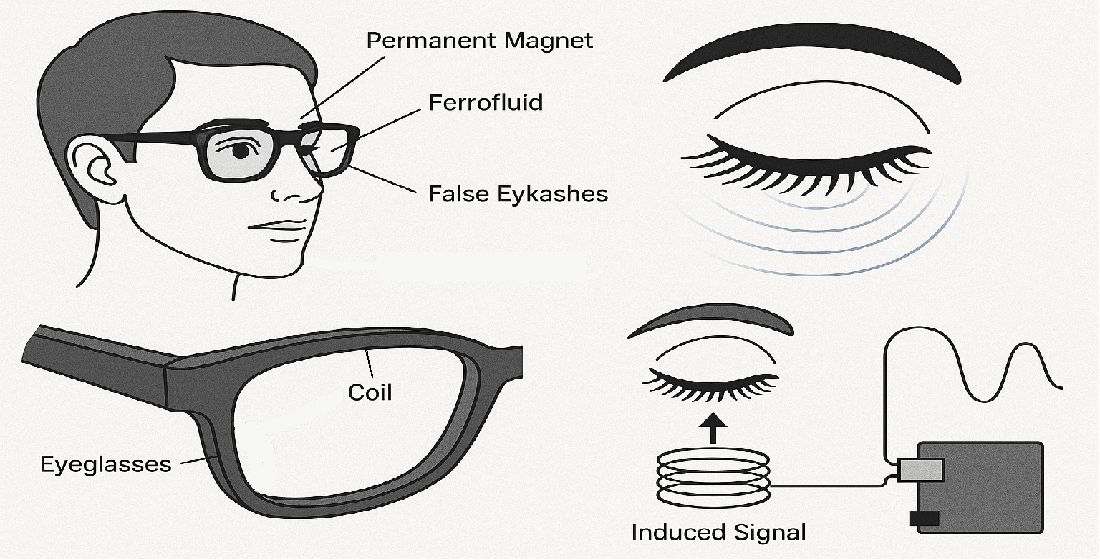
The object of the study is an eye movement monitoring system based on a combination of a permanent magnet, ferrofluid and glasses with built-in inductive sensors. In the current conditions of development of wearable technologies and biomedical devices, such a system has the potential for application in medicine, in particular for monitoring eye movements in real time, which can be useful for diagnostics and rehabilitation.
The problem considered in the study is to create a compact, comfortable and accurate system for non-contact monitoring of the frequency and nature of blinking. The main attention is paid to optimizing the design of the eyeglass frame with built-in coils, as well as the development of algorithms for collecting and processing induced signals, which allows for effective detection of eye movements without discomfort for the user.
The essence of the results obtained is the development of a wearable system that uses ferrofluid applied to false eyelashes and magnetic coils built into a 3D-printed eyeglass frame. Experimental tests demonstrated the system’s ability to clearly distinguish between slow and fast blinking based on induced signals obtained using an Arduino Uno board with a reading frequency of 200 Hz. It was found that the amplitude of the signals during fast blinking is significantly higher, which ensures reliable tracking of eye movements in different modes.
The results are explained by the innovative combination of a contactless magnetic sensor with a liquid form of ferrofluid, which ensures flexibility, comfort and invisibility of the system. Coils built into the frame allow for amplification of the induction signal, reducing the impact of noise and improving data quality. The use of a 3D model of the frame optimized for coil fixation ensures design reliability and repeatability of the results.
The innovation of the approach lies in the combination of advanced materials and 3D printing technologies with traditional electronic solutions to create a compact and convenient eye movement monitoring device. The proposed system is a promising tool for further application in medical, rehabilitation and interface technologies, where precise control of blinking is critically important.
References
- Tang, J., Luk, P., Zhou, Y. (2023). Wearable and Invisible Sensor Design for Eye-Motion Monitoring Based on Ferrofluid and Electromagnetic Sensing Technologies. Bioengineering, 10 (5), 514. https://doi.org/10.3390/bioengineering10050514
- Attivissimo, F., D’Alessandro, V. I., Di Nisio, A., Scarcelli, G., Schumacher, J., Lanzolla, A. M. L. (2023). Performance evaluation of image processing algorithms for eye blinking detection. Measurement, 223, 113767. https://doi.org/10.1016/j.measurement.2023.113767
- Tresanchez, M., Pallejà, T., Palacín, J. (2019). Optical Mouse Sensor for Eye Blink Detection and Pupil Tracking: Application in a Low-Cost Eye-Controlled Pointing Device. Journal of Sensors, 2019, 1–19. https://doi.org/10.1155/2019/3931713
- Bamuqaddam, A. M., Aladeemy, S. A., Ghanem, M. A., Al-Mayouf, A. M., Alotaibi, N. H., Marken, F. (2022). Foam Synthesis of Nickel/Nickel (II) Hydroxide Nanoflakes Using Double Templates of Surfactant Liquid Crystal and Hydrogen Bubbles: A High-Performance Catalyst for Methanol Electrooxidation in Alkaline Solution. Nanomaterials, 12 (5), 879. https://doi.org/10.3390/nano12050879
- Ban, S., Lee, Y. J., Yu, K. J., Chang, J. W., Kim, J.-H., Yeo, W.-H. (2023). Persistent Human–Machine Interfaces for Robotic Arm Control Via Gaze and Eye Direction Tracking. Advanced Intelligent Systems, 5 (7). https://doi.org/10.1002/aisy.202200408
- Deng, M., Huang, C., Liu, D., Jin, W., Zhu, T. (2015). All fiber magnetic field sensor with Ferrofluid-filled tapered microstructured optical fiber interferometer. Optics Express, 23 (16), 20668–20674. https://doi.org/10.1364/oe.23.020668
- Homa, D., Pickrell, G. (2014). Magnetic Sensing with Ferrofluid and Fiber Optic Connectors. Sensors, 14 (3), 3891–3896. https://doi.org/10.3390/s140303891
- Wang, C., Guo, Y., Wang, T. (2021). Magnetic and transport properties of orthorhombic rare-earth aluminum germanide GdAlGe. Journal of Magnetism and Magnetic Materials, 526, 167739. https://doi.org/10.1016/j.jmmm.2021.167739
- Turner, R. (2019). Arduino programming: 2 books in 1 – The ultimate beginner’s & intermediate guide to learn Arduino programming step by step. Nelly B.L. International Consulting Ltd, 328.
- Matthes, E. (2019). Python Crash Course: A hands‑on, project‑based introduction to programming. No Starch Press, 544.
- Moioli, G. (2022). Introduction to Blender 3.0: Learn Organic and Architectural Modeling, Lighting, Materials, Painting, Rendering, and Compositing with Blender. Apress. https://doi.org/10.1007/978-1-4842-7954-0
- Jordan, J. M. (2019). 3D Printing. Cambridge: The MIT Press. https://doi.org/10.7551/mitpress/11800.001.0001
- Di Cello, L., Pellegrini, M., Vagge, A., Borselli, M., Ferro Desideri, L., Scorcia, V. et al. (2021). Advances in the Noninvasive Diagnosis of Dry Eye Disease. Applied Sciences, 11 (21), 10384. https://doi.org/10.3390/app112110384
Downloads
Published
How to Cite
Issue
Section
License
Copyright (c) 2025 Oleksiy Mormitko

This work is licensed under a Creative Commons Attribution 4.0 International License.
The consolidation and conditions for the transfer of copyright (identification of authorship) is carried out in the License Agreement. In particular, the authors reserve the right to the authorship of their manuscript and transfer the first publication of this work to the journal under the terms of the Creative Commons CC BY license. At the same time, they have the right to conclude on their own additional agreements concerning the non-exclusive distribution of the work in the form in which it was published by this journal, but provided that the link to the first publication of the article in this journal is preserved.