Development of a model of raster power-linear conversion of digital images of light tones
DOI:
https://doi.org/10.15587/2706-5448.2025.337277Keywords:
power-linear conversion, raster tone reproduction, simulator, gradation characteristics, raster conversion characteristicsAbstract
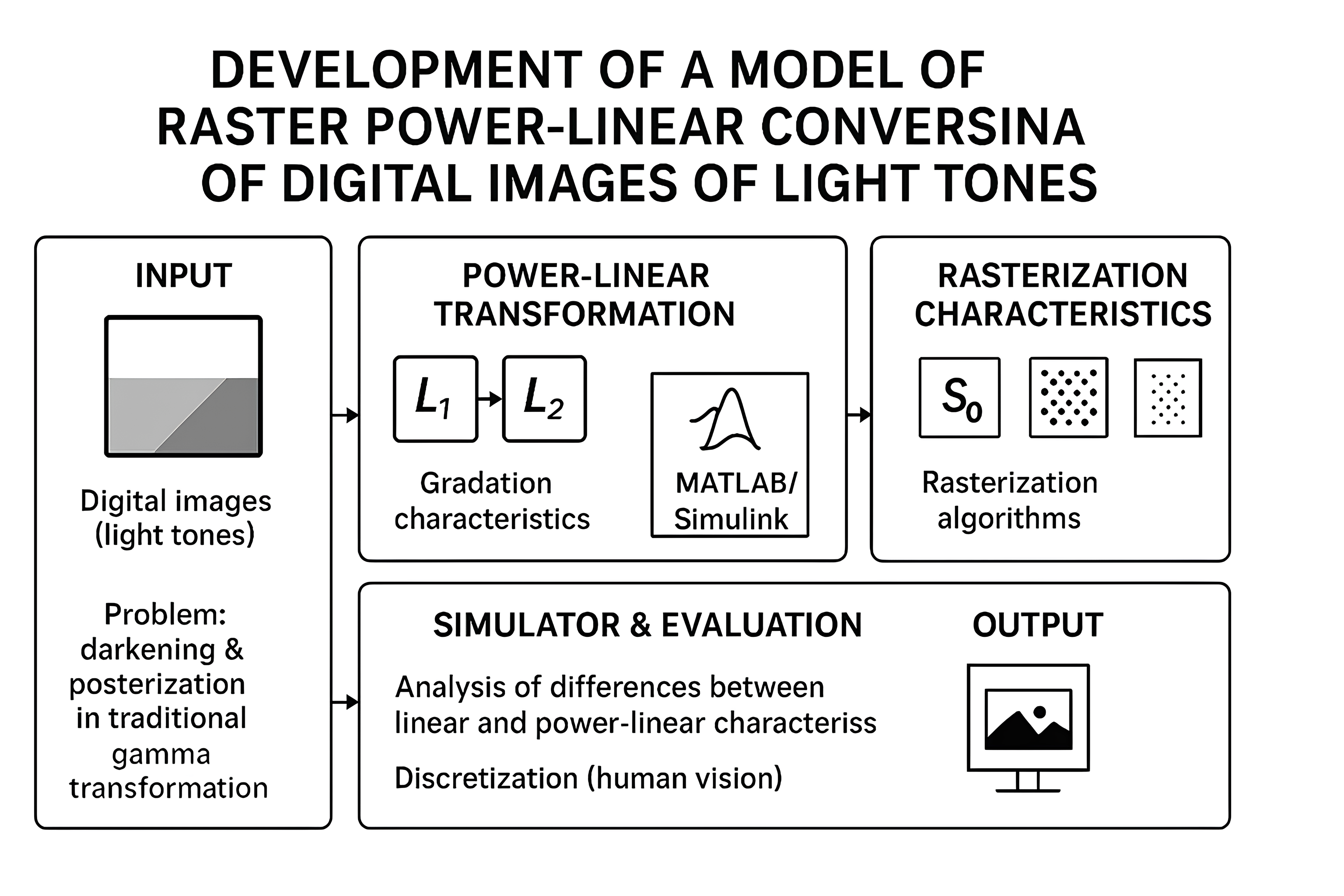
The object of research is the technological process of raster conversion of digital images based on power-linear transformation at the stage of preparation for printing.
The problem in the processes of prepress preparation is the lack of functionality in available computer image processing programs to construct the characteristics of the raster conversion, which are the main carrier of information about the image. Accordingly, this limits the capabilities of the reproduction process and leads to a loss of image quality on the print.
The work used the method of mathematical modeling, the theory of digital image conversion, and object-oriented programming. To solve the problems set, typical variants of power-linear transformation of digital images of different tonalities were constructed. In the process of the study, algorithms for raster transformation of different lineatures were developed, which are the main carrier of information about the image. Simulators for simulation modeling, analysis, and synthesis of power-linear transformation were built, ensuring high-quality tone reproduction of images of different lineatures.
A mathematical model of raster conversion of typical variants of power-linear conversion of digital images for light tones has been developed and new rasterization algorithms have been proposed. Based on them, a structural diagram of a simulator of raster power-linear conversion of images of light tones has been developed in the MATLAB:Simulink package, with which it is possible to calculate and construct gradation characteristics, rasterization characteristics and analyze their properties.
The proposed model of algorithms for raster power-linear conversion of digital images eliminates posterization of images in dark areas, which is an advantage of the developed new raster conversion algorithms using power-linear transformation.
The results of the conducted studies of raster tone reproduction can be recommended to operators and technologists for use in pre-printing processes at the stage of raster conversion of digital images.
References
- Kovalskiy, B., Semeniv, M., Shovgenyuk, M. (2016). Сomputer program for the image synthesis on impress for the new information and traditional technologies of color printing. Science and Education a New Dimention: Natural and Technical Science, IV (10 (91)), 72–78. Available at: https://seanewdim.com/wp-content/uploads/2021/03/Сomputer-program-for-the-image-synthesis-on-impress-for-the-new-information-and-traditional-technologies-of-color-printing-Kovalskiy-B.-Semeniv-M.-Shovgenyuk-M..pdf
- Lutskiv, M. M. (2012). Tsyfrovi tekhnolohii drukarstva. Lviv: UAD, 488.
- Durnyak, B., Lutskiv, M., Shepita, P., Karpyn, R., Savina, N. (2021). Determination of the Optical Density of Two-Parameter Tone Transfer for a Short Printing System of the Sixth Dimension. Intelligent International Technologies & Systems of Information Security: CEUR Worhshop Proceedings, 2853, 134–140. Available at: https://ceur-ws.org/Vol-2853/short11.pdf
- Jähne, B. (2005). Digital Image Processing. Springer-Verlag. Berlin Heidelberg. Available at: https://aitskadapa.ac.in/e-books/CSE/DIGITAL%20IMAGE%20PROCESSING/Digital%20Image%20Processing%20(%20PDFDrive%20)%20(1).pdf
- Gonnzalez, R., Woods, E. (2008). Digstal image Processing. Printice Hall, 954. Available at: https://dl.ebooksworld.ir/motoman/Digital.Image.Processing.3rd.Edition.www.EBooksWorld.ir.pdf
- Kavyn, B. (2025). Development of a model for coloring raster elements of polynomial transformation of digital images. Technology Audit and Production Reserves, 2 (2 (82)), 27–31. https://doi.org/10.15587/2706-5448.2025.323533
- Tkachenko, V., Hordieiev, A. (2022). Using Upsampling Technologies to Reproduce Low-Resolution Images. Technology and Technique of Typography, 2 (76), 66–73. https://doi.org/10.20535/2077-7264.2(76).2022.267428
- Durnyak, B., Lutskiv, M., Shepita, P., Sheketa, V., Karpyn, R., Pasyeka, N.; Hu, Z., Dychka, I., Petoukhov, S., He, M. (Eds.) (2022). Analysis of Transfer of Modulated Ink Flows in a Short Printing System of Parallel Structure. Advances in Computer Science for Engineering and Education. Cham: Springer, 17–26. https://doi.org/10.1007/978-3-031-04812-8_2
- Kavyn, S. (2025). Development of a model of power-linear conversion of digital images for dark tones. Technology Audit and Production Reserves, 2 (2 (82)), 32–36. https://doi.org/10.15587/2706-5448.2025.323535
- Doros, M. (2010). Przetwarzanie obrazow. Warszawa: Wydawca translator S. C., 352.
- Vorobel, R. A. (2012). Loharyfmichna obrobka zobrazhen. Kyiv: Naukovo-vyrobnyche pidpryiemstvo “Vydavnytstvo “Naukova dumka” NAN Ukrainy”, 232.
- Pashulia, P. L. (2011). Standartyzatsiia, metrolohiia, vidpovidnist, yakist u polihrafii. Lviv: UAD, 408.
- Baranovskyi, I. V., Lutskiv, M. M., Fil, L. V. (2013). Construction and analysis of characteristics screening. Naukovi zapysky, 4 (45), 131–138. Available at: https://nz.uad.lviv.ua/media/4-45/20.pdf
- Durnyak, B., Lutskiv, M., Shepita, P., Hunko, D., Savina, N. (2021). Formation of liner Characteristics of Normalized Roster Trans Formation for Rombic Elemtnts. Intelligent Information Technologies & System of Information Security. CEUR Workshop Proceedings, 2853, 127–133. Available at: https://ceur-ws.org/Vol-2853/short10.pdf
- Mrozek, B., Mrozek, Z. (2018). MATLAB: Simulink. Gliwce: Wydawnictwo Helion. Available at: https://helion.pl/pobierz-fragment/matlab-i-simulink-poradnik-uzytkownika-wydanie-iv-bogumila-mrozek-zbigniew-mrozek,matsi4/pdf?srsltid=AfmBOoolF31xdXgjRysP1rpxUKRzV9Q0hvEDTJ5jgFW1Od-2ScAhty5d
Downloads
Published
How to Cite
Issue
Section
License
Copyright (c) 2025 Sviatoslav Kavyn

This work is licensed under a Creative Commons Attribution 4.0 International License.
The consolidation and conditions for the transfer of copyright (identification of authorship) is carried out in the License Agreement. In particular, the authors reserve the right to the authorship of their manuscript and transfer the first publication of this work to the journal under the terms of the Creative Commons CC BY license. At the same time, they have the right to conclude on their own additional agreements concerning the non-exclusive distribution of the work in the form in which it was published by this journal, but provided that the link to the first publication of the article in this journal is preserved.