Evaluation of Prager and Chaboche models for reliable prediction of elastoplastic behaviour in low-cycle fatigue
DOI:
https://doi.org/10.15587/2706-5448.2025.339423Keywords:
Prager model, Chaboche model, 304L SS, cyclic, ratcheting, hardening, fatigueAbstract
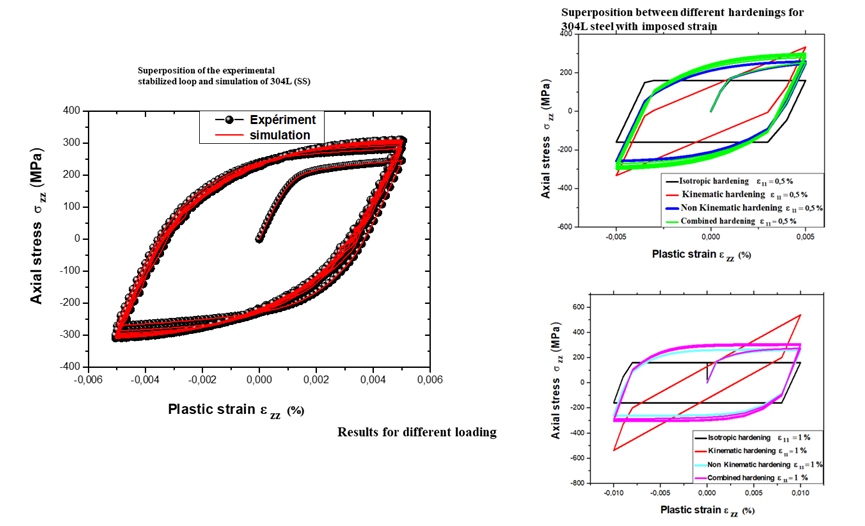
The object of this research is the cyclic elastoplastic behavior of materials, principally austenitic stainless steel (304L). The paper studies the 304L stainless steel behavior of exposed to different uniaxial and multiaxial cyclic loadings. It also determines the accuracy with which classical models, such as the Prager model, reproduce the phenomena of work hardening. All the models have which limits the reliability of fatigue life predictions for structures. For that, in this numerical study, a comparative analysis is performed between the Prager model and the Chaboche model. Chaboche model was selected to overcome the shortcomings of classical approaches, it can incorporate isotropic and nonlinear kinematic work hardening together. Numerous numerical simulations were conducted under various loading scenarios allowed to estimate the predictive capacity of the constitutive models and the limitations of simplified linear approaches. The results obtained, show that Chaboche model reproduces with excellent accuracy the phenomena of work hardening, additional work hardening, and ratcheting compared to the Prager model. This is explained by the fact that the Chaboche model can take into account the coupling between different phenomena which guarantees a realistic representation of cyclic elastoplastic behavior. Compared to similar models known in the literature, the Chaboche approach offers significant advantages: increased predictive accuracy, better representation of complex cyclic phenomena, and a fatigue life assessment of 304L stainless steel that closely reflects reality in demanding industrial applications.
References
- Chaboche, J.-L. (1981). Continuous damage mechanics – A tool to describe phenomena before crack initiation. Nuclear Engineering and Design, 64 (2), 233–247. https://doi.org/10.1016/0029-5493(81)90007-8
- Chaboche, J. L. (2008). A review of some plasticity and viscoplasticity constitutive theories. International Journal of Plasticity, 24 (10), 1642–1693. https://doi.org/10.1016/j.ijplas.2008.03.009
- Subasic, M., Alfredsson, B., Dahlberg, C. F. O., Öberg, M., Efsing, P. (2023). Mechanical Characterization of Fatigue and Cyclic Plasticity of 304L Stainless Steel at Elevated Temperature. Experimental Mechanics, 63 (8), 1391–1407. https://doi.org/10.1007/s11340-023-00992-5
- Azizoğlu, Y., Lindgren, L.-E. (2024). Temperature and plastic strain dependent Chaboche model for 316 L used in simulation of cold pilgering. International Journal of Material Forming, 18 (1). https://doi.org/10.1007/s12289-024-01864-6
- Skrzat, A., Wójcik, M. (2023). Explicit and Implicit Integration of Constitutive Equations of Chaboche Isotropic-Kinematic Hardening Material Model. Acta Metallurgica Slovaca, 29 (4), 200–205. https://doi.org/10.36547/ams.29.4.1949
- Belattar, A., Taleb, L. (2021). Experimental and numerical analyses of the cyclic behavior of austenitic stainless steels after prior inelastic histories. International Journal of Pressure Vessels and Piping, 189, 104256. https://doi.org/10.1016/j.ijpvp.2020.104256
- Kebir, T., Benguediab, M., Miloudi, A., Imad, A. (2017). Simulation of The Cyclic Hardening Behavior of luminum Alloys. Scientific Bulletin-University Politehnica of Bucharest. Series D, 79 (4), 240–250. Available at: https://www.scientificbulletin.upb.ro/rev_docs_arhiva/rezb11_236576.pdf
- Boussalih, F., Meziani, S., Fouathia, A., Fedaoui, K. (2019). Behavior of 304L stainless steel under uniaxial loading and effect of the mean stress on the ratcheting by simulation using Chaboche model. Scientific Bulletin-University Politehnica of Bucharest. Series D, 81 (2), 179–190. https://www.scientificbulletin.upb.ro/rev_docs_arhiva/fullaee_340862.pdf
- Acar, S. S., Yalçinkaya, T. (2025). Modeling of the Stress Path-Dependent Strain Ratcheting Behaviour of 304L Stainless Steel Through Crystal Plasticity Frameworks. Metals and Materials International, 31 (9), 2525–2540. https://doi.org/10.1007/s12540-025-01907-w
- Taleb, L., Hauet, A. (2009). Multiscale experimental investigations about the cyclic behavior of the 304L SS. International Journal of Plasticity, 25 (7), 1359–1385. https://doi.org/10.1016/j.ijplas.2008.09.004
- Delobelle, P., Robinet, P., Bocher, L. (1995). Experimental study and phenomenological modelization of ratchet under uniaxial and biaxial loading on an austenitic stainless steel. International Journal of Plasticity, 11 (4), 295–330. https://doi.org/10.1016/s0749-6419(95)00001-1
- Boussalih, F., Fedaoui, K., Zarza, T. (2022). Chaboche Model for Fatigue by Ratcheting Phenomena of Austenitic Stainless Steel under Biaxial Sinusoidal Loading. Civil Engineering Journal, 8 (3), 505–518. https://doi.org/10.28991/cej-2022-08-03-07
- Mazánová, V., Polák, J., Škorík, V., Kruml, T. (2017). Multiaxial elastoplastic cyclic loading of austenitic 316L steel. Frattura Ed Integrità Strutturale, 11 (40), 162–169. https://doi.org/10.3221/igf-esis.40.14
- Chaboche, J. L. (1989). Constitutive equations for cyclic plasticity and cyclic viscoplasticity. International Journal of Plasticity, 5 (3), 247–302. https://doi.org/10.1016/0749-6419(89)90015-6
- Djimli, L., Taleb, L., Meziani, S. (2010). The role of the experimental data base used to identify material parameters in predicting the cyclic plastic response of an austenitic steel. International Journal of Pressure Vessels and Piping, 87 (4), 177–186. https://doi.org/10.1016/j.ijpvp.2010.02.002
Downloads
Published
How to Cite
Issue
Section
License
Copyright (c) 2025 Amira Aboussalih, Salah Hammoudi, Kamel Fedaoui, Karim Arar, Lazhar Baroura

This work is licensed under a Creative Commons Attribution 4.0 International License.
The consolidation and conditions for the transfer of copyright (identification of authorship) is carried out in the License Agreement. In particular, the authors reserve the right to the authorship of their manuscript and transfer the first publication of this work to the journal under the terms of the Creative Commons CC BY license. At the same time, they have the right to conclude on their own additional agreements concerning the non-exclusive distribution of the work in the form in which it was published by this journal, but provided that the link to the first publication of the article in this journal is preserved.