Development of a logistic model for energy transition to renewable energy sources with energy security consideration
DOI:
https://doi.org/10.15587/2706-5448.2025.340373Keywords:
energy transition, renewable energy sources, modeling, energy security, logistic model, forecasting, resilience, risksAbstract
The object of the study is the process of energy transition to renewable energy sources (RES) at the enterprise or regional level, aimed at replacing traditional carbon-based sources of electricity. One of the most problematic issues is the insufficient consideration of energy security factors in existing forecasting models, which leads to risks of electricity shortages, especially under conditions of RES intermittency and geopolitical challenges such as military attacks or import dependence. A literature review showed that existing models do not account for dynamic constraints in the implementation of RES, which limits their practical applicability for ensuring power system resilience.
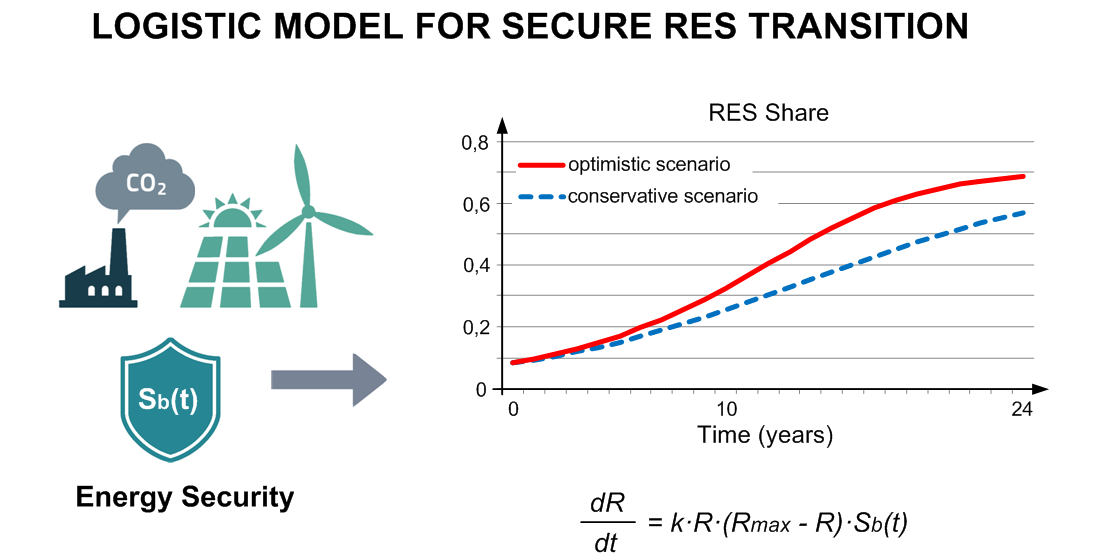
In the course of the research, numerical modeling methods were used, in particular an adaptation of the logistic growth equation with an integrated dynamic security factor Sb(t). This makes it possible to fill the gaps in existing models with regard to risk assessment and ensuring system stability. The obtained logistic model predicts the energy transition with RES reaching a 68% share in 24 years for a typical region without compromising security. This is due to the fact that the proposed model has such features as the integration of the coefficient of energy transition rate (CETR) and the dynamic constraint Sb(t), which adapts to changes in demand and reserve. This allows identifying the potential to increase system resilience through the optimal balance of RES and traditional sources during the transition.
As a result, it becomes possible to achieve such indicator values as a 68% share of RES, owing to the model’s flexibility to local conditions (variations of ρ, γ, k) and the consideration of worst-case scenarios (CF.min). Compared with similar known models, this provides advantages such as adaptability to regional risks, more accurate forecasting of the transition rate, and reduction of blackout probability. This is particularly relevant for vulnerable power systems, both in Ukraine and worldwide.
References
- Renewables 2025 Global Status Report (2025). REN21 Secretariat. Available at: https://www.ren21.net/gsr-2025/downloads/pdf/go/GSR_2025_GO_2025_Full_Report.pdf
- Motyka, M., Keefe, T. L., Hardin, K., Amon, C. (2024). 2025 renewable energy industry outlook. Deloitte Insights. Available at: https://www.deloitte.com/us/en/insights/industry/renewable-energy/renewable-energy-industry-outlook.html
- The energy transition: Where are we, really? (2024). McKinsey & Company. Available at: https://www.mckinsey.com/industries/electric-power-and-natural-gas/our-insights/the-energy-transition-where-are-we-really
- Bond, K., Butler-Sloss, S. (2023). The Renewable Revolution. Rocky Mountain Institute. Available at: https://rmi.org/wp-content/uploads/dlm_uploads/2023/06/rmi_renewable_revolution.pdf
- Zhu, Y., Raimi, D., Joiner, E., Holmes, B., Prest, B. C. (2025). Global energy outlook 2025: Headwinds and tailwinds in the energy transition. Resources for the Future. Available at: https://www.rff.org/publications/reports/global-energy-outlook-2025/
- Plazas-Niño, F. A., Ortiz-Pimiento, N. R., Montes-Páez, E. G. (2022). National energy system optimization modelling for decarbonization pathways analysis: A systematic literature review. Renewable and Sustainable Energy Reviews, 162, 112406. https://doi.org/10.1016/j.rser.2022.112406
- Volchyn, I. A., Haponych, L. S., Mokretskyy, V. O. (2022). Estimation and forecasting of carbon dioxide emissions from coal-fired thermal power plants in Ukraine. Naukovyi Visnyk Natsionalnoho Hirnychoho Universytetu, 5, 80–88. https://doi.org/10.33271/nvngu/2022-5/080
- Kim, H. (2023). Modeling a net-zero future: Energy experts harness simulation for global decarbonization. Argonne National Laboratory. Available at: https://www.anl.gov/education/modeling-a-netzero-future-energy-experts-harness-simulation-for-global-decarbonization
- Islam, Md. S., Khatun, Mst. S., Biswas, Md. H. A. (2024). Mathematical modelling of using renewable energy in the power sectors for the sustainable environment. Mathematical Modelling and Numerical Simulation with Applications, 4 (2), 216–237. https://doi.org/10.53391/mmnsa.1446574
- Sereda, B. P., Mukovska, D. Ya., Ziuzin, Ye. P., Orel, V. H. (2025). Mathematical models for optimization of the use of alternative energy sources in transport and production systems. Mathematical Modeling, 1 (52), 75–81. https://doi.org/10.31319/2519-8106.1(52)2025.330404
- Mokin, B. І., Shalagai, D. О., Mazuruk, O. V. (2024). Synthesis of Mathematical Models of the Process of Recovery and Development of Sources of Renewable Energy in Ukraine Close to the Realities of Today’s Warfare. Visnyk of Vinnytsia Politechnical Institute, 172 (1), 17–24. https://doi.org/10.31649/1997-9266-2024-172-1-17-24
- Kuznietsov, M. P. (2017). Construction of a mathematical model of electricity consumption mode. Vidnovluvana energetika, 4, 33–42. Available at: http://jnas.nbuv.gov.ua/article/UJRN-0000970781
- Protashchyk, O. V. (2018). Informatsiine zabezpechennia ekonomiko-matematychnoi modeli rozvytku enerhokompleksu Ukrainy. [Master's dissertation; Natsionalnyi tekhnichnyi universytet Ukrainy “Kyivskyi politekhnichnyi instytut imeni Ihoria Sikorskoho”].
- Barylo, A. A., Benmenni, M., Budko, V. I., Budko, M. O., Vasko, P. F., Holovko, V. M. et al.; Kudria, S. O. (Ed.) (2020). Vidnovliuvani dzherela enerhii. Kyiv: Instytut vidnovliuvanoi enerhetyky NAN Ukrainy, 392. Available at: https://www.ive.org.ua/wp-content/uploads/Monografia_final_21.12.2020.pdf
- Hrytsiuk, I., Volynets, V., Hrytsiuk, Y., Bandura, I., Komenda, N. (2025). Prospects for the integration of distributed energy sources into the Ukrainian power grid. Machinery & Energetics, 16 (1), 130–145. https://doi.org/10.31548/machinery/1.2025.130
- Fedorchuk, S. O. (2019). Zabezpechennia zaiavlenykh hrafikiv heneratsii vidnovliuvanykh dzherel enerhii na osnovi kontseptsii virtualnykh elektrychnykh stantsii. [PhD dissertation; Natsionalnyi tekhnichnyi universytet “Kharkivskyi politekhnichnyi instytut”].
- Honcharov, Ye., Benmenni, M. (2021). Modeliuvannia prohnozuvannia perekhodu Ukrainy na 100 % VDE do 2070 roku. Vidnovliuvana enerhetyka ta enerhoefektyvnist u XXI stolitti. ХХІІ Mizhnarodna naukovo-praktychna konferentsiia. Kyiv: Instytut vidnovliuvanoi enerhetyky NAN Ukrainy, 274–278. Available at: https://ela.kpi.ua/items/f4f0b9da-710b-4471-8f4d-ffe62e0406ce
- Zvit 3/ Zvit z modeliuvannia (2022). Instytut ekonomiky ta prohnozuvannia NAN Ukrainy. Yevropeiskyi bank rekonstruktsii ta rozvytku, 138. Available at: https://mepr.gov.ua/wp-content/uploads/2022/11/Rezultaty-modelyuvannya.pdf
- Kupchak, V. R., Pavlova, O. M., Pavlov, K. V., Lahodiienko, V. V. (2019). Formuvannia ta rehuliuvannia rehionalnykh enerhetychnykh system: teoriia, metodolohiia ta praktyka. Lutsk: SPD Hadiak Zhanna Volodymyrivna, drukarnia “Volynpolihraf”, 346. Available at: https://files.znu.edu.ua/files/Bibliobooks/Inshi73/0053830.pdf
- Pro zatverdzhennia Kodeksu systemy peredachi (2018). Postanova No 309. 14.03.2018. Available at: https://zakon.rada.gov.ua/go/v0309874-18
- Castro, J. F. C., Marques, D. C., Tavares, L., Dantas, N. K. L., Fernandes, A. L., Tuo, J., et al. (2022). Energy and Demand Forecasting Based on Logistic Growth Method for Electric Vehicle Fast Charging Station Planning with PV Solar System. Energies, 15 (17), 6106. https://doi.org/10.3390/en15176106
- Target compliance and benchmark (2024). ENTSO-E. Available at: https://2024.entsos-tyndp-scenarios.eu/target-compliance-and-benchmark/
- Joint Stock Company “Vinnytsiaoblenergo”. Available at: https://www.voe.com.ua
- Indicator 7.1.1Generation of power. State Statistics Service of Ukraine. Available at: https://sdg.ukrstat.gov.ua/uk/7-1-1
- Diachuk, O., Chepeliev, M., Podolets, R., Trypolska, H., Venher, V., Saprykina, T. et al.; Oharenko, Yu., Aliieva, O. (Eds.) (2017). Perekhid Ukrainy na vidnovliuvanu enerhetyku do 2050 roku. Kyiv: Vyd-vo TOV “ART KNYHA”, 88. Available at: https://energytransition.in.ua/wp-content/uploads/2018/11/Perehid-Ukrainy-na-vidnovlyuvanu-energetuky-do-2050_zvit.pdf
- Khvorov, M. M., Hryvkivska, O. V. (2020). Novyi zelenyi perekhid “European Green Deal” v Yevropi ta Ukraini. Naukovo-praktychni ekonomichni kontseptsii ta prohramy, 4. Available at: https://irback.e-u.edu.ua/server/api/core/bitstreams/5d3726f8-9a17-4257-b9c1-88acdccc93e0/content
- Hurochkina, V., Kohut, S. (2023). Formation of the energy balance of Ukraine using renewable energy sources. Economy, finances, management: Topical issues of science and practice, 4 (66), 109–133. https://doi.org/10.37128/2411-4413-2023-4-8
- The largest database of open data about energy of Ukraine. Energy Map. Available at: https://map.ua-energy.org/uk/
Downloads
Published
How to Cite
Issue
Section
License
Copyright (c) 2025 Oleksii Zhukov, Serhii Boiko, Andrii Koval, Olekcii Kotov, Sviatoslav Vyshnevsʹkyy

This work is licensed under a Creative Commons Attribution 4.0 International License.
The consolidation and conditions for the transfer of copyright (identification of authorship) is carried out in the License Agreement. In particular, the authors reserve the right to the authorship of their manuscript and transfer the first publication of this work to the journal under the terms of the Creative Commons CC BY license. At the same time, they have the right to conclude on their own additional agreements concerning the non-exclusive distribution of the work in the form in which it was published by this journal, but provided that the link to the first publication of the article in this journal is preserved.