Development of an optoelectronic image segmentation method from unmanned aerial vehicles based on the ant colony optimization algorithm under the influence of salt-and-pepper noise
DOI:
https://doi.org/10.15587/2706-5448.2025.344562Keywords:
optoelectronic image, segmentation, ant colony optimization algorithm, salt-and-pepper noiseAbstract
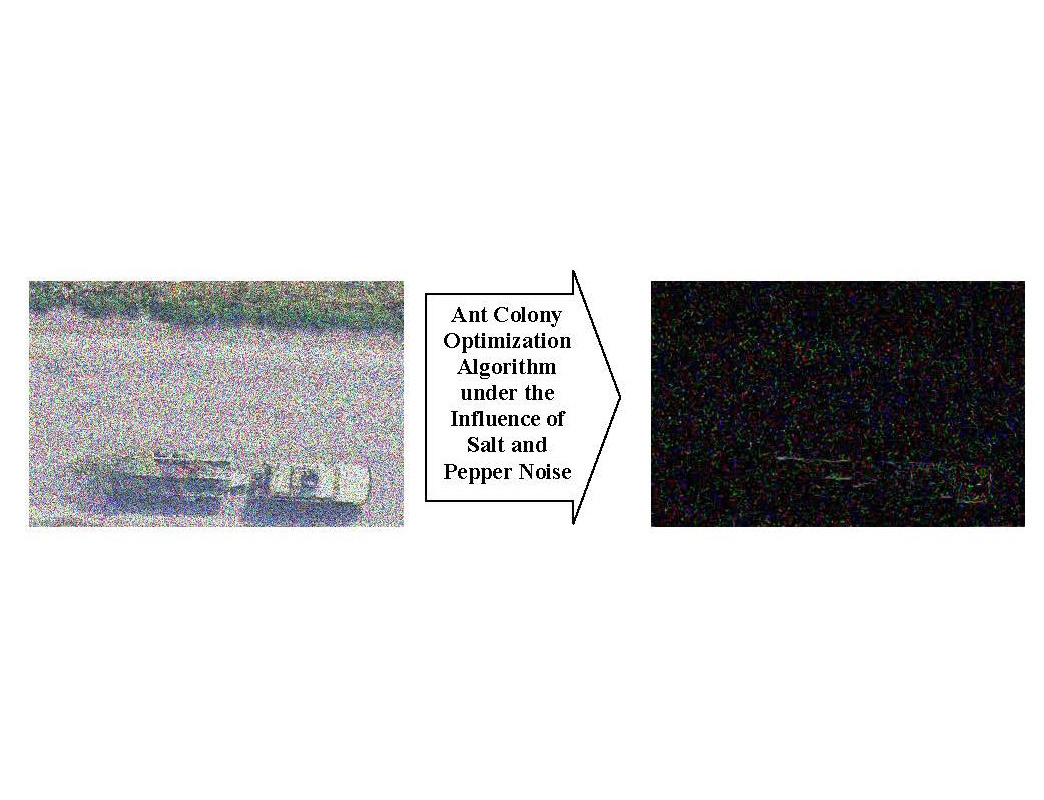
The object of research is the process of segmenting an image from an unmanned aerial vehicle based on the ant algorithm under the influence of salt-and-pepper noise.
“Salt”-and-“pepper” noise occurs due to data transmission errors, failures of digital camera sensors or malfunctions during recording/reading of information. It is characterized by the random appearance of individual pixels in the image, the value of which is equal to the minimum (“pepper”) or maximum (“salt”) brightness level.
Unlike the known ones, the method of segmenting an optoelectronic image based on the ant algorithm provides image segmentation under the influence of salt-and-pepper noise and involves:
– initialization of initial parameters;
– calculation of the length of the path segment of agents;
– calculation of the attractiveness of the route for the agent;
– updating the pheromone concentration;
– calculation of the probability of transition of agents;
– calculation of the objective function;
– movement of agents;
– determination of the best route of agents.
Experimental studies have shown that the segmentation method based on the ant algorithm provides a reduction in segmentation errors of the first kind on average:
– in the absence of salt-and-pepper noise – 4%;
– at the intensity of salt-and-pepper noise σ = 5–21%;
– at the intensity of salt-and-pepper noise σ = 15–10%.
The segmentation method based on the ant algorithm provides a reduction in segmentation errors of the second kind on average:
– in the absence of salt-and-pepper noise – 3%;
– at the intensity of salt-and-pepper noise σ = 5–15%;
– at the intensity of salt-and-pepper noise σ = 15–6%.
The practical significance of the segmentation method based on the ant algorithm is to ensure high-quality image segmentation under the influence of salt-and-pepper noise.
Supporting Agency
- The research was conducted with grant support from the National Research Foundation of Ukraine within the framework of the competition “Science for Strengthening the Defense Capability of Ukraine”, project “Information technology for automated segmentation of object images in FPV strike drone targeting systems based on swarm intelligence algorithms”, registration number 2023.04/0153.
References
- Zhang, Z., Zhu, L. (2023). A Review on Unmanned Aerial Vehicle Remote Sensing: Platforms, Sensors, Data Processing Methods, and Applications. Drones, 7 (6), 398. https://doi.org/10.3390/drones7060398
- Nersisyan, G. (2024). Upcoming Military Applications of Unmanned Aerial Vehicles with Digital Cameras and Other Sensors. Journal of Student Research, 13 (1). https://doi.org/10.47611/jsr.v13i1.2378
- Bazrafkan, A., Igathinathane, C., Bandillo, N., Flores, P. (2025). Optimizing integration techniques for UAS and satellite image data in precision agriculture – a review. Frontiers in Remote Sensing, 6. https://doi.org/10.3389/frsen.2025.1622884
- Bovik, A. C. (2010). Handbook of Image and Video Processing. Massachusetts: Academic Press, 1384. Available at: https://books.google.com.ua/books/about/Handbook_of_Image_and_Video_Processing.html?id=UM_GCfJe88sC&redir_esc=y
- Bishop, C. M. (2016). Pattern Recognition and Machine Learning (Information Science and Statistics). Springer, 778. Available at: https://books.google.com.ua/books/about/Pattern_Recognition_and_Machine_Learning.html?hl=ru&id=kOXDtAEACAAJ&redir_esc=y
- Khudov, H., Ruban, I., Makoveichuk, O., Stepanenko, Y., Khizhnyak, I., Glukhov, S. et al. (2021). Improved Imaging Model in the Presence of Multiplicative Spatially Extended Cloaking Interference. International Journal of Emerging Technology and Advanced Engineering, 11 (11), 189–198. https://doi.org/10.46338/ijetae1121_22
- Khudov, H., Makoveichuk, O., Misiuk, D., Butko, I., Khizhnyak, I., Shamrai, N. (2021). The Visual Information Structures Formation Model for the Visual Information Systems Processing. 2021 IEEE 3rd International Conference on Advanced Trends in Information Theory (ATIT). Kyiv, 15–19. https://doi.org/10.1109/atit54053.2021.9678806
- Babak, V., Zaporozhets, A., Kuts, Y., Fryz, M., Scherbak, L. (2025). Noise signals: Modelling and Analyses. Cham: Springer, 222. https://doi.org/10.1007/978-3-031-71093-3
- Wang, C., Pedrycz, W., Li, Z., Zhou, M. (2021). Residual-driven Fuzzy C-Means Clustering for Image Segmentation. IEEE/CAA Journal of Automatica Sinica, 8 (4), 876–889. https://doi.org/10.1109/jas.2020.1003420
- Rahman, A., Ali, H., Badshah, N., Zakarya, M., Hussain, H., Rahman, I. U. et al. (2022). Power Mean Based Image Segmentation in the Presence of Noise. https://doi.org/10.21203/rs.3.rs-1204261/v1
- Wang, Z., Zhao, Z., Guo, E., Zhou, L. (2023). Clean Label Disentangling for Medical Image Segmentation with Noisy Labels. arXiv:2311.16580v1. https://doi.org/10.48550/arXiv.2311.16580
- Wang, L., Guo, D., Wang, G., Zhang, S. (2021). Annotation-Efficient Learning for Medical Image Segmentation Based on Noisy Pseudo Labels and Adversarial Learning. IEEE Transactions on Medical Imaging, 40 (10), 2795–2807. https://doi.org/10.1109/tmi.2020.3047807
- Benfenati, A., Catozzi, A., Franchini, G., Porta, F. (2026). Unsupervised noisy image segmentation using Deep Image Prior. Mathematics and Computers in Simulation, 239, 986–1003. https://doi.org/10.1016/j.matcom.2025.07.052
- Zhang, X. (2023). Image denoising and segmentation model construction based on IWOA-PCNN. Scientific Reports, 13 (1). https://doi.org/10.1038/s41598-023-47089-6
- Gadetska, S., Dubnitskiy, V., Kushneruk, Y., Ponochovnyi, Y., Khodyrev, A. (2025). Determination of parameter-limited estimates of extreme value distributions and modeling of conditions for their occurrence using STATGRAPHICS and MATLAB. Advanced Information Systems, 9 (3), 32–41. https://doi.org/10.20998/2522-9052.2025.3.04
- Ruban, I., Khudov, H., Khudov, V., Makoveichuk, O., Khizhnyak, I., Shamrai, N. et al. (2025). Development of an image segmentation method from unmanned aerial vehicles based on the ant colony algorithm under the influence of speckle noise. Technology Audit and Production Reserves, 4 (2 (84)), 80–86. https://doi.org/10.15587/2706-5448.2025.334993
- Gonzalez, R., Woods, R. E. (2002). Digital Image Processing. Prentice Hall. Available at: https://uodiyala.edu.iq/uploads/PDF%20ELIBRARY%20UODIYALA/EL31/(%20DSP%20Book)%20-%20Gonzalez%20e%20Woods%20-%20Digital%20Image%20Processing%20(2nd%20ed)%20-%20Prentice%20Hall%202002%20(the%20only.pdf
- Dorigo, M., Stutzle, T. (2004). Ant Colony Optimization. Cambridge: MIT Press. https://doi.org/10.7551/mitpress/1290.001.0001
- Khudov, H., Hridasov, I., Khizhnyak, I., Yuzova, I., Solomonenko, Y. (2024). Segmentation of image from a first-person-view unmanned aerial vehicle based on a simple ant algorithm. Eastern-European Journal of Enterprise Technologies, 4 (9 (130)), 44–55. https://doi.org/10.15587/1729-4061.2024.310372
- Bezkoshtovnі resursi BPLA. PortalGIS.pro. Available at: https://portalgis.pro/bpla/bezkoshtovni-resursy-bpla
Downloads
Published
How to Cite
Issue
Section
License
Copyright (c) 2025 Igor Ruban, Hennadii Khudov, Vladyslav Khudov, Oleksandr Makoveichuk, Irina Khizhnyak, Ihor Butko, Andrii Hryzo, Rostyslav Khudov, Petro Mynko, Oleksii Baranik

This work is licensed under a Creative Commons Attribution 4.0 International License.
The consolidation and conditions for the transfer of copyright (identification of authorship) is carried out in the License Agreement. In particular, the authors reserve the right to the authorship of their manuscript and transfer the first publication of this work to the journal under the terms of the Creative Commons CC BY license. At the same time, they have the right to conclude on their own additional agreements concerning the non-exclusive distribution of the work in the form in which it was published by this journal, but provided that the link to the first publication of the article in this journal is preserved.