Optimization of public building glazing according to energy efficiency criteria
DOI:
https://doi.org/10.15587/2706-5448.2025.347970Keywords:
energy efficiency, glazing, facade, thermal insulation, Building Information Model, heat loss, energy conservation, thermal renovationAbstract
The object of research is a two-story office building. One of the problem areas in building envelopes is stained glass structures that do not meet modern energy efficiency requirements and have significant heat loss. The research aims to develop optimal design solutions for modernizing existing glazing, aimed at reducing heat loss while preserving the architectural appearance of the facade and the economic feasibility of implementing thermal renovation measures.
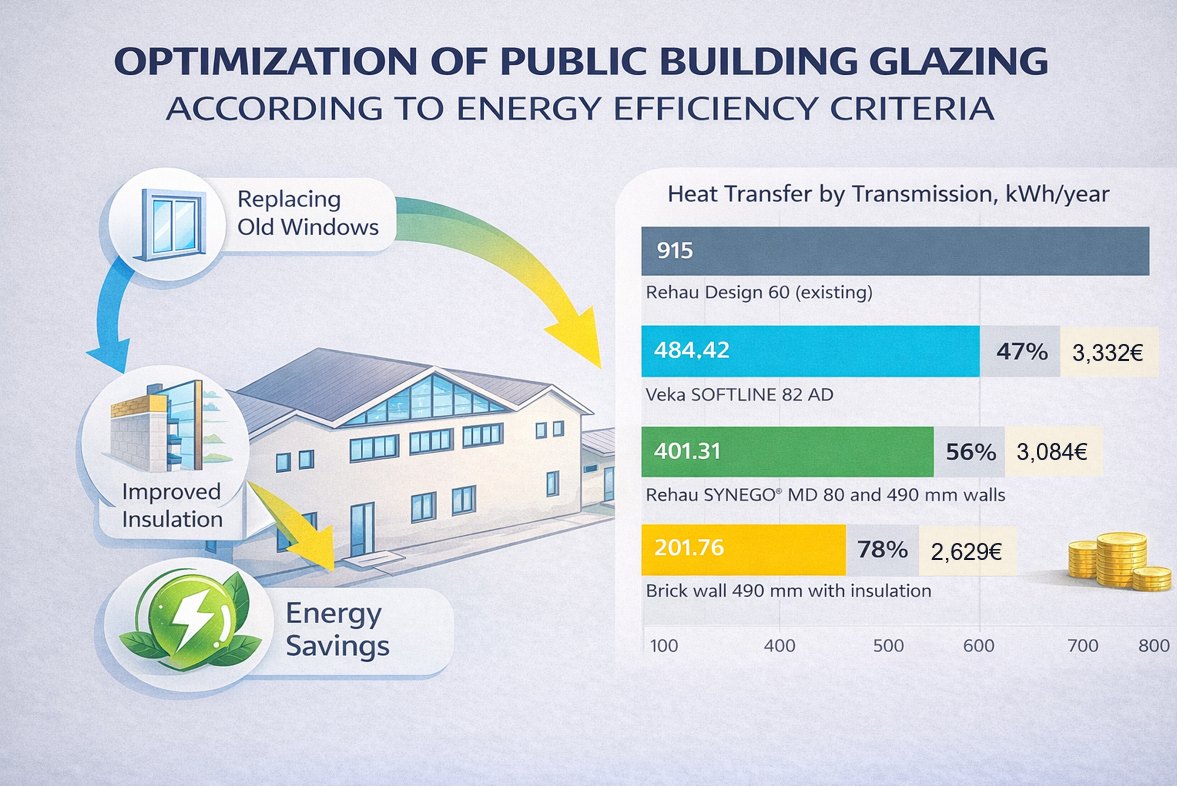
The research used a set of methods, namely the creation of a BIM model of the building, analysis of the thermal insulation properties of building envelopes, technical and economic comparison of thermal renovation options, and online calculation tools from window companies. The research results provided indicators of heat loss through the stained glass windows of the existing system and the proposed reconstruction options, as well as the amount of solar gain. Three options for replacing the stained glass windows were developed. One option involved the use of Rehau SYNEGO® MD-80 with 490 mm mullions and a reduction in the area of translucent structures. The heat loss savings are 56%, and the implementation cost is 3084 EUR, which is an acceptable indicator among the options considered. This is because the proposed option meets energy efficiency requirements and also takes into account the customer's restrictions on changing the architectural appearance of the facade by no more than 50%.
The proposed approach allows for a comprehensive assessment of the impact of the proposed measures on the energy balance of the building, taking into account architectural constraints and justifying an economically viable solution. Compared to traditional solutions for replacing stained glass windows based solely on thermal conductivity or standard facade solutions without taking into account the conditions of a specific object.
The results obtained can be used for implementation in similar objects in public and office buildings during reconstruction or new construction.
References
- Action Plan: Energy Efficiency in Buildings. Low Carbon Technology Partnerships Initiative (2015). World Business Council for Sustainable Development. Available at: https://docs.wbcsd.org/2015/12/LCTPi-EEB-Action-Plan.pdf
- Davis, A. (2018). Neither a borrower nor a lender be: Energy efficiency decision- making among class B and C offices in Pittsburgh. https://doi.org/10.31234/osf.io/z76xg
- Ur Rehman, H., Heimonen, I., Vainio, T., Ramesh, R., Wallin, A. (2022). Technical recommendations of the new built Nearly Zero Energy Building (NZEB) in Ukraine. VTT. Available at: https://www.vttresearch.com/sites/default/files/2022-12/NZEB_Final_Workshop_VTT_Presentation.pdf
- Primasetra, A., Larasati, D., Wonorahardjo, S. (2022). BIM Utilization in Improving Energy Efficiency Performance on Architectural Design Process: Challenges and Opportunities. IOP Conference Series: Earth and Environmental Science, 1058 (1), 012018. https://doi.org/10.1088/1755-1315/1058/1/012018
- Fürtön, B., Nagy, B. (2022). BIM based hygrothermal modelling of building constructions. Acta Polytechnica CTU Proceedings, 38, 340–346. https://doi.org/10.14311/app.2022.38.0340
- Erebor, E. M., Ibem, E. O., Ezema, I. C., Sholanke, A. B. (2021). Energy Efficiency Design Strategies in Office Buildings: A Literature Review. IOP Conference Series: Earth and Environmental Science, 665 (1), 012025. https://doi.org/10.1088/1755-1315/665/1/012025
- Arends, I., Prinz, C., Abma, F. (2017). Job quality, health and at-work productivity. OECD Social, Employment and Migration Working Papers, No. 195. Available at: https://www.oecd.org/content/dam/oecd/en/publications/reports/2017/06/job-quality-health-and-at-work-productivity_e4c3283e/43ff6bdc-en.pdf
- Kosenko, L., Koval, O., Yurchenko, E., Koval, A. (2023). Analysis of European regulatory requirements for near to zero energy consumption buildings and the possibility of implementation in Ukraine. Ventilation, Illumination and Heat Gas Supply, 47, 28–35. https://doi.org/10.32347/2409-2606.2023.47.28-35
- Bondarenko, A., Yurchenko, E., Olena, K., Savytskyi, M. (2023). Comparative analysis of microclimate parameters of residential low-rise buildings with different heating systems. Innovative technologies in construction, civil engineering and architecture, 2678. https://doi.org/10.1063/5.0119318
- Lyachovetskaya-Tokareva, M., Yurchenko, Y., Koval, O., Tymoshenko, O. (2023). Mathematical modeling of the refrigerating equipment in the air conditioning system during industrial energy audit. Innovative technologies in construction, civil engineering and architecture, 2678. https://doi.org/10.1063/5.0118991
- Demydov, O. (2024). Metody pidvyshchennia enerhoefektyvnosti ofisnoi budivli. Kvalifikatsiina vypuskova robota. Available at: http://srd.pgasa.dp.ua:8080/xmlui/handle/123456789/13430
- Demydov, O., Kosenko, L., Koval, O., Yurchenko, E. (2024). Research and simulation of an office lighting. Ventilation, Illumination and Heat Gas Supply, 49, 7–15. https://doi.org/10.32347/2409-2606.2024.49.7-15
- DSTU 9191:2022. Teploizoliatsiia budivel. Metody vyboru teploizoliatsiinoho materialu dlia uteplennia budivel (2023). Tekhnichnyi komitet standartyzatsii TK 302 “Enerhoefektyvnist budivel i sporud”. Available at: https://online.budstandart.com/ua/catalog/doc-page.html?id_doc=98996
- DBN V.2.6-31:2021. Teplova izoliatsiia ta enerhoefektyvnist budivel (2022). DP “Derzhavnyi naukovo-doslidnyi instytut budivelnykh konstruktsii”. Available at: https://online.budstandart.com/ua/catalog/doc-page.html?id_doc=98037
- DSTU 9190:2022. Enerhetychna efektyvnist budivel. Metod rozrakhunku enerhospozhyvannia pid chas opalennia, okholodzhennia, ventyliatsii, osvitlennia ta hariachoho vodopostachannia (2023). Tekhnichnyi komitet standartyzatsii TK 302 “Enerhoefektyvnist budivel i sporud”. Available at: https://online.budstandart.com/ua/catalog/doc-page.html?id_doc=98995
- VEKA's online service for designing and calculating the energy efficiency of glazing. Available at: https://windoplan.veka.com/
- Energy Efficiency. REHAU Window Solutions. https://window.rehau.com/uk-en/why-choose-pvcu/energy-efficiency
Downloads
Published
How to Cite
Issue
Section
License
Copyright (c) 2025 Leonid Kosenko, Olena Koval, Yevhenii Yurchenko, Artem Koval, Serhii Hryshyn

This work is licensed under a Creative Commons Attribution 4.0 International License.
The consolidation and conditions for the transfer of copyright (identification of authorship) is carried out in the License Agreement. In particular, the authors reserve the right to the authorship of their manuscript and transfer the first publication of this work to the journal under the terms of the Creative Commons CC BY license. At the same time, they have the right to conclude on their own additional agreements concerning the non-exclusive distribution of the work in the form in which it was published by this journal, but provided that the link to the first publication of the article in this journal is preserved.