Development of system-type-centric paradigm of computer-software systems architectural design for automation systems
DOI:
https://doi.org/10.15587/2706-5448.2026.349943Keywords:
software architecture, automation systems, system taxonomy, computer systems, architectural designAbstract
The object of research is the design processes of computer-software systems in the automation domain. Computer-software systems are considered as a combination of software and hardware.
This research focuses on addressing the lack of a formal methodology that differentiates the architectural design of computer-software systems for automation systems, including in hybrid Information Technology/Operational Technology environments.
Existing approaches, methods, and models for designing the architecture of computer-software systems do not account for the differentiation of approaches based on the fundamental differences in the nature of various system types used in the automation domain. This precludes the establishment of standardized and differentiated processes and methods for designing the architecture of such systems.
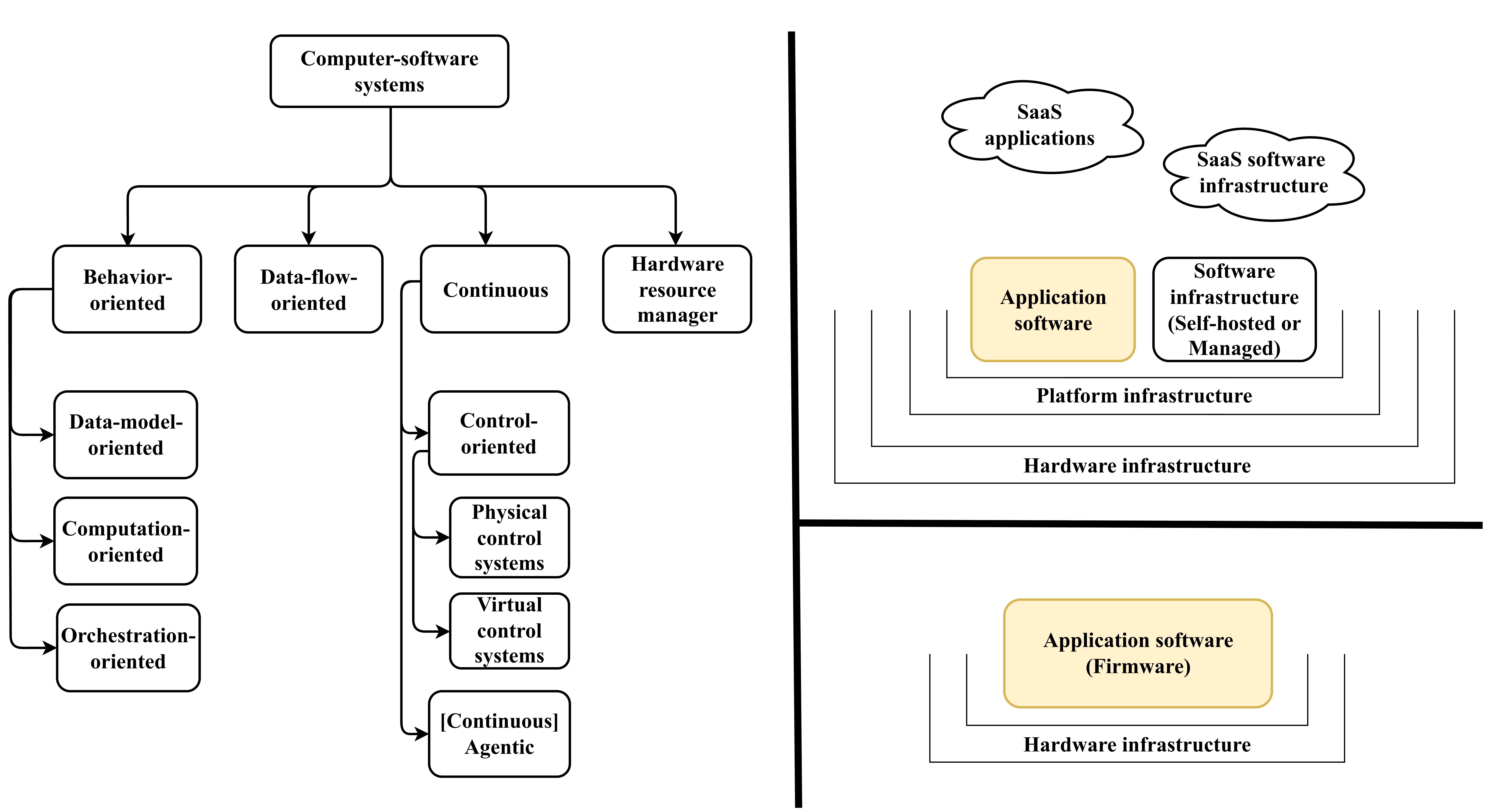
The main result is a new type-centric paradigm of architectural design, based on a taxonomy that classifies computer-software systems into fundamental types by their architectural nature. Furthermore, within the scope of the research, the levels and elements of computer-software systems are defined, which forms a standardized vision of the systems' constituent parts.
In contrast to existing models, approaches, and methodologies, the proposed type-centric paradigm for the architectural design of computer-software systems incorporates the fundamental aspects of the systems' nature that are important for architectural design, classifying systems based on this factor.
The proposed paradigm provides a foundation for systematized, specialized, and differentiated architectural design processes adapted to the specifics of the systems' nature. This ensures standardization, interoperability, and systematicity in the design of computer-software systems for automation systems, potentially forming a basis for automated architectural design systems.
References
- Williams, T. J. (1990). A Reference Model for Computer Integrated Manufacturing from the Viewpoint of Industrial Automation. IFAC Proceedings Volumes, 23 (8), 281–291. https://doi.org/10.1016/s1474-6670(17)51748-6
- IEC 62264-1:2013 Enterprise-control system integration – Part 1: Models and terminology (2013). International Electrotechnical Commission. Available at: https://webstore.iec.ch/en/publication/6675
- The Industrial Internet Reference Architecture (IIRA), Version 1.10: An Industry IoT Consortium foundational document (2022). Boston: Industry IoT Consortium. Available at: https://www.iiconsortium.org/wp-content/uploads/sites/2/2022/11/IIRA-v1.10.pdf Last accessed: 16.10.2025
- Controllers. Kubernetes. Available at: https://kubernetes.io/docs/concepts/architecture/controller Last accessed: 16.10.2025
- Kruchten, P. B. (1995). The 4+1 View Model of architecture. IEEE Software, 12 (6), 42–50. https://doi.org/10.1109/52.469759
- Starke, G., Simons, M., Zörner, S., Müller, R. D., Losch, H. (2019). arc42 by Example: Software architecture documentation in practice. Birmingham: Packt Publishing.
- arc42. arc42. Available at: https://arc42.org Last accessed: 16.10.2025
- ISO/IEC/IEEE 42010:2022. Software, systems and enterprise – Architecture description (2022). ISO/IEC/IEEE. Available at: https://www.iso.org/standard/74393.html Last accessed: 16.10.2025
- ISO/IEC/IEEE 42020:2019. Systems and software engineering – Architecture processes (2019). ISO/IEC/IEEE. Available at: https://www.iso.org/standard/68982.html Last accessed: 16.10.2025
- Bass, L., Clements, P., Kazman, R. (2021). Software Architecture in Practice. Boston: Addison-Wesley Professional.
- Cervantes, H., Kazman, R. (2016). Designing Software Architectures: A Practical Approach. Boston: Addison-Wesley Professional.
- Rozanski, N., Woods, E. (2012). Software Systems Architecture: Working With Stakeholders Using Viewpoints and Perspectives. Boston: Addison-Wesley.
- Bauer, M., Boussard, M., Bui, N., Carrez, F., Siemens, C., Alube, J. et al. (2013). Internet of Things – Architecture IoT-A Deliverable D1.5 – Final architectural reference model for the IoT v3.0. Available at: https://www.researchgate.net/publication/272814818_Internet_of_Things_-_Architecture_IoT-A_Deliverable_D15_-_Final_architectural_reference_model_for_the_IoT_v30
- Fornés-Leal, A., Lacalle, I., Palau, C. E., Szmeja, P., Ganzha, M., Paprzycki, M. et al. (2022). ASSIST-IoT: A Reference Architecture for Next Generation Internet of Things. New Trends in Intelligent Software Methodologies, Tools and Techniques. https://doi.org/10.3233/faia220243
- Szmeja, P., Fornés-Leal, A., Lacalle, I., Palau, C. E., Ganzha, M., Pawłowski, W. et al. (2023). ASSIST-IoT: A Modular Implementation of a Reference Architecture for the Next Generation Internet of Things. Electronics, 12 (4), 854. https://doi.org/10.3390/electronics12040854
- Megow, J. (2020). Reference architecture models for Industry 4.0, smart manufacturing and IoT: An introduction. Berlin: Begleitforschung PAiCE; iit – Institut für Innovation und Technik in der VDI / VDE Innovation + Technik GmbH.
- ANSI/ISA-88.00.01-2010 Batch Control Part 1: Models and Terminology (2010). International Society of Automation. Available at: https://www.isa.org/products/isa-88-00-01-2010-batch-control-part-1-models Last accessed: 16.10.2025
- AUTOSAR (AUTomotive Open System ARchitecture). AUTOSAR Consortium. Available at: https://www.autosar.org Last accessed: 16.10.2025
- Evans, E. (2003). Domain-Driven Design: Tackling Complexity in the Heart of Software. Boston: Addison-Wesley Professional.
- Lamm, J. G., Weilkiens, T. (2013). Method for Deriving Functional Architectures from Use Cases. Systems Engineering, 17 (2), 225–236. https://doi.org/10.1002/sys.21265
- Forlingieri, M., Lamm, J. G., Roth, S., Walker, M. (2022). Model-based system architecture. Hoboken: Wiley. https://doi.org/10.1002/9781119746683
- Eichmann, O. C., Lamm, J. G., Melzer, S., Weilkiens, T., God, R. (2024). Development of functional architectures for cyber‐physical systems using interconnectable models. Systems Engineering, 27 (6), 993–1011. https://doi.org/10.1002/sys.21761
- Griffor, E. R., Greer, C., Wollman, D. A., Burns, M. J. (2017). Framework for Cyber-Physical Systems: Volume 1, Overview (NIST Special Publication 1500-201). National Institute of Standards and Technology. Available at: https://doi.org/10.6028/NIST.SP.1500-201
- NASA Systems Engineering Handbook (NASA/SP-2016-6105 Rev2) (2017). National Aeronautics and Space Administration. Available at: https://ntrs.nasa.gov/citations/20170001761 Last accessed: 16.10.2025
- The DoDAF Architecture Framework Version 2.02 (2010). The U.S. Department of Defense. Available at: https://dodcio.defense.gov/Library/DoD-Architecture-Framework Last accessed: 16.10.2025
- MOD Architecture Framework (2012). Ministry of Defence. Available at: https://www.gov.uk/guidance/mod-architecture-framework Last accessed: 16.10.2025
- About the Unified Architecture Framework Specification Version 1.2 (2022). Object Management Group. Available at: https://www.omg.org/spec/UAF/1.2/About-UAF Last accessed: 16.10.2025
- Plum, N. (2025). TRAK Enterprise architecture framework. Available at: https://sourceforge.net/projects/trak Last accessed: 16.10.2025
- NATO Architecture Framework Version 4 (NAFv4) (2020). NATO. Available at: https://www.nato.int/content/dam/nato/webready/documents/publications-and-reports/NAFv4_2020.09.pdf Last accessed: 16.10.2025
- The TOGAF® Standard (2022). The Open Group. Zaltbommel: Van Haren Publishing.
- Gesellschaft für Systems Engineering e.V. (GfSE). System Architecture Framework. Available at: https://saf.gfse.org/ Last accessed: 16.10.2025
- Dömel, A. (2025). The Robot Architecture Framework: A systematic approach for describing the architecture of complex, autonomous robotic systems. [Doctoral dissertation; University of Bremen].
- Hatebur, D., Heisel, M. (2009). Deriving Software Architectures from Problem Descriptions. Software Engineering, 383–392.
- Alebrahim, A., Hatebur, D., Heisel, M. (2011). A Method to Derive Software Architectures from Quality Requirements. 2011 18th Asia-Pacific Software Engineering Conference. IEEE, 322–330. https://doi.org/10.1109/apsec.2011.29
- Fitzgerald, J., Gamble, C., Larsen, P. G., Pierce, K., Woodcock, J. (2015). Cyber-Physical Systems Design: Formal Foundations, Methods and Integrated Tool Chains. 2015 IEEE/ACM 3rd FME Workshop on Formal Methods in Software Engineering. Florence 40–46. https://doi.org/10.1109/formalise.2015.14
- Rama, A., Reddy, M., Govindarajulu, P., Naidu, M. M. (2007). A Process Model for Software Architecture. International Journal of Computer Science and Network Security, 7 (4), 272–280.
- Liu, L. (2018). The Process to Design an Automation System. Journal of Physics: Conference Series, 1087, 042001. https://doi.org/10.1088/1742-6596/1087/4/042001
- Cantor, M. (2003). Rational Unified Process for Systems Engineering: Part 1. Journal of Systems Architecture – JSA.
- Sas, C., Capiluppi, A. (2022). Antipatterns in software classification taxonomies. Journal of Systems and Software, 190, 111343. https://doi.org/10.1016/j.jss.2022.111343
- Britto, R., Wohlin, C., Mendes, E. (2016). An extended global software engineering taxonomy. Journal of Software Engineering Research and Development, 4 (1). https://doi.org/10.1186/s40411-016-0029-2
- Usman, M., Britto, R., Börstler, J., Mendes, E. (2017). Taxonomies in software engineering: A Systematic mapping study and a revised taxonomy development method. Information and Software Technology, 85, 43–59. https://doi.org/10.1016/j.infsof.2017.01.006
- Guenther, J., Falk, I., Cole, M. J. (2023). Theory building from qualitative evaluation. Evaluation, 29 (4), 410–427. https://doi.org/10.1177/13563890231196603
- Lukka, K. (2003). Case study research in logistics. Turku: Turku School of Economics and Business Administration, 83–101.
- Kwasnik, B. (1999). The role of classification in knowledge representation and discovery. Library Trends, 48 (1).
- Mohammed, S. S. (2024). Deductive and inductive research. Introduction to Research Methods. Japan Bilingual Publishing Co., 203.
- Iovino, M., Förster, J., Falco, P., Chung, J., Siegwart, R., Smith, C. (2024). Comparison between Behavior Trees and Finite State Machines. arXiv:2405.16137. https://doi.org/10.48550/arXiv.2405.16137
- Zhang, Y., Li, R., Liang, P., Sun, W., Liu, Y. (2025). Knowledge-Based Multi-Agent Framework for Automated Software Architecture Design. Proceedings of the 33rd ACM International Conference on the Foundations of Software Engineering, 530–534. https://doi.org/10.1145/3696630.3728493
- Guo, X., Keivan, D., Syed, U., Qin, L., Zhang, H., Dullerud, G. et al. (2024). ControlAgent: Automating Control System Design via Novel Integration of LLM Agents and Domain Expertise. arXiv:2410.19811. https://doi.org/10.48550/arXiv.2410.19811
Downloads
Published
How to Cite
Issue
Section
License
Copyright (c) 2026 Ihor Polataiko, Leonid Zamikhovskyі

This work is licensed under a Creative Commons Attribution 4.0 International License.
The consolidation and conditions for the transfer of copyright (identification of authorship) is carried out in the License Agreement. In particular, the authors reserve the right to the authorship of their manuscript and transfer the first publication of this work to the journal under the terms of the Creative Commons CC BY license. At the same time, they have the right to conclude on their own additional agreements concerning the non-exclusive distribution of the work in the form in which it was published by this journal, but provided that the link to the first publication of the article in this journal is preserved.