Development of a system of indices for monitoring and assessing the sustainability of underground utilities
DOI:
https://doi.org/10.15587/2706-5448.2026.350994Keywords:
indicator, operational sustainability, indicative planning, technical condition of networks, organizational and technological monitoringAbstract
The object of research is the exploitative sustainability of the urban underground utility system. The subject of research is performance indices and methodological approaches to assess the sustainability and performance of urban underground utility systems.
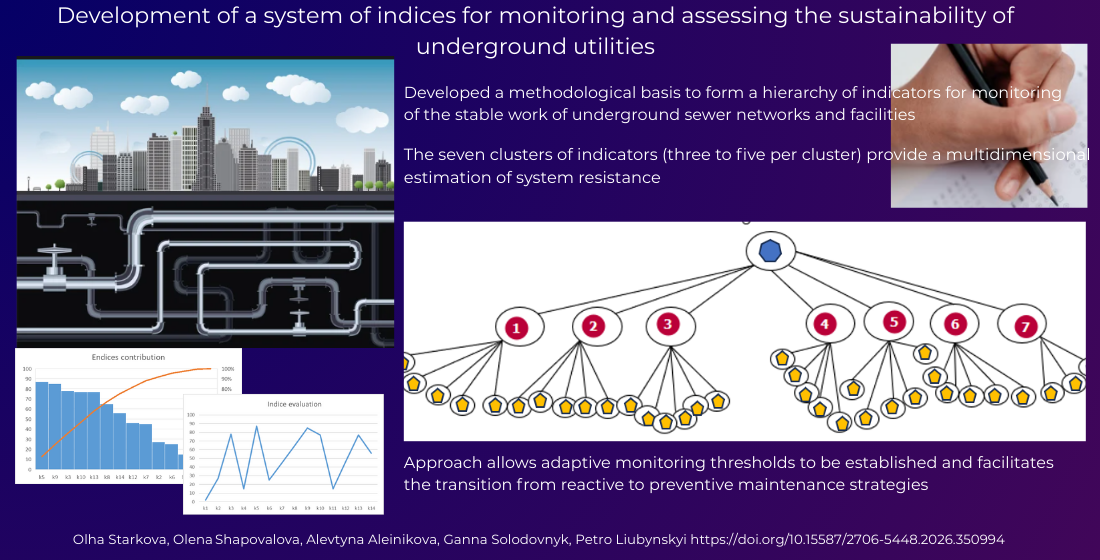
The research study proposes a comprehensive system of indices to monitor and assess the sustainability of urban underground utilities and address critical issues such as aging infrastructure, aggressive operating environments, and financial constraints. The research study identifies seven categories of performance indices such as availability, funding sources, effectiveness of rehabilitation work, accident mitigation, environmental safety, efficient use of funds and efficiency of monitoring implementation. Each index is intended to measure a specific aspect of utility performance and provide a clearly defined basis to assess operational reliability and sustainability. Each of these indexes serves to evaluate a certain aspect of engineering networks functioning. This creates a firmly formalized foundation to the following analysis of the exploitation reliability and network durability. The methodology used regulations the calculation of these indexes, establishes the range of values and their possible variations; also, defines correlations between indexes and characteristics of sustainability of engineering communications. Indexes presented in this research provide an opportunity to predictive planning, increase efficiency of reconstruction and modernization strategies and ensure optimal resource allocation, which increases the operational safety. The methodology used regulations the calculation of these indexes, establishes the range of values and their possible variations; also, defines correlations between indexes and characteristics of sustainability of engineering communications. Indexes presented in this research provide an opportunity to predictive planning, increase efficiency of reconstruction and modernization strategies and ensure optimal resource allocation, which increases the operational safety.
Practical value of the results obtained in this research consists in the possibility of the heads of municipal utilities to take grounded management decisions. The research shows the level of impact of synergistic combination modern technology and financial planning on forming long-term stability of engineering structures. The proposed research allows improving the quality of urban infrastructure management. The application of the developed tools contributes to the stability of service provision and reduces the level of risks associated with the aging of engineering networks.
References
- Aleinikova, A., Bondarenko, D., Goncharenko, D., Starkova, O. (2022). Methodological principles for informational and technological monitoring of the stable operation of the sewerage networks. Kharkiv, 272. Available at: http://repository.hneu.edu.ua/handle/123456789/29772
- Hojjati, A., Jefferson, I., Metje, N., Rogers, C. D. F. (2018). Sustainability assessment for urban underground utility infrastructure projects. Proceedings of the Institution of Civil Engineers – Engineering Sustainability, 171 (2), 68–80. https://doi.org/10.1680/jensu.16.00050
- Huang, H., Zhang, D., Huang, Z. (2022). Resilience of city underground infrastructure under multi-hazards impact: From structural level to network level. Resilient Cities and Structures, 1 (2), 76–86. https://doi.org/10.1016/j.rcns.2022.07.003
- Sakai, H. (2024). Review of research on performance indicators for water utilities. AQUA – Water Infrastructure, Ecosystems and Society, 73 (2), 167–182. https://doi.org/10.2166/aqua.2024.224
- Fares, H., Zayed, T. (2010). Hierarchical Fuzzy Expert System for Risk of Failure of Water Mains. Journal of Pipeline Systems Engineering and Practice, 1 (1), 53–62. https://doi.org/10.1061/(asce)ps.1949-1204.0000037
- Shoaei, A., Sousa, V., Cruz, C. O. (2024). Literature review on the evaluation of resilience in infrastructure projects. Journal of Infrastructure Policy and Development, 8 (15), 9984. https://doi.org/10.24294/jipd9984
- Suprayoga, G. B., Bakker, M., Witte, P., Spit, T. (2020). A systematic review of indicators to assess the sustainability of road infrastructure projects. European Transport Research Review, 12 (1). https://doi.org/10.1186/s12544-020-0400-6
- Yang, Z., Barroca, B., Mebarki, A., Laffréchine, K., Dolidon, H., Lilas, L. (2024). Critical infrastructure resilience: a guide for building indicator systems based on a multi-criteria framework with a focus on implementable actions. Natural Hazards and Earth System Sciences, 24 (11), 3723–3753. https://doi.org/10.5194/nhess-24-3723-2024
- Zhu, Y., Zhang, Q.-B. (2025). Modelling and assessing lifetime resilience of underground infrastructure to multiple hazards: Toward a unified approach. Tunnelling and Underground Space Technology, 156, 106212. https://doi.org/10.1016/j.tust.2024.106212
- De Matos, B., Salles, R., Mendes, J., Gouveia, J. R., Baptista, A. J., Moura, P. (2022). A Review of Energy and Sustainability KPI-Based Monitoring and Control Methodologies on WWTPs. Mathematics, 11 (1), 173. https://doi.org/10.3390/math11010173
- Carluccio, S., Mian, J., Andrews, L. et al. (2021). A review of the landscape of guidance, tools and standards for sustainable and resilient infrastructure. PreventionWeb. Available at: https://www.preventionweb.net/publication/review-landscape-guidance-tools-and-standards-sustainable-and-resilient-infrastructure
- Endrodi-Kovacs, V., Tankovsky, O. (2022). A composite indicator for economic integration maturity: the case of Western Balkan countries. Eastern Journal of European Studies, 13 (1), 148–166. https://doi.org/10.47743/ejes-2022-0107
- Nam, S.-N., Yun, H., Park, K., Oh, J. (2020). Proposed Framework of Performance Indicators for Evaluation of Sewerage Services: A Case Study of Seoul Metropolitan Government. Journal of Korean Society of Environmental Engineers, 42 (8), 393–404. https://doi.org/10.4491/ksee.2020.42.8.393
- He, Y., Yang, L., Xu, H., Han, X., Sun, C., Di, Y., Zhao, T. (2024). Construction of an evaluation system for the effectiveness of rural sewage treatment facilities and empirical research. Frontiers in Environmental Science, 12. https://doi.org/10.3389/fenvs.2024.1430068
- Shapovalova, O., Starkova, O., Solodovnyk, G. (2021). Automated system for determining a damage class for sections of a wastewater disposal network. CEUR Workshop Proceedings. Available at: http://ceur-ws.org/Vol-3039/short5.pdf
- Xiao, X. (2022). Evaluation of operation cost control of urban sewage treatment plants in China. Modern Salt Chemical Industry, 49, 111–112. https://doi.org/10.19465/j.cnki.2095-9710.2022.05.021
Downloads
Published
How to Cite
Issue
Section
License
Copyright (c) 2026 Оlha Starkova, Olena Shapovalova, Alevtyna Aleinikova, Ganna Solodovnyk, Petro Liubynskyi

This work is licensed under a Creative Commons Attribution 4.0 International License.
The consolidation and conditions for the transfer of copyright (identification of authorship) is carried out in the License Agreement. In particular, the authors reserve the right to the authorship of their manuscript and transfer the first publication of this work to the journal under the terms of the Creative Commons CC BY license. At the same time, they have the right to conclude on their own additional agreements concerning the non-exclusive distribution of the work in the form in which it was published by this journal, but provided that the link to the first publication of the article in this journal is preserved.