Symmetric approach to industrial safety risk assessment based on mutual probability correspondence
DOI:
https://doi.org/10.15587/2706-5448.2026.353068Keywords:
probabilistic risk assessment, industrial safety, dynamic Bayesian modeling, Monte Carlo modeling, symmetric probabilistic modelingAbstract
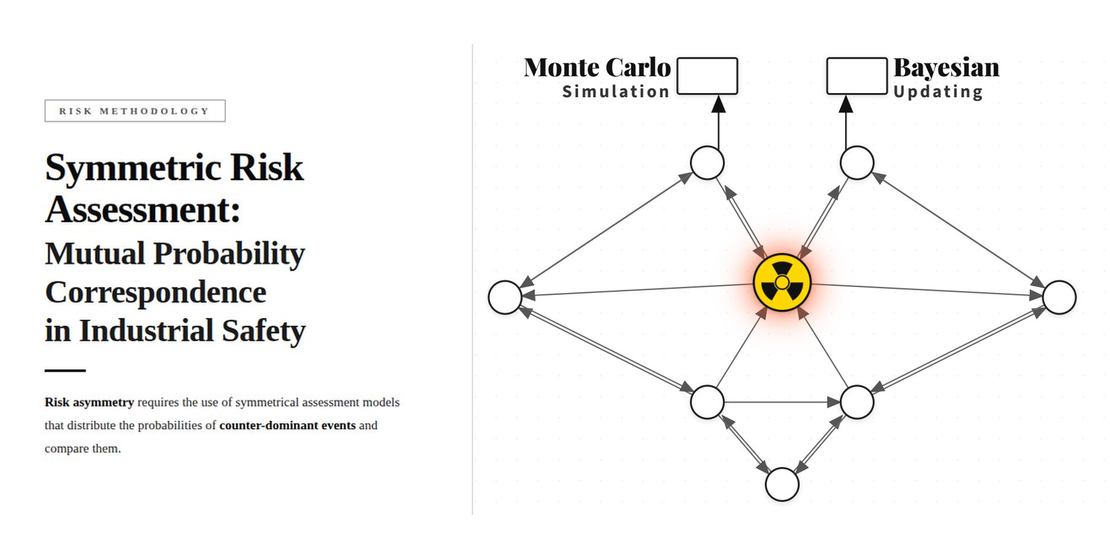
The object of research is the process of assessing the level of safety of complex technical systems of critical infrastructure under conditions of uncertainty. The problem of the limitations and asymmetry of risk assessment methods was investigated. Risk assessment processes were studied based on IAEA data, using a combination of theoretical and computational modeling methods. The theoretical basis was based on factor risk analysis. Dynamic and temporal dependencies were taken into account using a synthesized modular scalable dynamic Bayesian network (MSDBN), which integrated local components and their interaction into hierarchical models. Probabilistic assessments were performed using Monte Carlo simulation, as well as structural and hybrid learning algorithms for Bayesian networks. The limitations, asymmetry, and dependence on expert opinion of traditional risk assessment methods were shown. It was shown that the synthesis of Bayesian networks and the Monte Carlo method as basic approaches meets the criteria for symmetry in risk event modeling. It was established that the maximum adequacy of risk event prediction is achieved when using a modular Bayesian architecture with a multi-criteria approach through assessing the compliance of production system elements with regulatory requirements, historical analogies and/or modeling results. MSDBN improves the quality and validity of management decisions, is integrated into automated control systems, serves as a tool for digital twins, can be used in the educational process, is symmetric and suitable for assessing the effectiveness of security measures. The proposed approach is useful for state, defense and industrial systems, including under conditions of uncertainty.
References
- Borys, O. P. (2017). History of development of state fire protection and its role in formation of the system of civil protection of Ukraine. Derzhavne upravlinnia: udoskonalennia ta rozvytok, 1, 28–36. Available at: http://www.dy.nayka.com.ua/?op=1&z=1330 Last accessed: 25.12.2025
- ISO 31000:2018. Risk management – Guidelines (2018). Geneva: International Organization for Standardization, 16.
- ISO 31010:2019. Risk management – Risk assessment techniques (2019). Geneva: International Organization for Standardization, 92.
- Blanco, C. C., Caro, F., Corbett, C. J. (2019). Managing Safety‐Related Disruptions: Evidence from the U.S. Nuclear Power Industry. Risk Analysis, 39 (10), 2197–2213. Portico. https://doi.org/10.1111/risa.13307
- Zhang, J., Yin, X., Xing, J., An, X. (2023). Dynamic risk assessment for train brake system considering time-dependent components and human factors. Computers & Industrial Engineering, 185, 109687. https://doi.org/10.1016/j.cie.2023.109687
- Zarei, E., Khakzad, N., Cozzani, V., Reniers, G. (2019). Safety analysis of process systems using Fuzzy Bayesian Network (FBN). Journal of Loss Prevention in the Process Industries, 57, 7–16. https://doi.org/10.1016/j.jlp.2018.10.011
- Bazaluk, O., Tsopa, V., Cheberiachko, S., Deryugin, O., Radchuk, D., Borovytskyi, O., Lozynskyi, V. (2023). Ergonomic risk management process for safety and health at work. Frontiers in Public Health, 11. https://doi.org/10.3389/fpubh.2023.1253141
- Mandal, M. K., Mandal, A. (2023). Human Reliability: Cognitive Bias in People–System Interface. Human Reliability Programs in Industries of National Importance for Safety and Security. Springer, 127–138. https://doi.org/10.1007/978-981-99-5005-8_13
- Hollcroft, B., Lyon, B. K., Popov, G. (2022). Risk assessment: A practical guide to assessing operational risks. Wiley, 380. Available at: https://www.wiley.com/en-us/Risk+Assessment%3A+A+Practical+Guide+to+Assessing+Operational+Risks%2C+2nd+Edition-p-9781119755920
- Purkait, P., Mondal, S., Changmai, S., Volli, V., Shu, C. (2024). Hazards and safety in process industries: Case studies. Routledge. Available at: https://www.routledge.com/Hazards-and-Safety-in-Process-Industries-Case-Studies/Purkait-Mondal-Changmai-Volli-Shu/p/book/9780367516512
- Environment of peace: Security in a new era of risks (2022). Stockholm International Peace Research Institute (SIPRI). Available at: https://www.sipri.org/publications/2022/policy-reports/environment-peace-security-new-era-risk
- Matsuk, Z. M. (2021). Concept of security and energy efficiency of the oil and gas industry of Ukraine. Ukrainian Journal of Civil Engineering and Architecture, 4, 46–57. https://doi.org/10.30838/j.bpsacea.2312.310821.46.789
- Matsuk, Z., Belykov, A., Cheberiachko, Y., Nesterova, O. (2026). Methodology of Safety Risk: Assessment of Adequacy of Measures. International Conference: Challenges of Ensuring Ukraine’s Mineral Resources in the Context of Post-War Reconstruction (CEUMR), 172, 327–334. https://doi.org/10.4028/p-qviuu5
- Chernobyl accident: Updating of INSAG-1 (INSAG-7) (1992). International Atomic Energy Agency. Available at: https://www-pub.iaea.org/MTCD/Publications/PDF/Pub913e_web.pdf
- Amano, Y. (Ed.) (2015). The Fukushima Daiichi accident: Report by the Director General. International Atomic Energy Agency. Available at: https://www.iaea.org/publications/10962/the-fukushima-daiichi-accident
- The Fukushima Daiichi Nuclear Accident Independent Investigation Commission: The official report (2012). International Atomic Energy Agency. Available at: https://warp.ndl.go.jp/en/web/20121025090656/naiic.go.jp/en/report/
- Kelman, M., Ortynsky, V. (2021). Chernobyl disaster – a tragic lesson for all humanities: 35th anniversary of the Chernobyl accident. Visnyk Natsionalnoho Universytetu “Lvivska Politehnika”. Seria: Yurydychni Nauky, 8 (2 (30)), 1–7. Available at: https://science.lpnu.ua/law/all-volumes-and-issues/volume-8-number-230-2021/chernobyl-disaster-tragic-lesson-all-humanities
- Grabowska, S., Saniuk, S. (2022). Business Models in the Industry 4.0 Environment – Results of Web of Science Bibliometric Analysis. Journal of Open Innovation: Technology, Market, and Complexity, 8 (1), 19. https://doi.org/10.3390/joitmc8010019
- Gajdzik, B., Grabowska, S., Saniuk, S., Wieczorek, T. (2020). Sustainable Development and Industry 4.0: A Bibliometric Analysis Identifying Key Scientific Problems of the Sustainable Industry 4.0. Energies, 13 (16), 4254. https://doi.org/10.3390/en13164254
- Liao, Y., Deschamps, F., Loures, E. de F. R., Ramos, L. F. P. (2017). Past, present and future of Industry 4.0 – a systematic literature review and research agenda proposal. International Journal of Production Research, 55 (12), 3609–3629. https://doi.org/10.1080/00207543.2017.1308576
- Friedman, N., Koller, D. (2003). Being Bayesian About Network Structure. A Bayesian Approach to Structure Discovery in Bayesian Networks. Machine Learning, 50 (1-2), 95–125. https://doi.org/10.1023/a:1020249912095
- Hari Krishna, S. M., Sharma, R. (2024). Comparative Study of Orchestration using gRPC API and REST API in Server Creation Time: An Openstack Case. International Journal of Computer Networks & Communications, 16 (1), 87–104. https://doi.org/10.5121/ijcnc.2024.16106
- xAI. (2025). Grok (Version 4.1) [Computer software]. Available at: https://x.ai/grok
Downloads
Published
How to Cite
Issue
Section
License
Copyright (c) 2026 Zakhar Matsuk, Anatolii Bielikov, Ihor Maladyka, Oleksandr Tyshchenko, Vadim Kharchenko

This work is licensed under a Creative Commons Attribution 4.0 International License.
The consolidation and conditions for the transfer of copyright (identification of authorship) is carried out in the License Agreement. In particular, the authors reserve the right to the authorship of their manuscript and transfer the first publication of this work to the journal under the terms of the Creative Commons CC BY license. At the same time, they have the right to conclude on their own additional agreements concerning the non-exclusive distribution of the work in the form in which it was published by this journal, but provided that the link to the first publication of the article in this journal is preserved.