Determination of quantitative relationships between the non-dimensional axial length of an annular pre-turbine mixing chamber and the integral characteristics of temperature field uniformity
DOI:
https://doi.org/10.15587/2706-5448.2026.353156Keywords:
gas turbine engine, annular mixing chamber, temperature non-uniformity, turbulent mixing, CFD modelingAbstract
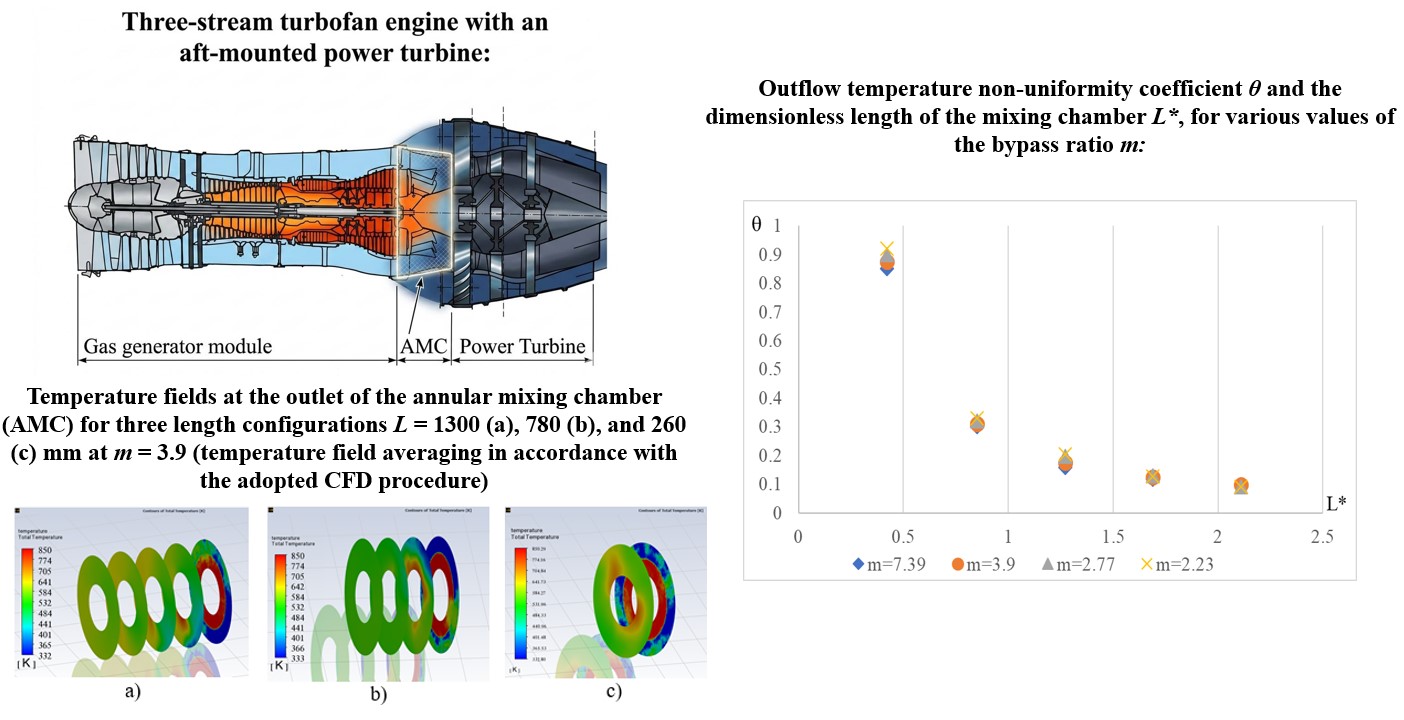
The object of the research is the annular mixing chamber of the pre-turbine duct of a three-stream aircraft turbofan engine, designed to enforce the mixing of hot and cold flows within a confined axial geometry, with particular emphasis on the gas-dynamic and thermal processes occurring within it. The research problem addressed in this research was the determination of the minimally required relative length of the mixing chamber. This length must ensure an acceptable level of temperature uniformity at the turbine inlet without increasing the overall dimensions of the propulsion system. This condition is particularly critical for compact engines, including propulsion systems for unmanned aerial vehicles. A series of three-dimensional CFD simulations was performed using ANSYS Fluent with a Reynolds stress model (RSM) for turbulence. The modeling was conducted for an annular chamber with fixed geometric parameters (D = 1107 mm, d = 492 mm) within a range of relative lengths L* = 0.42–2.11. The research covered four different engine operating conditions, varying in bypass ratio. The results revealed a clear nonlinear dependence of the temperature non-uniformity coefficient θ on the relative chamber length L*. It was found that for L* < 1.2, the mixing process remains incomplete, accompanied by a significant increase in temperature non-uniformity. In contrast, within the range L* = 1.2–1.7, nearly complete temperature equalization is achieved (θ ≤ 0.1). These results can be explained by the dominance of the turbulent mixing mechanism, as confirmed by low Richardson numbers (Ri << 1) and the minor influence of operating parameters compared to geometric factors. The findings can be applied in the design of compact mixing chambers for aircraft gas turbine engines, especially under strict constraints on their axial dimensions. This is particularly relevant for propulsion systems of unmanned aerial vehicles.
References
- Moirou, N. G. M., Sanders, D. S., Laskaridis, P. (2023). Advancements and prospects of boundary layer ingestion propulsion concepts. Progress in Aerospace Sciences, 138, 100897. https://doi.org/10.1016/j.paerosci.2023.100897
- Advanced Air Transport Technology Project. National Aeronautics and Space Administration. Available at: https://www.nasa.gov/directorates/armd/aavp/aatt/
- RTX Pratt & Whitney accelerates development of NGAP engine (2025). RTX. Available at: https://www.rtx.com/news/news-center/2025/09/23/rtxs-pratt-whitney-accelerates-development-of-ngap-engine
- Tereshchenko, Iu. M., Kulik, N. S., Lastivka, I. A. (2010). Teoriia aviatcionnykh trekhkonturnykh turboreaktivnykh dvigatelei. K.: Izd-vo Natc. aviatc. un-ta «NAU-druk». Available at: https://scholar.google.com/citations?view_op=view_citation&hl=ru&user=A67lffQAAAAJ&citation_for_view=A67lffQAAAAJ:YFjsv_pBGBYC
- Lefebvre, A. H., Ballal, D. R. (2010). Gas Turbine Combustion. CRC Press. https://doi.org/10.1201/9781420086058
- Moustapha, H., Zelesky, M. F., Baines, N. C., Japikse, D. (2003). Axial and radial turbines. Concepts Eti, 358.
- Chauhan, S., Wessley, G. J. J. (2025). Simulation-driven design of UAV Micro Gas Turbines: a dual-platform validation approach. Journal of Thermal Analysis and Calorimetry, 150 (19), 15751–15760. https://doi.org/10.1007/s10973-025-14894-2
- Abramovich, G. N.; Schindel, L. (Ed.) (2003). The Theory of Turbulent Jets. MIT Press. https://doi.org/10.7551/mitpress/6781.001.0001
- Hinze, J. O. (1975). Turbulence. McGraw-Hill College, 790.
- Pope, S. B. (2000). Turbulent Flows. Cambridge University Press. https://doi.org/10.1017/cbo9780511840531
- Karagozian, A. R. (2010). Transverse jets and their control. Progress in Energy and Combustion Science, 36 (5), 531–553. https://doi.org/10.1016/j.pecs.2010.01.001
- Vorobieff, P., Truman, C. R., Ragheb, A. M., Elliott, G. S., Laystrom-Woodard, J. K., King, D. M. et al. (2011). Mixing enhancement in a multi-stream injection nozzle. Experiments in Fluids, 51 (3), 711–722. https://doi.org/10.1007/s00348-011-1090-6
- Ren, D., Fan, W., Zhang, R. (2024). Experimental and numerical study on flow mixing and combustion characteristics of a novel multibypass integrated combustor. Physics of Fluids, 36 (4). https://doi.org/10.1063/5.0199051
- Goldsmith, E. L., Seddon, J. (1993). Practical intake aerodynamic design. American Institute of Aeronautics and Astronautics, 434. Available at: https://openlibrary.org/books/OL14752011M/Practical_intake_aerodynamic_design
- Casey, M., Wintergerste, T. (Eds.). (2000). ERCOFTAC best practice guidelines: Industrial computational fluid dynamics of single-phase flows. ERCOFTAC. Available at: https://www.ercoftac.org/publications/ercoftac_best_practice_guidelines/single-phase_flows_spf2-electronic-copy-/
- Yudin, I. (2025). Comparison of numerical simulation results of the mixing chamber with physical experiment data. Aerospace Technic and Technology, 4, 39–44. https://doi.org/10.32620/aktt.2025.4.06
Downloads
Published
How to Cite
Issue
Section
License
Copyright (c) 2026 Yurii Tereshchenko , Illia Yudin

This work is licensed under a Creative Commons Attribution 4.0 International License.
The consolidation and conditions for the transfer of copyright (identification of authorship) is carried out in the License Agreement. In particular, the authors reserve the right to the authorship of their manuscript and transfer the first publication of this work to the journal under the terms of the Creative Commons CC BY license. At the same time, they have the right to conclude on their own additional agreements concerning the non-exclusive distribution of the work in the form in which it was published by this journal, but provided that the link to the first publication of the article in this journal is preserved.