Determination of the influence of the method of introducing C₆₀ fullerenes and functionalized carbon nanotube on the formation of the properties of aluminum alloy
DOI:
https://doi.org/10.15587/2706-5448.2026.353175Keywords:
aluminum alloy AK12, fullerene C₆₀, carbon nanotubes, nanomodification, microstructure, hardnessAbstract
The object of research is the influence of carbon nanotubes and fullerene nanomaterials C60 when introduced into the aluminum alloy AK12 on the formation of the eutectic microstructure.
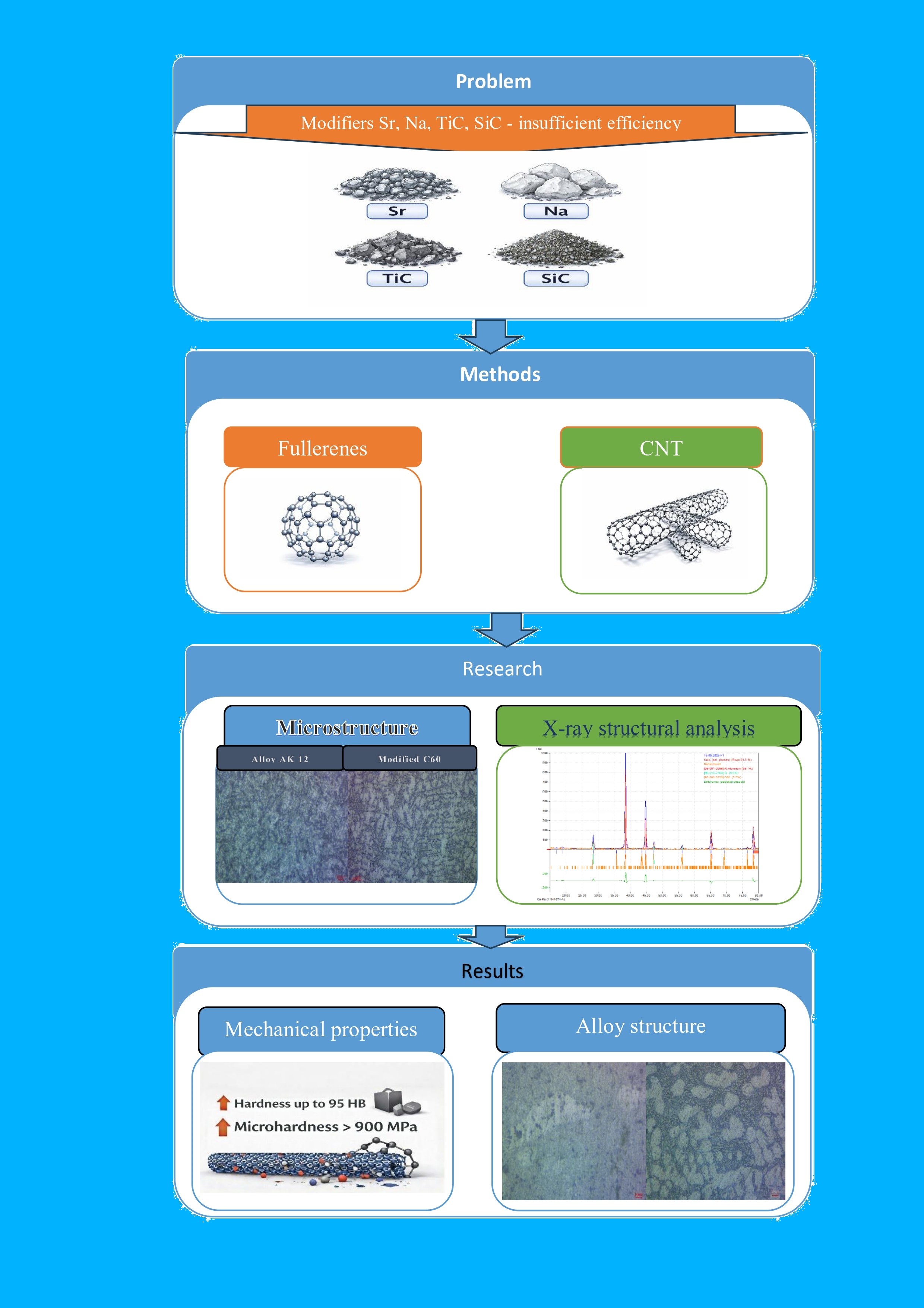
The problem solved during the research is the insufficient effectiveness of existing modifiers such as Sr, Na, TiC and SiC to improve silicon globularization, as well as the lack of simple and effective methods for introducing carbon nanomaterials.
In the work, two methods for introducing carbon nanoparticles into the aluminum alloy were developed. Improved silicon globularization, mechanical and physical properties were achieved. The thickness of the silicon dendritic axis was reduced to almost 20–25 microns, the size of silicon inclusions was reduced from 2–10 microns, and the microhardness was increased almost twice, depending on the method. The improvement of properties is due to the fact that nanoparticles become centers of crystal nucleation and do not allow them to grow, which leads to a finer, more homogeneous structure of the alloy. Pre-treatment of nanomaterials allows them to be evenly distributed in the alloy, and the addition of magnesium improves the wetting properties.
The features and distinctive features of the obtained results are that two technologically simple methods of introducing nanoparticles into the liquid AK12 alloy have been proposed, without the use of ultrasound. A significant improvement in the mechanical and physical properties of the alloy has been achieved compared to the reference AK12 alloy. Controlled grinding of the silicon structure has been ensured. Available materials and equipment, which are available in Ukraine and suitable for scaling up in industrial volumes, have been used. The modified AK12 alloy allows it to be used for the manufacture of castings of critical importance, such as pistons, transmission mechanisms, and engine housings.
References
- Singhal, V., Shelly, D., Babbar, A., Lee, S.-Y., Park, S.-J. (2024). Review of Wear and Mechanical Characteristics of Al-Si Alloy Matrix Composites Reinforced with Natural Minerals. Lubricants, 12 (10), 350. https://doi.org/10.3390/lubricants12100350
- Bin Reyaz, M. S., Singh, J., Bhati, S., Mehdi, H., Mishra, S. (2025). Examining the effect of multi-pass FSP on microstructure, texture, and mechanical properties of hybrid reinforced AA2024-T351 surface composites. Composite Interfaces, 33 (1), 87–110. https://doi.org/10.1080/09276440.2025.2514871
- Wu, Z., Yan, H., Han, Q., Chen, N., Peng, X., Wang, R., Cai, Z. (2026). Microstructure, thermo-physical and mechanical properties of heterogeneous Al/Al–70Si composites. Journal of Materials Research and Technology, 40, 392–403. https://doi.org/10.1016/j.jmrt.2025.12.074
- Nirala, A., Soren, S., Kumar, N., Khan, M. A., Islam, S., Khan, N. A. (2023). Micro-mechanical and tribological behavior of Al/SiC/B4C/CNT hybrid nanocomposite. Scientific Reports, 13 (1). https://doi.org/10.1038/s41598-023-39713-2
- Trenov, M. S., Ponomarenko, O. I., Kniaziev, S. A. (2025). Analysis of Methods for Introducing Nanoparticles into Aluminum-Based Alloys. Metal and Casting of Ukraine, 33 (1), 25–31. https://doi.org/10.15407/steelcast2025.01.025
- Lakhtakia, A. (Ed.). (2004). The Handbook of Nanotechnology. Nanometer Structures: Theory, Modeling, and Simulation. SPIE Press. https://doi.org/10.1117/3.537698
- Gleiter, H. (2000). Nanostructured materials: basic concepts and microstructure. Acta Materialia, 48 (1), 1–29. https://doi.org/10.1016/s1359-6454(99)00285-2
- Kroto, H. W., Heath, J. R., O’Brien, S. C., Curl, R. F., Smalley, R. E. (1985). C60: Buckminsterfullerene. Nature, 318 (6042), 162–163. https://doi.org/10.1038/318162a0
- Manika, I., Maniks, J., Kalnacs, J. (1997). Atmosphere-Induced Effect in Microhardness, Dislocation Mobility and Plasticity of C60and Graphite Crystals. Fullerene Science and Technology, 5 (1), 149–166. https://doi.org/10.1080/15363839708011979
- Trenov, M. S., Ponomarenko, O. I. (2025). Vykorystannia nanodyspersnykh materialiv dlia vdoskonalennia vlastyvostei aliuminiievykh splaviv u lyvarnomu vyrobnytstvi. Lytvo. Metalurhiia. 2025. Kharkiv; Kyiv: NTU «KhPI», 285–287. Available at: https://repository.kpi.kharkov.ua/handle/KhPI-Press/90592
- Sowrabh, B. S., Gurumurthy, B. M., Shivaprakash, Y. M., Sharma, S. S. (2021). Reinforcements, production techniques and property analysis of AA7075 matrix composites − a critical review. Manufacturing Review, 8, 31. https://doi.org/10.1051/mfreview/2021029
- Agarwal, S., Singh, S. (2024). Production techniques and properties of particulate reinforce metal matrix composites: a review. Materials Physics and Mechanics, 52 (6), 136–153.
- Trenov, M. S., Ponomarenko, O. I. (2024). Vykorystannia fulereniv u metalurhii. Lytvo. Metalurhiia. 2024. Kharkiv; Kyiv: NTU «KhPI», 255–256. Available at: https://repository.kpi.kharkov.ua/items/15f6524a-20cd-4a6e-8122-3a086f904570
- DSTU 2839-94. Splavy aliuminiievi lyvarni. Tekhnichni umovy (1994). Available at: https://online.budstandart.com/ua/catalog/doc-page.html?id_doc=50317
Downloads
Published
How to Cite
Issue
Section
License
Copyright (c) 2026 Mykola Trenov, Olga Ponomarenko

This work is licensed under a Creative Commons Attribution 4.0 International License.
The consolidation and conditions for the transfer of copyright (identification of authorship) is carried out in the License Agreement. In particular, the authors reserve the right to the authorship of their manuscript and transfer the first publication of this work to the journal under the terms of the Creative Commons CC BY license. At the same time, they have the right to conclude on their own additional agreements concerning the non-exclusive distribution of the work in the form in which it was published by this journal, but provided that the link to the first publication of the article in this journal is preserved.