Application of ultra-high frequency electromagnetic radiation energy to increase the efficiency of gas preparation processes in hydrate formation conditions
DOI:
https://doi.org/10.15587/2706-5448.2026.354467Keywords:
hydrates, low-temperature separation, microwave radiation, inhibitors, methanol, gas preparation, energy efficiencyAbstract
The effective operation of modern gas systems requires new approaches to combat hydrate plugs, which limit the flow and cause emergency shutdowns. The object of research is the process of formation and destruction of gas hydrates in industrial pipelines under the influence of microwave radiation. The research is aimed at solving the problem of excessive use of methanol to combat hydrates. This reagent is very toxic and expensive, and its real costs in the fields of Ukraine are often 15–20% higher than the norm due to outdated dosing methods.
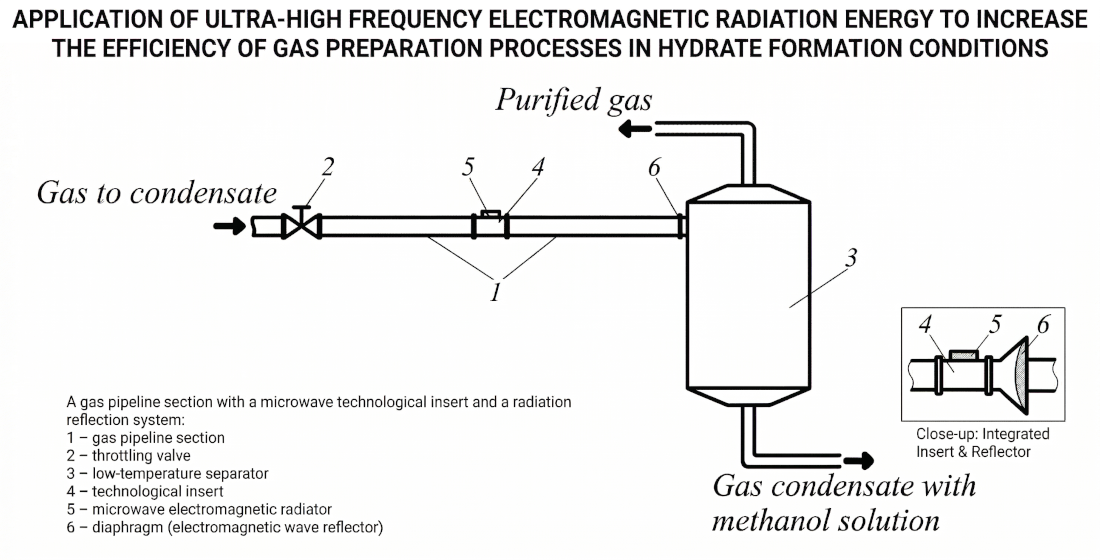
The results of the work are based on modeling the technological processes of the Machukhske field (Ukraine) in the Aspen HYSYS program. The most dangerous zone of hydrate formation was identified in a 20-meter section immediately after the throttle when the gas temperature drops to –30.11°C. To protect this unit, a new design of a removable insert with a magnetron has been developed, which provides thermodynamic decomposition of crystal hydrates by directly transferring the energy of the microwave field to water molecules in the flow volume.
A distinctive feature of the development is the creation of a resonant zone between the choke and the diaphragm, which allows concentrating the field and accelerating the dissociation of hydrates by 1.5–3 times compared to thermal heating. The optimized geometry of the diaphragm provides high wave reflection without a significant increase in the hydrodynamic resistance of the gas flow.
The practical value of the work lies in the possibility of integrating the developed design of the ultrahigh-frequency electromagnetic radiation device into low-temperature gas separation units and hydrocarbon collection systems with a complex temperature regime. The introduction of the device allows maintaining a stable hydrate-free mode of pipeline operation, reducing the consumption of chemical reagents and increasing the environmental safety of gas production in Ukrainian fields by minimizing the use of toxic methanol.
References
- Kutnyi, B., Krot, O., Chernetska, I. (2024). Intensification of Hydrate Formation by Microbubbles. Problems of the Regional Energetics, 4 (64), 200–213. https://doi.org/10.52254/1857-0070.2024.4-64.17
- Dmytrenko, V. I., Zezekalo, I. G., Vynnykov, Y. L. (2022). The use of bischofite in the gas industry as an inhibitor of hydrate formation. IOP Conference Series: Earth and Environmental Science, 1049 (1). https://doi.org/10.1088/1755-1315/1049/1/012052
- Kutnyi, B., Pavlenko, A., Cherednikova, O. (2023). Theoretical Foundations of Gas Hydrate Synthesis Intensification. Environmental and Climate Technologies, 27 (1), 666–682. https://doi.org/10.2478/rtuect-2023-0049
- Pedchenko, M., Pedchenko, N., Pedchenko, L. (2025). Reducing the man-made impact of hydrate formation inhibitors on the environment by applying gas hydrate technologies. IOP Conference Series: Earth and Environmental Science, 1491 (1). https://doi.org/10.1088/1755-1315/1491/1/012038
- Dmytrenko, V., Podoliak, T. (2024). Research of methanol content in technological flows of facilities that process gas preparation by low-temperature separation method. Technology Audit and Production Reserves, 6 (1 (80)), 46–53. https://doi.org/10.15587/2706-5448.2024.318926
- Dmytrenko, V., Zezekalo, I., Vynnykov, Y., Manhura, A. (2021). Efficiency evaluation of using highly mineralized reservoir waters for preventing hydrate formation of natural gas in the conditions of Zakhidno-Radchenkivske gas-condensate field. IOP Conference Series: Earth and Environmental Science, 628 (1). https://doi.org/10.1088/1755-1315/628/1/012015
- Obanijesu, E. O., Pareek, V., Gubner, R., Tade, M. O. (2011). Hydrate formation and its influence on natural gas pipeline internal corrosion. Nafta, 62 (5-6), 164–173. Available at: https://hrcak.srce.hr/file/104431
- Volovetskyi, V. B., Vytiaz, O. Yu., Shchyrba, O. M. (2010). Poperedzhennia vidkladannia hidrativ ta zbyrannia ridyny pid chas produvannia sverdlovyny ta shleifu. Rozvidka ta rozrobka naftovykh i hazovykh rodovyshch, 1 (34), 160–164. Available at: http://elar.nung.edu.ua/bitstream/123456789/4125/1/986p.pdf
- Sloan, E. D. (1998). Clathrate hydrates of natural gases. New York: Marcel Dekker, 705. Available at: https://www.abebooks.com/9780824799373/Clathrate-Hydrates-Natural-Gases-Second-0824799372/plp
- Fatykhov, M. A., Akchurina, V. A., Stolpovsky, M. V. (2020). Numbrigal simulation of a thermodynamic process to decompose gas hydrate in a gas production well using, radiofrequency electromagnetic radiation. IOP Conference Series: Materials Science and Engineering, 862 (6). https://doi.org/10.1088/1757-899x/862/6/062075
- Yang, H., Liu, X., Yue, J., Tang, X. (2022). Analysis of factors affecting microwave heating of natural gas hydrate combined with numerical simulation method. Petroleum, 8 (3), 391–402. https://doi.org/10.1016/j.petlm.2021.12.003
- Bera, A., Babadagli, T. (2017). Effect of native and injected nano-particles on the efficiency of heavy oil recovery by radio frequency electromagnetic heating. Journal of Petroleum Science and Engineering, 153, 244–256. https://doi.org/10.1016/j.petrol.2017.03.051
- Bondarenko, V. I., Sai, K. S., Hanushevych, K. A., Ovchynnikov, M. P. (2015). Rozrobka matematychnoi modeli intensyfikatsii protsesu hidratoutvorennia za rezultatamy eksperymentalnykh doslidzhen. Rozrobka rodovyshch, 9 (1), 259–266. Available at: https://rr.nmu.org.ua/pdf/2015/20150906-34.pdf
- Vysniauskas, A., Bishnoi, P. R. (1983). A kinetic study of methane hydrate formation. Chemical Engineering Science, 38 (7), 1061–1072. https://doi.org/10.1016/0009-2509(83)80027-x
- Pedchenko, M. M.; Biletskyi, V. S. (Ed.) (2014). Hidratoutvorennia vuhlevodnevykh haziv. Poltava: PoltNTU, 182. Available at: https://www.researchgate.net/publication/338117028_Pedcenko_MM_Gidratoutvorenna_vuglevodnevih_gaziv_monografia_MM_Pedcenko_za_red_VS_Bileckogo_-_Poltava_PoltNTU_2014_-_182_s_ISBN_978-966-616-129-4
- Balakirev, V. A., Sotnikov, G. V., Tkach, Yu. V., Yatsenko, T. Yu. (2001). Removal of asphalt-paraffin deposits in oil pipelines by a moving source of high-frequency electromagnetic radiation. Technical Physics, 46 (9), 1069–1075. https://doi.org/10.1134/1.1404155
- Fatykhov, M. A., Idrisov, R. I. (2007). Degassing of a hydrocarbon fluid in a high-frequency electromagnetic field. Journal of Engineering Physics and Thermophysics, 80 (3), 630–633. https://doi.org/10.1007/s10891-007-0083-z
- Fatykhov, M. A., Bagautdinov, N. Ya. (2005). Experimental Investigation of the Decomposition of a Nonpolar-Gas Hydrate in a Pipe Under the Action of a Microwave Electromagnetic Field. Journal of Engineering Physics and Thermophysics, 78 (3), 524–531. https://doi.org/10.1007/s10891-005-0090-x
- Sarmento, R. C., Ribbe, G. A. S., Azevedo, L. F. A. (2004). Wax Blockage Removal by Inductive Heating of Subsea Pipelines. Heat Transfer Engineering, 25 (7), 2–12. https://doi.org/10.1080/01457630490495797
- Li, D.-L., Liang, D.-Q., Fan, S.-S., Li, X.-S., Tang, L.-G., Huang, N.-S. (2008). In situ hydrate dissociation using microwave heating: Preliminary study. Energy Conversion and Management, 49 (8), 2207–2213. https://doi.org/10.1016/j.enconman.2008.01.031
- Tang, L. G., Xiao, R., Huang, C., Feng, Z. P., Fan, S. S. (2005). Experimental Investigation of Production Behavior of Gas Hydrate under Thermal Stimulation in Unconsolidated Sediment. Energy & Fuels, 19 (6), 2402–2407. https://doi.org/10.1021/ef050223g
- Khan, S. H., Misra, A. K., Majumder, C. B., Arora, A. (2020). Hydrate Dissociation Using Microwaves, Radio Frequency, Ultrasonic Radiation, and Plasma Techniques. ChemBioEng Reviews, 7 (4), 130–146. https://doi.org/10.1002/cben.202000004
- Wang, B., Dong, H., Fan, Z., Liu, S., Lv, X., Li, Q., Zhao, J. (2020). Numerical analysis of microwave stimulation for enhancing energy recovery from depressurized methane hydrate sediments. Applied Energy, 262. https://doi.org/10.1016/j.apenergy.2020.114559
- Fan, S., Wang, H., Zhang, X., Liu, Y., Lan, W., Ma, W. et al. (2024). Study on microwave heating energy supplement technology for gas hydrate reservoir. Energy, 286. https://doi.org/10.1016/j.energy.2023.129624
- Dreus, A. Y., Gubin, O. I., Bondarenko, V. I., Liu, B., Batuta, V. I. (2022). Numerical study of microwave impact on gas hydrate plugs in a pipeline. Naukovyi Visnyk Natsionalnoho Hirnychoho Universytetu, 4, 28–33. https://doi.org/10.33271/nvngu/2022-4/028
- Zhang, X., Guan, Y., Yue, C., Sun, Z., Guo, H., Zhang, Y., Wang, D., Wang, Y. (2026). Multiphysics modeling of synergistic microwave heating and nitrogen injection for methane hydrate recovery. Fuel, 410. https://doi.org/10.1016/j.fuel.2025.137880
- Wang, S., Zhu, Y., Bondarenko, V., Dreus, A., Liang, J., Liu, B. (2021). Design and numerical simulation of a microwave antenna with coaxial slots for preventing secondary formation of gas hydrate. E3S Web of Conferences, 230. https://doi.org/10.1051/e3sconf/202123001008
- Chong, Z. R., Yang, S. H. B., Babu, P., Linga, P., Li, X.-S. (2016). Review of natural gas hydrates as an energy resource: Prospects and challenges. Applied Energy, 162, 1633–1652. https://doi.org/10.1016/j.apenergy.2014.12.061
- Davletshina, M. R., Stolpovsky, M. V., Chiglintseva, A. S., Gimaltdinov, I. K. (2020). Features of decomposition of gas hydrate when exposed to microwave radiation. IOP Conference Series: Materials Science and Engineering, 919 (6). https://doi.org/10.1088/1757-899x/919/6/062071
- Pat. WO2018191743A1 (2018). Microwave antenna assembly and methods. Available at: https://patents.google.com/patent/WO2018191743A1/en
- Kondrat, O. R., Hutak, A. D. (2015). Energy efficient modification of a low-temperature gas separation plant. Naftohazova haluz Ukrainy, 5, 26–30. Available at: http://elar.nung.edu.ua/handle/123456789/317
Downloads
Published
How to Cite
Issue
Section
License
Copyright (c) 2026 Taras Podoliak, Victoriia Dmytrenko

This work is licensed under a Creative Commons Attribution 4.0 International License.
The consolidation and conditions for the transfer of copyright (identification of authorship) is carried out in the License Agreement. In particular, the authors reserve the right to the authorship of their manuscript and transfer the first publication of this work to the journal under the terms of the Creative Commons CC BY license. At the same time, they have the right to conclude on their own additional agreements concerning the non-exclusive distribution of the work in the form in which it was published by this journal, but provided that the link to the first publication of the article in this journal is preserved.