Development of an approach to forming a frame-based dictionary for the personalization of an educational chatbot
DOI:
https://doi.org/10.15587/2706-5448.2026.356218Keywords:
prompt engineering, personalized learning, flexible query construction, table of thematic representationsAbstract
The object of research is the process of functioning and using AI-based educational chatbots in the educational environment. The problem addressed in the research is the training of chatbots using dictionaries. The paper presents an approach to chatbot personalization through the use of a thematic dictionary and query adjustment with the help of prompts.
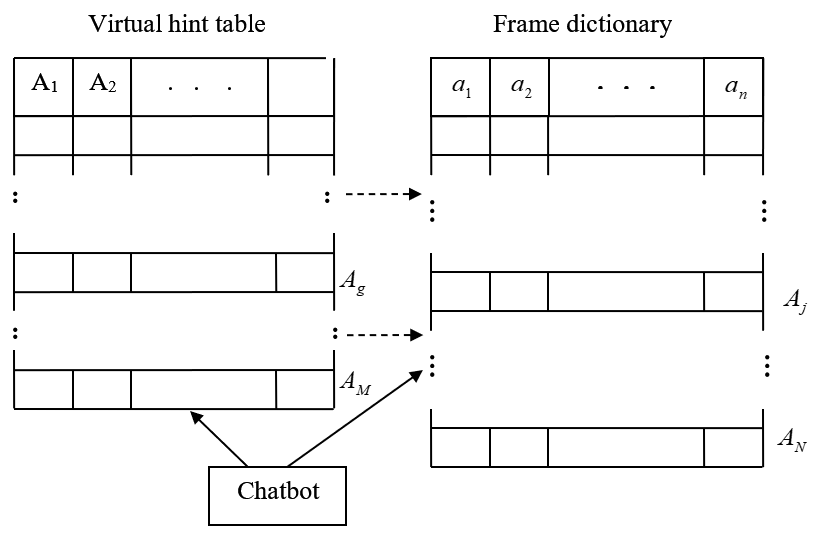
A frame-based model of a dictionary has been developed, which can be added to a chatbot as a PDF document. The frames represent the subject domain as a hierarchically organized system. User prompts and the processing of frame structures are integrated with the chatbot through thematic representations. This ensures flexible query formulation, scalability of dictionary resources, and the possibility of further expansion of the subject domain without violating the integrity of the language model.
Schemes for combining contextual projection of query interaction and dictionary search have been developed and substantiated. To implement prompts, an algorithm was designed based on the principle of a “marked bullet” selection of a term or expression. Chatbot personalization is achieved through the formation of a series of user-generated prompts.
Based on the results of experiments on adapting ChatGPT to users’ educational needs, frame-based dictionaries were implemented and tested. For the sequential dictionary implementation scheme, at an accuracy level of 10⁻⁶, the total computational complexity is approximately 4.67, while increasing the accuracy requirement to 10⁻⁸ reduces this value to 3.287. The hierarchical scheme, based on the frame organization of the dictionary and the use of TemaView, demonstrates comparable or lower complexity values (10⁻⁶ = 6.69 and 10⁻⁸ = 4.69).
The practical application lies in supporting the educational process through the use of personalized educational chatbots within learning systems.
References
- Fillmore, C. J. (1982). Frame semantics. Linguistics in the Morning Calm. Hanshin Publishing Company, 111–137. Available at: https://brenocon.com/Fillmore%201982_2up.pdf
- Ruppenhofer, J., Ellsworth, M., Petruck, M. R. L., Johnson, C. R., Scheffczyk, J. (2010). FrameNet II: Extended theory and practice. International Computer Science Institute. Available at: https://my.eng.utah.edu/~cs6961/papers/FrameNet_book.pdf
- Chundru, J. K., Poddar, R., Cao, J., Jiang, T. (2025). Do LLMs Encode Frame Semantics? Evidence from Frame Identification. Proceedings of the 2025 Conference on Empirical Methods in Natural Language Processing. Suzhou: Association for Computational Linguistics, 29476–29488. https://doi.org/10.18653/v1/2025.emnlp-main.1499
- Kryazhych, O., Ivanov, I., Iushchenko, K., Kupri, O., Vasenko, O., Riznyk, V. et al. (2025). Devising an approach to preventing information chaos in chat bots using generative artificial intelligence. Eastern-European Journal of Enterprise Technologies, 2 (2 (134)), 84–95. https://doi.org/10.15587/1729-4061.2025.324957
- Hase, P., Diab, M. T., Celikyilmaz, A., Li, X., Kozareva, Z., Stoyanov, V. et al. (2021). Do Language Models Have Beliefs? Methods for Detecting, Updating, and Visualizing Model Beliefs. ArXiv. Available at: https://www.semanticscholar.org/paper/Do-Language-Models-Have-Beliefs-Methods-for-and-Hase-Diab/4a247cbfca9dcf91e2da24e6d2d84601a9041a8f
- Millière, R., Buckner, C. (2024). A philosophical introduction to language models – Part I: Continuity with classic debates. arXiv. https://doi.org/10.48550/arXiv.2401.03910
- Li, Y., Qu, S., Shen, J., Min, S., Yu, Z. (2023). Curriculum-Driven Edubot: A Framework for Developing Language Learning Chatbots Through Synthesizing Conversational Data. arXiv. Available at: https://arxiv.org/abs/2309.16804
- Bayraktar, R., Sarıtürk, B., Elmas Erdem, M. (2024). Assessing Fine-Tuning Efficacy in LLMs: A Case Study with Learning Guidance Chatbots. International Journal of Innovative Science and Research Technology, 2461–2471. https://doi.org/10.38124/ijisrt/ijisrt24may1600
- Aldhafeeri, L., Aljumah, F., Thabyan, F., Alabbad, M., AlShahrani, S., Alanazi, F. et al. (2025). Generative AI Chatbots Across Domains: A Systematic Review. Applied Sciences, 15 (20), 11220. https://doi.org/10.3390/app152011220
- McGrath, C., Farazouli, A., Cerratto-Pargman, T. (2024). Generative AI chatbots in higher education: a review of an emerging research area. Higher Education, 89 (6), 1533–1549. https://doi.org/10.1007/s10734-024-01288-w
- Memarian, B., Doleck, T. (2024). Human-in-the-loop in artificial intelligence in education: A review and entity-relationship (ER) analysis. Computers in Human Behavior: Artificial Humans, 2 (1), 100053. https://doi.org/10.1016/j.chbah.2024.100053
- Wölfel, M., Shirzad, M. B., Reich, A., Anderer, K. (2023). Knowledge-Based and Generative-AI-Driven Pedagogical Conversational Agents: A Comparative Study of Grice’s Cooperative Principles and Trust. Big Data and Cognitive Computing, 8 (1), 2. https://doi.org/10.3390/bdcc8010002
- Peng, B., Galley, M., He, P., Cheng, H., Xie, Y., Hu, Y. et al. (2023). Check Your Facts and Try Again: Improving Large Language Models with External Knowledge and Automated Feedback. arXiv. https://doi.org/10.48550/arXiv.2302.12813
- Gao, Y., Xiong, Y., Gao, X., Jia, K., Pan, J., Bi, Y. et al. (2023). Retrieval-Augmented Generation for Large Language Models: A Survey. arXiv. https://doi.org/10.48550/arXiv.2312.10997
- El mourabit, I., Jai Andaloussi, S., Ouchetto, O., Miyara, M. (2025). AI Chatbots in Higher Education: Opportunities and Challenges for Personalized and Mobile Learning. International Journal of Interactive Mobile Technologies (IJIM), 19 (12), 19–37. https://doi.org/10.3991/ijim.v19i12.54163
- Chen, D.-L., Aaltonen, K., Lampela, H., Kujala, J. (2024). The Design and Implementation of an Educational Chatbot with Personalized Adaptive Learning Features for Project Management Training. Technology, Knowledge and Learning, 30 (2), 1047–1072. https://doi.org/10.1007/s10758-024-09807-5
- Davar, N. F., Dewan, M. A. A., Zhang, X. (2025). AI Chatbots in Education: Challenges and Opportunities. Information, 16 (3), 235. https://doi.org/10.3390/info16030235
- Labadze, L., Grigolia, M., Machaidze, L. (2023). Role of AI chatbots in education: systematic literature review. International Journal of Educational Technology in Higher Education, 20 (1). https://doi.org/10.1186/s41239-023-00426-1
- Huang, Q., Liu, X., Ko, T., Wu, B., Wang, W., Zhang, Y. et al. (2024). Selective Prompting Tuning for Personalized Conversations with LLMs. Findings of the Association for Computational Linguistics ACL 2024, 16212–16226. https://doi.org/10.18653/v1/2024.findings-acl.959
- Raj, K., Roy, K., Bonagiri, V., Govil, P., Thirunarayan, K., Goswami, R. et al. (2024). K-PERM: Personalized Response Generation Using Dynamic Knowledge Retrieval and Persona-Adaptive Queries. Proceedings of the AAAI Symposium Series, 3 (1), 219–226. https://doi.org/10.1609/aaaiss.v3i1.31203
- Krouska, A., Troussas, C., Voyiatzis, I., Mylonas, P., Sgouropoulou, C. (2024). ChatGPT-based Recommendations for Personalized Content Creation and Instructional Design with a Tailored Prompt Generator. 2024 2nd International Conference on Foundation and Large Language Models (FLLM). Dubai: IEEE, 295–299. https://doi.org/10.1109/fllm63129.2024.10852487
Downloads
Published
How to Cite
Issue
Section
License
Copyright (c) 2026 Olha Kryazhych, Vasyl Vasenko, Oleksandr Vasenko, Anastasiia Pavlenko, Kateryna Iushchenko

This work is licensed under a Creative Commons Attribution 4.0 International License.
The consolidation and conditions for the transfer of copyright (identification of authorship) is carried out in the License Agreement. In particular, the authors reserve the right to the authorship of their manuscript and transfer the first publication of this work to the journal under the terms of the Creative Commons CC BY license. At the same time, they have the right to conclude on their own additional agreements concerning the non-exclusive distribution of the work in the form in which it was published by this journal, but provided that the link to the first publication of the article in this journal is preserved.