Development of a method for adaptation of radioacoustic sounding systems of the atmosphere to the meteorological conditions
DOI:
https://doi.org/10.15587/2706-5448.2026.356834Keywords:
radioacoustic sounding of the atmosphere, Bragg condition, frequency adaptation, stochastic control, sounding signalAbstract
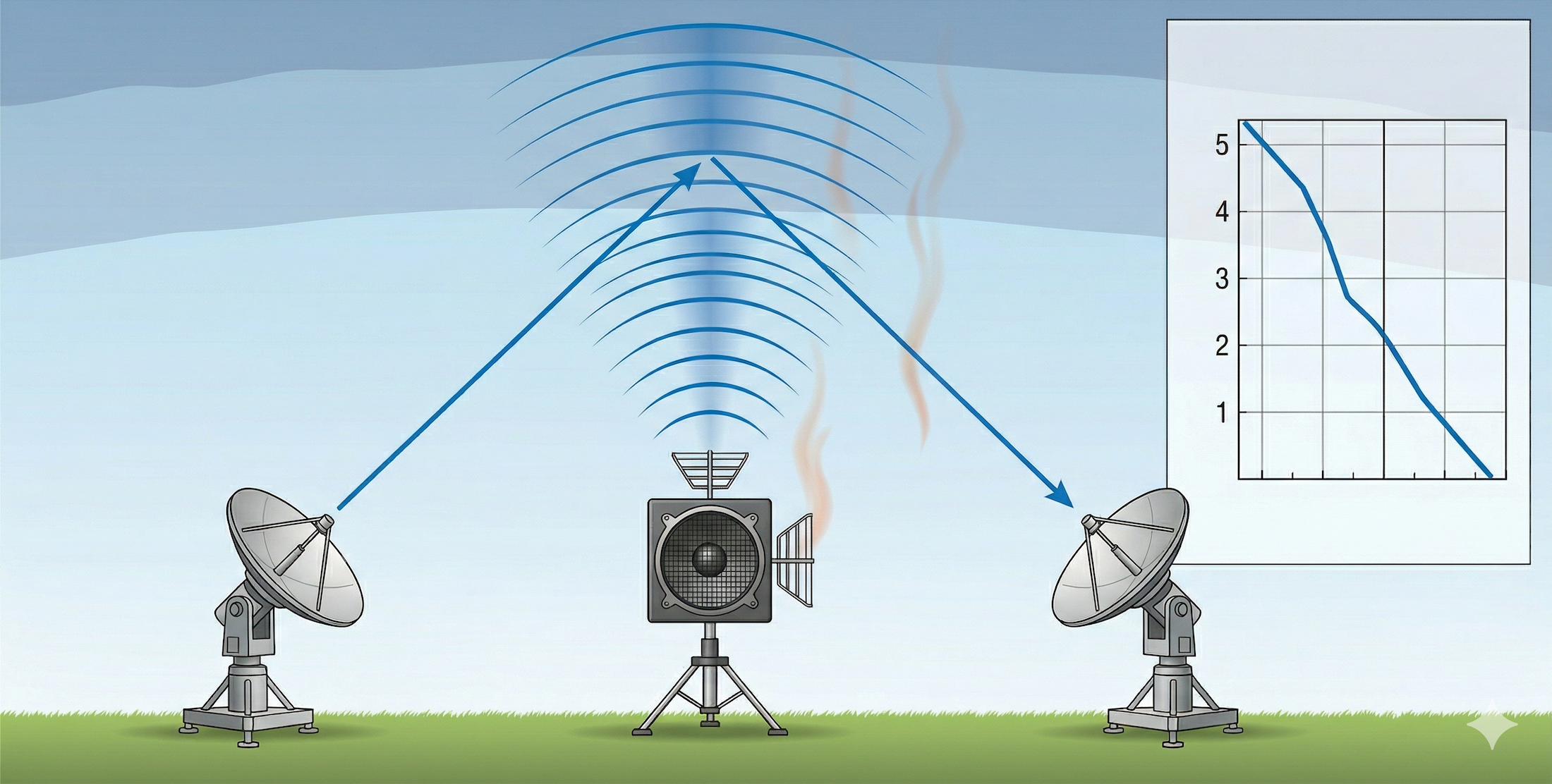
The object of research is the process of ensuring the Bragg condition between the lengths of acoustic and electromagnetic waves when measuring the altitude profiles of the atmosphere using the radioacoustic sounding (RAS) method.
The problem solved in the work is the lack of a generalized theoretical basis for developing methods for adapting RAS systems to maintain the Bragg condition during the movement of the acoustic wave packet (AWP) in the atmosphere.
In the work, using the theory of stochastic optimal control, a method for frequency adaptation of RAS systems was developed to ensure the Bragg condition along the sounding path. The method includes the operations of estimating the speed of sound, stochastic linear filtering of the AWP state parameter vector and controlling the frequency of the radio signal based on the obtained data. A method for estimating the information parameters of the signal was proposed, and an algorithm for sequential filtering of AWP parameters was developed.
The developed frequency adaptation method will significantly improve the quality indicators of RAS systems – the accuracy of measuring atmospheric temperature profiles and the efficiency of sounding. The use of the method in practice will also allow to increase the range of sounding systems by more effectively adjusting to the Bragg conditions at small values of the signal-to-noise ratio, characteristic of long ranges.
The improvement of the main characteristics of the systems is achieved by more accurately ensuring the Bragg condition in the process of measuring the sound speed values, as a result of which the measurement results do not have systematic errors, and the random component of errors is significantly reduced. Therefore, the averaging time of individual measurement results to achieve the required integral accuracy of estimating the atmospheric temperature profile is significantly reduced, from tens to units of minutes.
The proposed method can be implemented in practice by improving the existing RAS atmospheric systems manufactured by industry.
References
- Emeis, S. (2021). Sodar and RASS. Springer Handbook of Atmospheric Measurements. Cham: Springer, 661–681. https://doi.org/10.1007/978-3-030-52171-4_23
- Bradley, S. (2007). Atmosphere Acoustic Remote Sensing. Principes and Application. CRC Press, 267. Available at: https://www.taylorfrancis.com/books/mono/10.1201/9781420005288/atmospheric-acoustic-remote-sensing-stuart-bradley
- Kartashov, V., Babkin, S., Kartashov, A., Pershyn, Y. (2023). Development of the Atmosphere Radio-Acoustic Sounding Method in Ukraine and in the World in the Period of 1961-2000. 2023 IEEE International Conference on Information and Telecommunication Technologies and Radio Electronics (UkrMiCo). Kyiv, 372–376. https://doi.org/10.1109/ukrmico61577.2023.10380339
- Emeis, S. (2011). Surface-Based Remote Sensing of the Atmospheric Boundary Layer. Berlin, Heidelberg: Springer, 175. https://doi.org/10.1007/978-90-481-9340-0
- Garcia-Benadi, A., Bech, J., Udina, M., Campistron, B., Paci, A. (2022). Multiple Characteristics of Precipitation Inferred from Wind Profiler Radar Doppler Spectra. Remote Sensing, 14 (19), 5023. https://doi.org/10.3390/rs14195023
- Thampy, B. P., Judy, M. V., Kottayil, A. (2023). Wind profiler Doppler power spectrum segmentation using U-Net. 2023 International Conference on Advances in Intelligent Computing and Applications (AICAPS), 1–6. https://doi.org/10.1109/aicaps57044.2023.10074415
- Lataitis, R. J. (1993). Theory and Application of a radio-acoustic sounding system (RASS): NOAA Technical Memorandum ERL WPL-230. Nat. Oceanic and Atmos. Admin. Environ, Res. Labs. Boulder, CO, 207. Available at: https://repository.library.noaa.gov/view/noaa/32558
- Lehmann, V., Brown, W.; Foken, T. (Ed.) (2021). Radar Wind Profiler. Springer Handbook of Atmospheric Measurements. Cham: Springer, 901–933. https://doi.org/10.1007/978-3-030-52171-4_31
- Kartashov, V. M., Babkin, S. I., Tolstykh, Y. G., Lepeha, N. G. (2016). Systematic errors in measurement of meteorological variables in correlation processing of signal of radio acoustic sounding systems. Telecommunications and Radio Engineering, 75 (9), 835–843. https://doi.org/10.1615/telecomradeng.v75.i9.80
- Temperature Profiler RASS. Metek. Available at: https://metek.de/product-group/rass/ Last accessed: 18.11.2025
- Overview. RASS (Radio Acoustic Sounding System) addition to the SODAR PCS2000. Available at: https://www.biral.com/product/rass-sodar-pcs2000/#product-overview Last accessed: 18.11.2025
- Remtech Radio Acoustic Sounding System (RASS) for remote sensing of temperature. RASS. Available at: https://remtechinc.com/wp-content/uploads/RASS3.pdf Last accessed: 18.03.2025
- Remtech PA-0 SODAR acoustic wind profiler. PA-0. Available at: https://remtechinc.com/wp-content/uploads/PA-0.pdf Last accessed: 18.11.2025
- RASS for Radar Wind Profilers. Available at: https://www.scintec.com/catalogs/rass-for-radar-wind-profilers/ Last accessed: 18.11.2025
- RASS for Sodar Wind Profilers. Available at: https://www.scintec.com/catalogs/rass-for-sodar-wind-profilers/ Last accessed: 18.11.2025
- Lindenberg column. DWD. Available at: https://www.dwd.de/EN/research/observing_atmosphere/lindenberg_column/lindenberg_column_node.html;jsessionid=8458988E48142AB0B4F55375227909C7.live11054 Last accessed: 18.11.2025
- Skolnik, I. M. (2008). Radar Handbook. New York: McGraw-Hill Education, 1328. Available at: https://ftp.idu.ac.id/wp-content/uploads/ebook/tdg/ADNVANCED%20MILITARY%20PLATFORM%20DESIGN/Radar%20Handbook.pdf
- Terrell, W. J. (1999). Some Fundamental Control Theory II: Feedback Linearization of Single Input Nonlinear Systems. The American Mathematical Monthly, 106 (9), 812–828. https://doi.org/10.1080/00029890.1999.12005126
- Kychak, V. M., Volovyk, A. Yu., Shutylo, M. A., Chervak, O. P. (2018). Radiotekhnichni systemy (Osnovy proektuvannia. Chastyna 1). Vinnytsia: VNTU, 122. Available at: http://pdf.lib.vntu.edu.ua/books/IRVC/Kichak_P1_2018_122.pdf
- Kartashov, V. M., Babkin, S. I., Kushnir, M. K., Oleinikova, E. I. (2015). Formation of empirical and methodical foundations of science in the field of atmosphere radioacoustic sounding systems. Telecommunications and Radio Engineering, 74 (15), 1391–1407. https://doi.org/10.1615/telecomradeng.v74.i15.70
- Dorf, R. C., Bishop, R. H. (2022). Modern Control Systems. Pearson, 512. Available at: https://studylib.net/doc/27877119/modern-control-systems-book
- Kartashov, V. M. (2003). Signal Scattering Functions of Atmospheric Sounding Systems. Telecommunications and Radio Engineering, 59 (7-9). https://doi.org/10.1615/telecomradeng.v59.i7-9.70
- Kartashov, V. M., Tikhonov, V. A., Voronin, V. V., Tymoshenko, L. P. (2016). Complex models of random signals in problems of acoustic sounding of atmosphere. Telecommunications and Radio Engineering, 75 (20), 1885–1892. https://doi.org/10.1615/telecomradeng.v75.i20.80
- Kartashov, V. M., Tikhonov, V. A., Voronin, V. V. (2017). Features of construction and application of complex systems for the atmosphere remote sounding. Telecommunications and Radio Engineering, 76 (8), 743–749. https://doi.org/10.1615/telecomradeng.v76.i8.70
- Oleynikov, V. N., Zubkov, O. V., Kartashov, V. M., Korytsev, I. V., Babkin, S. I., Sheiko, S. A. (2019). Investigation of detection and recognition efficiency of small unmanned aerial vehicles on their acoustic radiation. Telecommunications and Radio Engineering, 78 (9), 759–770. https://doi.org/10.1615/telecomradeng.v78.i9.20
- Semenets, V. V., Kartashov, V. M., Leonidov, V. I. (2018). Registration of refraction phenomenon in the problem of acoustic sounding of atmosphere in airports zone. Telecommunications and Radio Engineering, 77 (5), 461–468. https://doi.org/10.1615/telecomradeng.v77.i5.90
- Muradyan, P., Coulter, R. (2020). Radar Wind Profiler (RWP) and Radio Acoustic Sounding System (RASS) Instrument Handbook. Environmental Science Division, Argonne National Laboratory, 20. Available at: https://www.arm.gov/publications/tech_reports/handbooks/rwp_handbook.pdf Last accessed: 14.11.2025
Downloads
Published
How to Cite
Issue
Section
License
Copyright (c) 2026 Volodymyr Kartashov, Igor Kondrashov, Oleksandr Kartashov, Roman Bobniev, Anton Shamrai

This work is licensed under a Creative Commons Attribution 4.0 International License.
The consolidation and conditions for the transfer of copyright (identification of authorship) is carried out in the License Agreement. In particular, the authors reserve the right to the authorship of their manuscript and transfer the first publication of this work to the journal under the terms of the Creative Commons CC BY license. At the same time, they have the right to conclude on their own additional agreements concerning the non-exclusive distribution of the work in the form in which it was published by this journal, but provided that the link to the first publication of the article in this journal is preserved.