Proof-of-Indicators: development and validation of an adaptive consensus mechanism for Internet of Things blockchain networks
DOI:
https://doi.org/10.15587/2706-5448.2026.356851Keywords:
proof-of-authority, decentralized networks, embedded systems, node selection, block size optimizationAbstract
The object of this research is the consensus mechanism in blockchain networks for the Internet of Things (IoT). The expansion of IoT requires a decentralized approach, making blockchain a promising solution. The Proof of Authority (PoA) consensus protocol was identified as the most suitable base for heterogeneous IoT, however, it has limitations regarding fork occurrence, data duplication, and the signer selection process.
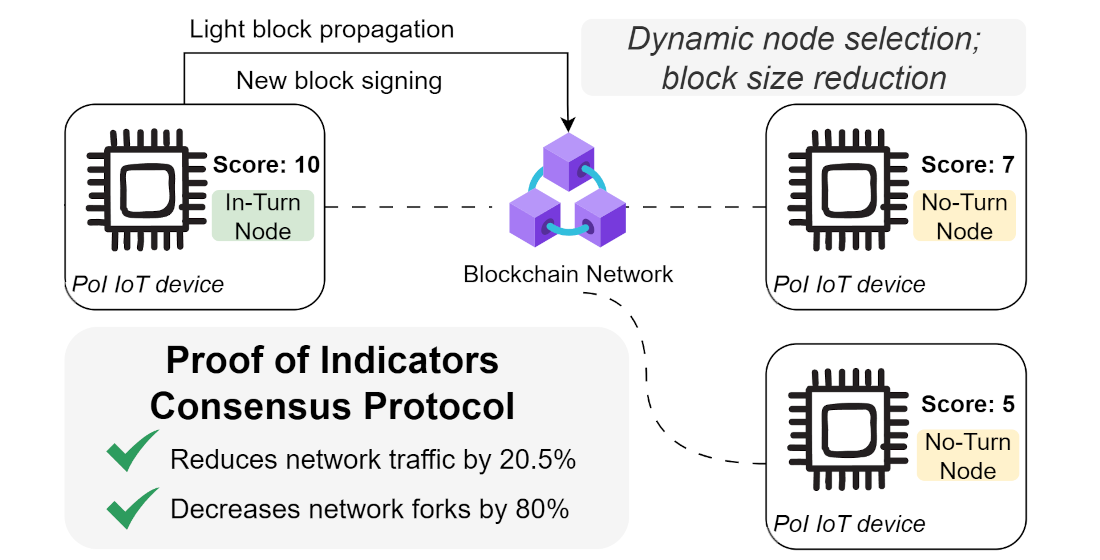
The obtained results include the creation of the Proof of Indicators (PoI) consensus protocol that optimizes IoT network by reducing block size and prioritizing capable nodes for consensus tasks for devices with different performance and network conditions. PoI is based on Go-Ethereum's PoA Clique implementation; and a comparative performance analysis was conducted between PoI and Clique in a simulated IoT network.
Testing shows that PoI reduces overall network traffic by 20.5% and decreases network forks by 80%. Under testing, PoI improves transaction throughput and decreases block propagation time, compared to Clique. These gains occur with a modest increase in resource consumption: an average rise of 6.5% in CPU usage and 5.4% in memory usage.
A distinctive feature of this work is combining dynamic node selection with light block propagation within the blockchain consensus layer to address previously found limitations.
The PoI system is a suitable solution for secure and purpose-specific blockchain application in IoT, where blockchain node can be hosted on low-powered devices, such as the Raspberry Pi, creating a fully decentralized cloud-independent infrastructure.
References
- Minerva, R., Biru, A., Rotondi, D. (2015). Towards a definition of the Internet of Things (IoT). IEEE Internet Initiative.
- Kuchuk, H., Malokhvii, E. (2024). Integration of IoT with cloud, fog, and edge computing: a review. Advanced Information Systems, 8 (2), 65–78. https://doi.org/10.20998/2522-9052.2024.2.08
- Hossain, M., Kayas, G., Hasan, R., Skjellum, A., Noor, S., Islam, S. M. R. (2024). A Holistic Analysis of Internet of Things (IoT) Security: Principles, Practices, and New Perspectives. Future Internet, 16 (2), 40. https://doi.org/10.3390/fi16020040
- Cao, K., Liu, Y., Meng, G., Sun, Q. (2020). An Overview on Edge Computing Research. IEEE Access, 8, 85714–85728. https://doi.org/10.1109/access.2020.2991734
- Miller, R., Whelan, H., Chrubasik, M., Whittaker, D., Duncan, P., Gregório, J. (2024). A Framework for Current and New Data Quality Dimensions: An Overview. Data, 9 (12), 151. https://doi.org/10.3390/data9120151
- Ullah, I., Havinga, P. J. M. (2023). Governance of a Blockchain-Enabled IoT Ecosystem: A Variable Geometry Approach. Sensors, 23 (22), 9031. https://doi.org/10.3390/s23229031
- Susnjara, S., Smalley, I. What is blockchain? IBM. Available at: https://www.ibm.com/topics/blockchain
- Upadhyay, V., Vaish, A., Kokila, J. (2024). The need for Lightweight Consensus algorithms in IoT environment: A review. Proceedings of the 2024 Sixteenth International Conference on Contemporary Computing. ACM, 366–376. https://doi.org/10.1145/3675888.3676072
- Lin, S.-Y., Zhang, L., Li, J., Ji, L., Sun, Y. (2022). A survey of application research based on blockchain smart contract. Wireless Networks, 28 (2), 635–690. https://doi.org/10.1007/s11276-021-02874-x
- Ahmad, A., Alabduljabbar, A., Saad, M., Nyang, D., Kim, J., Mohaisen, D. (2021). Empirically comparing the performance of blockchain’s consensus algorithms. IET Blockchain, 1 (1), 56–64. https://doi.org/10.1049/blc2.12007
- Islam, Md. M., Merlec, M. M., In, H. P. (2022). A Comparative Analysis of Proof-of-Authority Consensus Algorithms: Aura vs Clique. 2022 IEEE International Conference on Services Computing (SCC). IEEE, 327–332. https://doi.org/10.1109/scc55611.2022.00054
- Szilágyi, P. (2017). EIP-225: Clique proof-of-authority consensus protocol. Ethereum Improvement Proposals. Available at: https://eips.ethereum.org/EIPS/eip-225
- Kopanitsa. Web3 Arduino: An Arduino (or ESP32) library to use web3 on Ethereum platform. GitHub. Available at: https://github.com/kopanitsa/web3-arduino
- Almudayni, Z., Soh, B., Samra, H., Li, A. (2025). Energy Inefficiency in IoT Networks: Causes, Impact, and a Strategic Framework for Sustainable Optimisation. Electronics, 14 (1), 159. https://doi.org/10.3390/electronics14010159
- Verma, L. P., Kumar, G., Khalaf, O. I., Wong, W.-K., Hamad, A. A., Rawat, S. S. (2024). Adaptive congestion control in IoT networks: Leveraging one-way delay for enhanced performance. Heliyon, 10 (22), e40266. https://doi.org/10.1016/j.heliyon.2024.e40266
- Gordieiev, O., Rainer, A., Kharchenko, V., Pishchukhina, O., Gordieieva, D. (2024). A Unified Approach to the Development of Technology-Based Software Quality Models on the Example of Blockchain Systems. IEEE Access, 12, 118875–118889. https://doi.org/10.1109/access.2024.3448271
- Hemminger, S. (2011). Tc-netem – Linux manual page. Linux Foundation. Available at: https://man7.org/linux/man-pages/man8/tc-netem.8.html
- Albrecht, H. (2023). Introduction. Edgeshark. Siemens. Available at: https://edgeshark.siemens.io
- Combs, G. Wireshark: Network protocol analyzer. Wireshark Foundation.
- Alasmar, M., Clegg, R., Zakhleniuk, N., Parisis, G. (2021). Internet Traffic Volumes are Not Gaussian – They are Log-Normal: An 18-Year Longitudinal Study With Implications for Modelling and Prediction. IEEE/ACM Transactions on Networking, 29 (3), 1266–1279. https://doi.org/10.1109/tnet.2021.3059542
Downloads
Published
How to Cite
Issue
Section
License
Copyright (c) 2026 Leonid Chepel, Yuriy Boyko

This work is licensed under a Creative Commons Attribution 4.0 International License.
The consolidation and conditions for the transfer of copyright (identification of authorship) is carried out in the License Agreement. In particular, the authors reserve the right to the authorship of their manuscript and transfer the first publication of this work to the journal under the terms of the Creative Commons CC BY license. At the same time, they have the right to conclude on their own additional agreements concerning the non-exclusive distribution of the work in the form in which it was published by this journal, but provided that the link to the first publication of the article in this journal is preserved.