Development of methods for overcoming self-oscillatory modes in an asynchronous electric drive with a thyristor voltage regulator
DOI:
https://doi.org/10.15587/2706-5448.2026.358421Keywords:
starting devices, self-oscillation modes, controlled reactor compensator, simulation modelingAbstract
The object of research is the processes of electromagnetic transformation in powerful asynchronous electric drives during controlled starting using a thyristor voltage regulator.
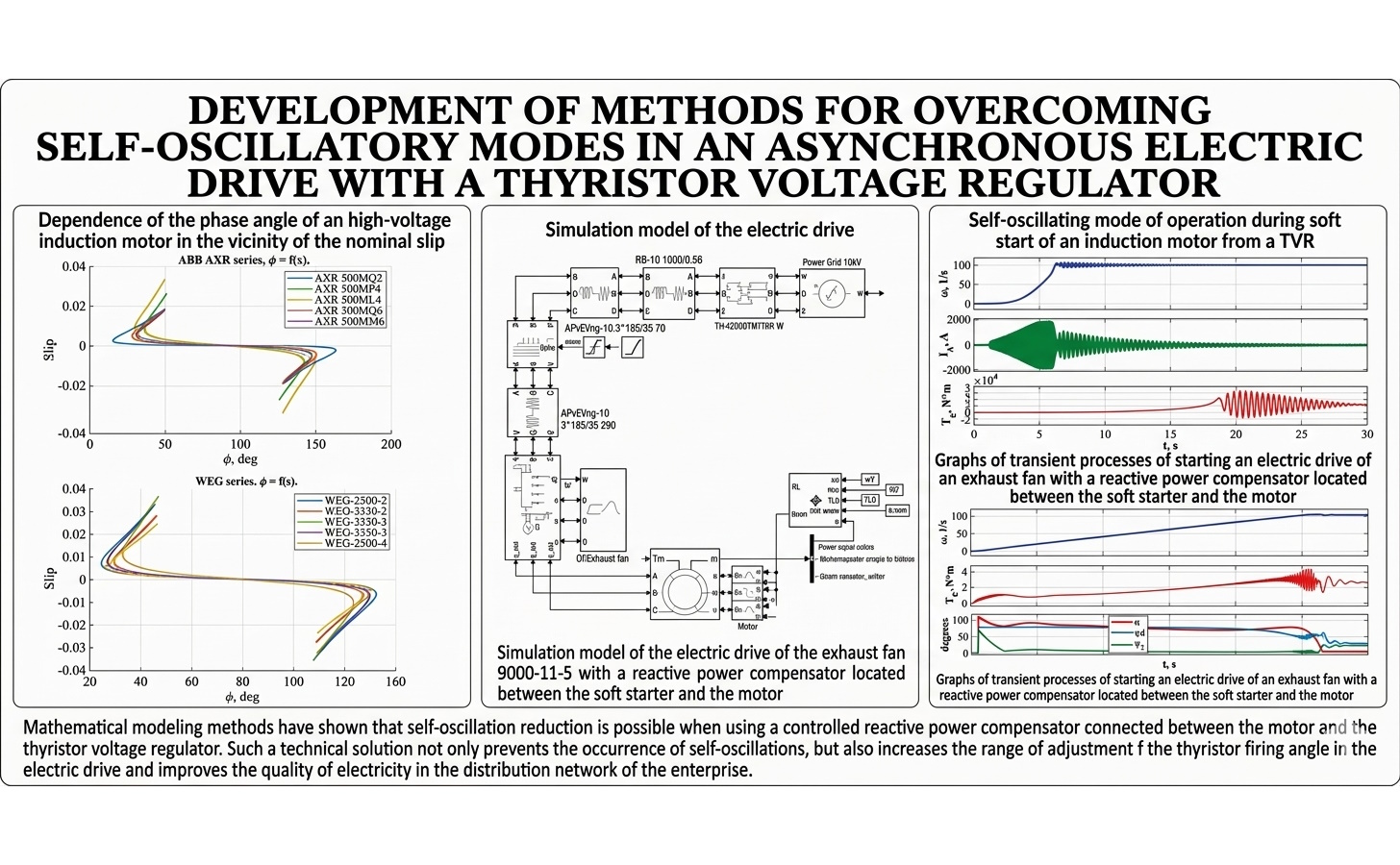
The problem to be solved by the research is overcoming the self-oscillating modes of powerful high-voltage asynchronous electric drives during controlled starting in the nominal slip range.
A design feature of powerful high-voltage induction motors in comparison with general-purpose motors is a small value (up to 1%) of the nominal slip. Also, such electric motors have a relatively small value of their own moment of inertia. These features create conditions for the occurrence of self-oscillations when entering a steady-state operating mode.
A mathematical model of an induction motor has been developed taking into account the influence of the rotor current displacement phenomenon to study the modes of controlled starting of an asynchronous electric drive of an industrial mechanism taking into account the influence of the enterprise's distribution network.
From the point of view of the power supply network, an induction motor is a nonlinear active-inductive resistance, the phase angle of which can quickly change over a wide range in the vicinity of the nominal slip. The mechanism of the occurrence of self-oscillations during controlled start-up of high-voltage induction motors from a thyristor voltage regulator is disclosed. Self-oscillations occur in the nominal slip region due to the transition of the thyristor voltage regulator to an uncontrolled operating mode, when the load phase angle becomes greater than the thyristor control angle, including in the quasi-generator operating mode.
To prevent the occurrence of self-oscillation modes, it is proposed to use a controlled reactive power compensator between the motor and the thyristor voltage regulator, which stabilizes the total load phase angle, which helps to improve the controllability of the electric drive.
References
- Tan, O. T., Paap, G. C., Kolluru, M. S. (1993). Thyristor-controlled voltage regulators for critical induction motor loads during voltage disturbances. IEEE Transactions on Energy Conversion, 8 (1), 100–106. https://doi.org/10.1109/60.207412
- Soft Starter Market (2024–2030). Grand View Research. Available at: https://www.grandviewresearch.com/industry-analysis/soft-starter-market-report
- Thanyaphirak, V., Kinnares, V., Kunakorn, A. (2017). Comparison of Starting Current Characteristics for Three-Phase Induction Motor Due to Phase-control Soft Starter and Asynchronous PWM AC Chopper. Journal of Electrical Engineering and Technology, 12 (3), 1090–1100. https://doi.org/10.5370/jeet.2017.12.3.1090
- Antonino-Daviu, J. A., Corral-Hernandez, J., Resina-Munoz, E., Climente-Alarcon, V. (2015). A study of the harmonics introduced by soft-starters in the induction motor starting current using continuous time-frequency transforms. 2015 IEEE 13th International Conference on Industrial Informatics (INDIN). Cambridge: IEEE, 777–781. https://doi.org/10.1109/indin.2015.7281835
- Zhou, J., Sun, X., Sirat, A. P., Mu, Q., Wang, Y., Zhao, T. (2024). Optimized Soft Starting of SiC MOSFET-Based Soft Starter with Constant Transient Current for Motor Control Center Applications. IECON 2024–50th Annual Conference of the IEEE Industrial Electronics Society. Chicago: IEEE, 1–6. https://doi.org/10.1109/iecon55916.2024.10905667
- Tytiuk, V., Rozhnenko, Z., Baranovska, M., Berdai, A., Chornyi, O., Saravas, V. (2020). Soft Starters of Powerful Electric Motors and Economic Aspects of Their Application. 2020 IEEE Problems of Automated Electrodrive. Theory and Practice (PAEP). Kremenchuk: IEEE. https://doi.org/10.1109/paep49887.2020.9240859
- Sundareswaran, K., Jos, B. M. (2005). Development and analysis of novel soft-starter/energy-saver topology for delta-connected induction motors. IEE Proceedings – Electric Power Applications, 152 (4), 922–932. https://doi.org/10.1049/ip-epa:20050091
- Deraz, S. A., Azazi, H. Z. (2017). Current limiting soft starter for three phase induction motor drive system using PWM AC chopper. IET Power Electronics, 10 (11), 1298–1306. https://doi.org/10.1049/iet-pel.2016.0762
- Dinolova, P., Ruseva, V., Dinolov, O. (2023). Energy Efficiency of Induction Motor Drives: State of the Art, Analysis and Recommendations. Energies, 16 (20), 7136. https://doi.org/10.3390/en16207136
- Dems, M., Majer, K., Komeza, K. (2025). Optimization of Induction Motor Control to Limit the Maximum Current and Torque During Voltage Start-Up Using FEM and Analytical Simulation. Energies, 19 (1), 240. https://doi.org/10.3390/en19010240
- Busher, V., Chornyi, O., Tytiuk, V., Glazeva, O., Shestaka, A., Melnikova, L. (2023). Research of Electromagnetic and Electromechanical Processes in High-Voltage Soft Start Devices with Gate Turn-Off Thyristors. 2023 IEEE 5th International Conference on Modern Electrical and Energy System (MEES). Kremenchuk: IEEE, 1–5. https://doi.org/10.1109/mees61502.2023.10402382
- Jiang, F., Tu, C., Guo, Q., Wu, Z., Li, Y. (2019). Adaptive soft starter for a three‐phase induction‐motor driving device using a multifunctional series compensator. IET Electric Power Applications, 13 (7), 977–983. https://doi.org/10.1049/iet-epa.2018.5079
- Wang, Y., Yin, K., Yuan, Y., Chen, J. (2019). Current-Limiting Soft Starting Method for a High-Voltage and High-Power Motor. Energies, 12 (16), 3068. https://doi.org/10.3390/en12163068
- Kucuk, S., Ajder, A. (2022). Analytical voltage drop calculations during direct on line motor starting: Solutions for industrial plants. Ain Shams Engineering Journal, 13 (4), 101671. https://doi.org/10.1016/j.asej.2021.101671
- Bhuvaneswari, G., Charles, S., Nair, M. G. (2008). Power quality studies on a Soft-start for an induction motor. 2008 IEEE/PES Transmission and Distribution Conference and Exposition. Chicago: IEEE, 1–6. https://doi.org/10.1109/tdc.2008.4517215
- Tytiuk, V., Chornyi, O., Zachepa, Y., Kuznetsov, V., Tryputen, M. (2020). Control of the start of high-powered electric drives with the optimization in terms of energy efficiency. Naukovyi Visnyk Natsionalnoho Hirnychoho Universytetu, 5, 101–108. https://doi.org/10.33271/nvngu/2020-5/101
- Maddi, Z., Aouzellag, D. (2017). Dynamic modelling of induction motor squirrel cage for different shapes of rotor deep bars with estimation of the skin effect. Progress In Electromagnetics Research M, 59, 147–160. https://doi.org/10.2528/pierm17060508
- High voltage induction motors. ABB. Available at: https://search.abb.com/library/Download.aspx?DocumentID=9AKK103508&LanguageCode=en&DocumentPartId=&Action=Launch=
- W60 GP three phase induction motor. WEG. Available at: https://static.weg.net/medias/downloadcenter/h18/he1/WEG-three-phase-induction-motor-w60-gp-line-50140909-brochure-english.pdf
- Zhang, Y., Peng, H., Hofmann, W. (2023). Transient skin effect in highly dynamic induction motor drives: energy-optimized design. Electrical Engineering, 105 (2), 1015–1024. https://doi.org/10.1007/s00202-022-01712-3
- Zhuk, O., Zhuk, D., Kryvoruchko, D., D’yakonov, O. (2018). Control of Improved Hybrid Power Line Conditioner. 2018 IEEE 38th International Conference on Electronics and Nanotechnology (ELNANO). Kyiv: IEEE, 605–610. https://doi.org/10.1109/elnano.2018.8477453
Downloads
Published
How to Cite
Issue
Section
License
Copyright (c) 2026 Victor Busher, Vladyslav Baranovskyi, Oleksiy Gromovyy, Valeriy Druzhinin, Lubov Melnikova, Andriі Tkachuk, Andrii Romanets, Oleksandr Pidtychenko, Anna Humeniuk, Ilya Kolysnychenko

This work is licensed under a Creative Commons Attribution 4.0 International License.
The consolidation and conditions for the transfer of copyright (identification of authorship) is carried out in the License Agreement. In particular, the authors reserve the right to the authorship of their manuscript and transfer the first publication of this work to the journal under the terms of the Creative Commons CC BY license. At the same time, they have the right to conclude on their own additional agreements concerning the non-exclusive distribution of the work in the form in which it was published by this journal, but provided that the link to the first publication of the article in this journal is preserved.