Development of mathematic model of electron energy transport in electric propulsion devices with closed electron drift
DOI:
https://doi.org/10.15587/2706-5448.2026.358836Keywords:
closed electron drift, potential barrier, velocity distribution function, electrons mass and energy fluxAbstract
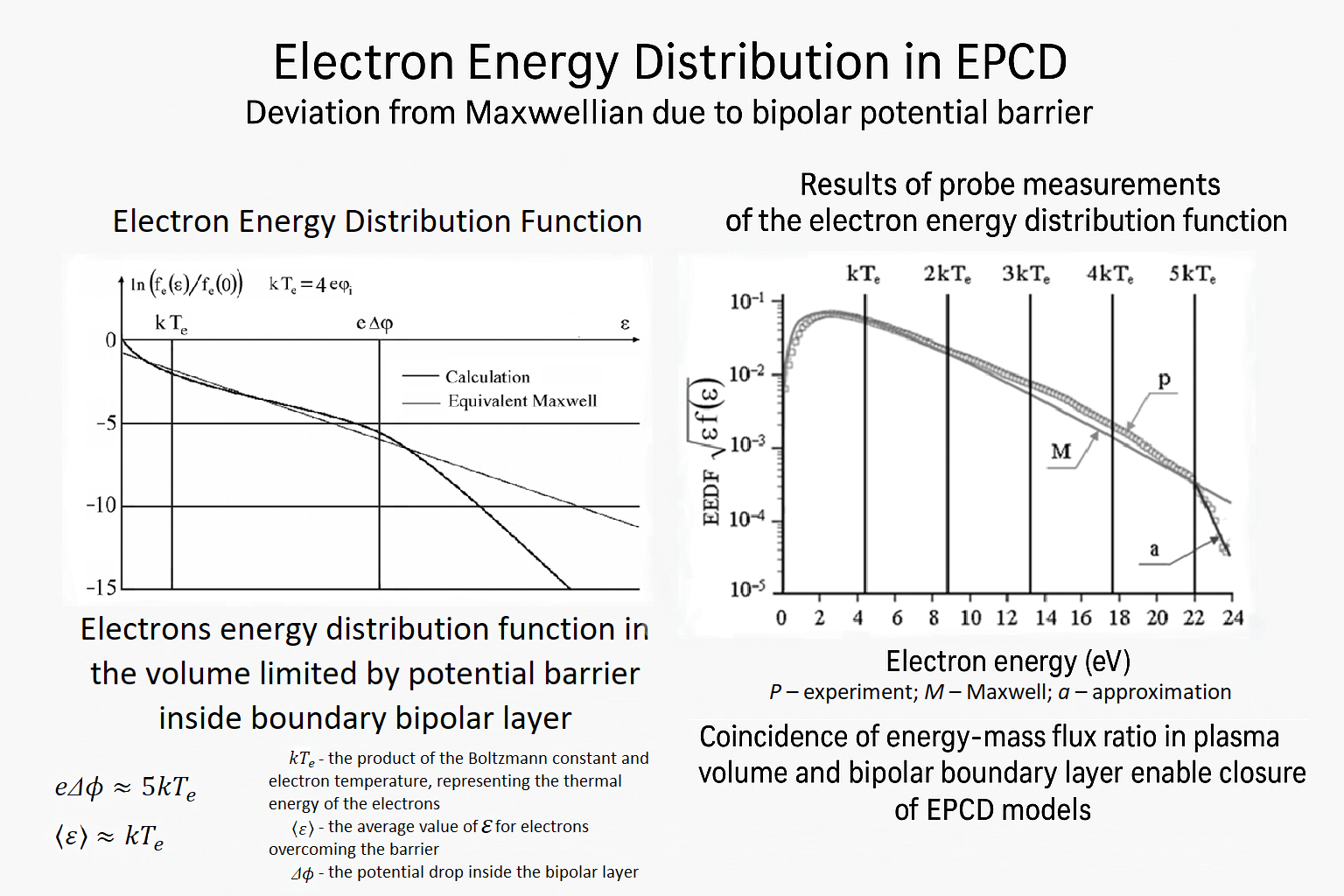
The object of research is a physical process of the electron energy transport in electric propulsion devices with closed electron drift. Such devices include ionization chambers of plasma-ion thrusters, Hall effect thrusters, helicon thrusters, and high-frequency plasma, ions and electrons sources where electron-electron collisions free path is small compared to the channel width. This means that the electron velocity distribution function cannot be considered as Maxwell.
The height of the potential barrier in the boundary bipolar layer and the average electrons energies removed from the plasma should be solved as a kinetic one. The presence of a potential barrier also means that only electrons with energies greater than the barrier height participate in mass and energy transfer. The classical representation, which represents the entire spectrum, is therefore inapplicable.
This means that the results of the research must be used on the object, and this will enable the object to improve, i. e. the electron energy transport must be described by expression obtained in this research.
The above problem is solved in this work using the tools of a compromise kinetic-fluid model considering the presence of isotropy factors of electrons velocity projections distribution. It has been shown that the removal of mass and energy from the plasma is carried out only by electrons in a narrow spectral band, about half the electron temperature. The equations of the zero and first angular moments of the distribution function are written with an approximate notation for the radial-azimuth component of the second angular moment as a second-rank tensor. It is shown that the ratio of the energy and mass flux densities in the volume is almost the same as that at the boundary with the bipolar layer, which allows to close the equations system of the mathematical model of processes in electric propulsion devices with a closed electron drift. The obtained results can be applied in the case of subsonic electron flow, which is typical for plasma of all types of electric propulsion devices.
References
- Hahn, D. W., Özişik, M. N. (2012). Heat Conduction. John Wiley & Sons. https://doi.org/10.1002/9781118411285
- Torvén, S.; Palmadesso, P. J., Papadopoulos, K. (Eds.) (1979). Formation of Double Layers in Laboratory Plasmas. Wave Instabilities in Space Plasmas. Dordrecht: Springer, 109–128. https://doi.org/10.1007/978-94-009-9500-0_9
- Hofer, R., Katz, I., Mikellides, I., Gamero-Castano, M. (2006). Heavy Particle Velocity and Electron Mobility Modeling in Hybrid-PIC Hall Thruster Simulations. 42nd AIAA/ASME/SAE/ASEE Joint Propulsion Conference & Exhibit. https://doi.org/10.2514/6.2006-4658
- Lopez Ortega, A., Mikellides, I. G. (2023). 2D Fluid-PIC Simulations of Hall Thrusters with Self-Consistent Resolution of the Space-Charge Regions. Plasma, 6 (3), 550–562. https://doi.org/10.3390/plasma6030038
- Panelli, M., Morfei, D., Milo, B., D’Aniello, F. A., Battista, F. (2021). Axisymmetric Hybrid Plasma Model for Hall Effect Thrusters. Particles, 4 (2), 296–324. https://doi.org/10.3390/particles4020026
- Nesterenko, S., Zhihao, H., Roshanpour, S. (2025). Compromise kinetic-fluid model of electrons dynamics in electric propulsion devices with closed electrons drift as an alternative to the hybrid PIC-Fluid method. Aerospace Technic and Technology, 1, 28–37. https://doi.org/10.32620/aktt.2025.1.03
- Pitaevskii, L. P., Lifshitz, E. M. (1981). Physical kinetics. Butterworth-Heinemann, 461. Available at: https://dokumen.pub/qdownload/physical-kinetics.html
- Fitzpatrick, R. (2016). Plasma Fluid Theory. University of Texas at Austin. Available at: https://farside.ph.utexas.edu/teaching/plasma/Plasma/Plasmahtml.html
- Nesterenko, S., Roshanpour, S., Huang, Z. (2025). Mathematical aspects of M unlimited angular model in electric propulsion. 2nd International Scientific and Practical Conference “Challenges and Opportunities in Modern Scientific Research”. Ivano-Frankivsk, 208–213. Available at: https://isu-conference.com/wp-content/uploads/2025/07/Ivano-Frankivsk_Ukraine_23.04.25.pdf
- Loyan, A. V., Nesterenko, S. Y., Zongshuai, G., Zhihao, H. (2021). Quasi-one-dimensional mathematical model of processes in Hall effect and plasma-ion thrusters. Open Information and Computer Integrated Technologies, 92, 41–54. https://doi.org/10.32620/oikit.2021.92.04
- Guo, Z. (2021). Radial distribution of electrons rotation moment in hall effect and plasma-ion thrusters. Aerospace Technic and Technology, 4, 28–34. https://doi.org/10.32620/aktt.2021.4.04
- Nesterenko, S., Huang, Z., Roshanpour, S. (2025). Parameters of the bipolar boundary layer in electric propulsion thrusters with closed electron drift: M1+ angular model. 2nd International Scientific and Practical Conference “Modern Scientific Research: Theoretical and Practical Aspects”. Riga: European Open Science Space, 462–479. Available at: https://www.eoss-conf.com/en/archive/modern-scientific-research-theoretical-and-practical-aspects-26-05-25/
- Huang, Z. (2025). Electron dynamics in the Langmur layer in M-unlimited angular model in electric propulsion. 2nd International Scientific and Practical Conference “Achievements of Science and Applied Research”. Dublin: European Open Science Space, 231–239. Available at: https://www.eoss-conf.com/en/archive/achievements-of-science-and-applied-research-19-05-25/
- Langmuir Probe System – Thruster Application (2021). Impedans. Available at: https://www.impedans.com/wp-content/uploads/2021/12/Langmuir_ThrusterApplication.pdf
Downloads
Published
How to Cite
Issue
Section
License
Copyright (c) 2026 Shahram Roshanpour

This work is licensed under a Creative Commons Attribution 4.0 International License.
The consolidation and conditions for the transfer of copyright (identification of authorship) is carried out in the License Agreement. In particular, the authors reserve the right to the authorship of their manuscript and transfer the first publication of this work to the journal under the terms of the Creative Commons CC BY license. At the same time, they have the right to conclude on their own additional agreements concerning the non-exclusive distribution of the work in the form in which it was published by this journal, but provided that the link to the first publication of the article in this journal is preserved.