Development of a model for coloring raster elements based on determining the contrast of colored raster polynomially transformed digital images
DOI:
https://doi.org/10.15587/2706-5448.2026.359690Keywords:
polynomial transformation, raster transformation, coloring, relative contrast, simulator, quantitative assessmentAbstract
The object of research is the technological process of pre-printing adjustment of image tone reproduction based on the determination of the contrast of colored raster polynomially transformed digital images.
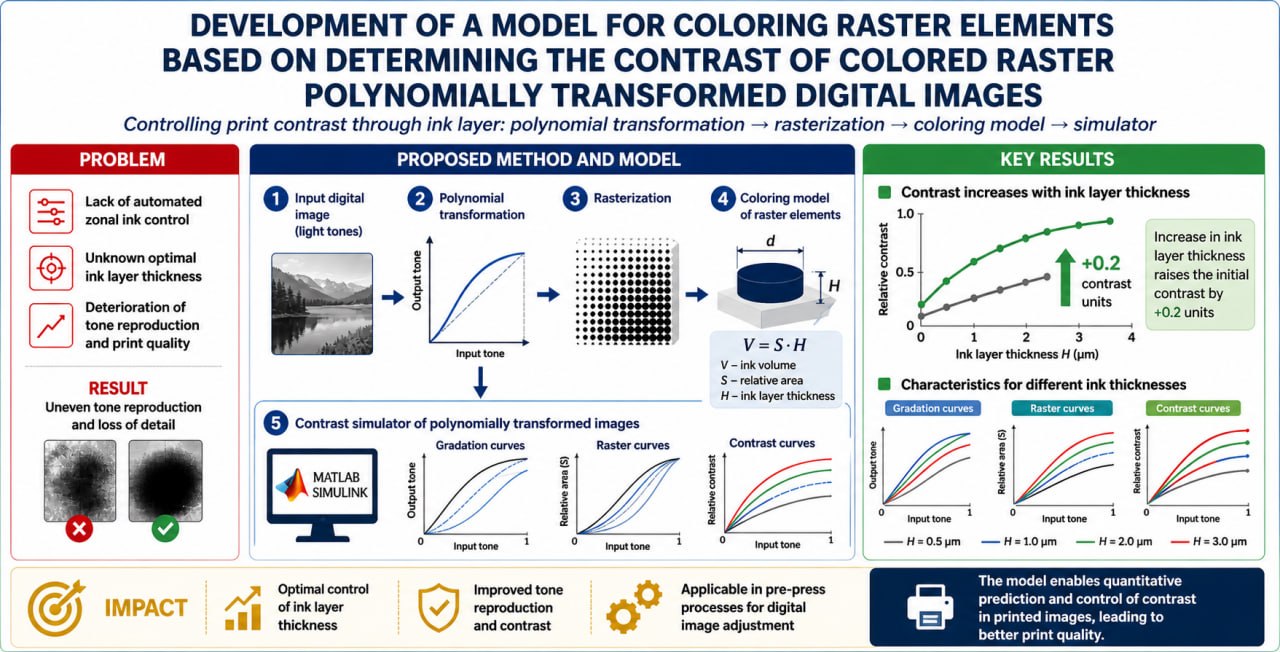
One of the significant problems in the process of pre-printing image preparation is the absence of an automated zonal ink supply adjustment system in most offset machines. Accordingly, this makes it impossible to determine the optimal ink layer to ensure high-quality tone reproduction. Therefore, the urgent task of determining the contrast of colored raster polynomially transformed images over the entire tone reproduction interval arises.
The research process is based on the use of the method of mathematical transformation, the theory of digital image processing and object-oriented programming.
Rasterization algorithms have been developed based on the use of polynomial transformation of digital images of light tones. The result of raster transformation is the determination of the relative area of the coloring of raster elements, which is the main carrier of information about the tonality of the image.
A structural diagram of a contrast simulator of colored polynomially transformed images was constructed, with the help of which the characteristics of coloring of raster elements and the characteristics of the contrast of colored polynomially transformed images were constructed.
The proposed coloring model describes the dependence of coloring of raster elements on the change in the relative contrast of colored raster polynomially transformed images. It is proved that an increase in the thickness of the ink layer increases the initial contrast by +0.2 units. Therefore, changing the thickness of the ink layer can ensure optimal visual image quality due to a change in contrast, which is an advantage of the model.
The research results can be recommended for use in pre-printing processes of adjusting digital images.
References
- Vorobel, R. A. (2012). Loharyfmichna obrobka zobrazhen. Kyiv: Naukovo-vyrobnyche pidpryiemstvo “Vydavnytstvo “Naukova dumka” NAN Ukrainy”, 322.
- Lutskiv, M. M. (2012). Tsyfrovi tekhnolohii drukarstva. Lviv: UAD, 480.
- Kavyn, B. (2025). Development of a model for coloring raster elements of polynomial transformation of digital images. Technology Audit and Production Reserves, 2 (2 (82)), 27–31. https://doi.org/10.15587/2706-5448.2025.323533
- Gonzales, R. C., Woods, R. E. (2018). Digital image processing: international Version 4 Edition. Pearson, 1104. Available at: https://www.cl72.org/090imagePLib/books/Gonzales,Woods-Digital.Image.Processing.4th.Edition.pdf
- Umbaugh, S. E. (2022). Digital Image Processing and Analysis. CRC Press, 488. https://doi.org/10.1201/9781003221135
- Kavyn, S. (2025). Development of a model of raster power-linear conversion of digital images of light tones. Technology Audit and Production Reserves, 4 (2 (84)), 60–64. https://doi.org/10.15587/2706-5448.2025.337277
- Durnyak, B., Lutskiv, M., Shepita, P., Hunko, D., Savina, N. (2021). Formation of liner Characteristics of Normalized Roster Trans Formation for Rombic Elemtnts. Intelligent Information Technologies & System of Information Security. CEUR Workshop Proceedings, 2853, 127–133. Available at: https://ceur-ws.org/Vol-2853/short10.pdf
- Blanchet, G., Charbit, M. (2015). Digital Signal and Image Processing Using Matlab®. Vol. 2, Advances and applications: The Deterministic Case. ISTE Ltd and John Wiley & Sons Inc, 287. https://doi.org/10.1002/9781118999592
- Bredies, K., Lorenz, D. (2018). Mathematical Image Processing. Applied and Numerical Harmonic Analysis. Springer International Publishing, 473. https://doi.org/10.1007/978-3-030-01458-2
- Kovalskiy, B., Semeniv, M., Shovgenyuk, M. (2016). Сomputer program for the image synthesis on impress for the new information and traditional technologies of color printing. Science and Education a New Dimention: Natural and Technical Science, IV (10 (91)), 72–78.
- Durniak, B. V., Senkivskyi, V. M., Lutskiv, M. M., Musiiovska, M. M. (2021). Informatsiina tekhnolohiia tonovidtvorennia v korotkykh farbodrukarskykh systemakh poslidovnoi struktury. Lviv: UAD, 176.
- Distante, A., Distante, C. (2020). Handbook of Image Processing and Computer Vision. Springer International Publishing, 432. https://doi.org/10.1007/978-3-030-42374-2
- Durnyak, B., Lutskiv, M., Shepita, P., Karpyn, R., Savina, N. (2021). Determination of the Optical Density of Two-Parameter Tone Transfer for a Short Printing System of the Sixth Dimension. Intelligent International Technologies & Systems of Information Security: CEUR Worhshop Proceedings, 2853, 134–140. Available at: https://ceur-ws.org/Vol-2853/short11.pdf
- Lutskiv, M., Fedyna, B., Nakonechnyi, M. (2025). Simulation of tone reproduction of digital rast images with change of paint thickness. Technological Complexes, 17 (1), 30–40. https://doi.org/10.36910/4293-52779-2025-17-01-03
Downloads
Published
How to Cite
Issue
Section
License
Copyright (c) 2026 Sviatoslav Kavyn, Bohdan Kavyn

This work is licensed under a Creative Commons Attribution 4.0 International License.
The consolidation and conditions for the transfer of copyright (identification of authorship) is carried out in the License Agreement. In particular, the authors reserve the right to the authorship of their manuscript and transfer the first publication of this work to the journal under the terms of the Creative Commons CC BY license. At the same time, they have the right to conclude on their own additional agreements concerning the non-exclusive distribution of the work in the form in which it was published by this journal, but provided that the link to the first publication of the article in this journal is preserved.