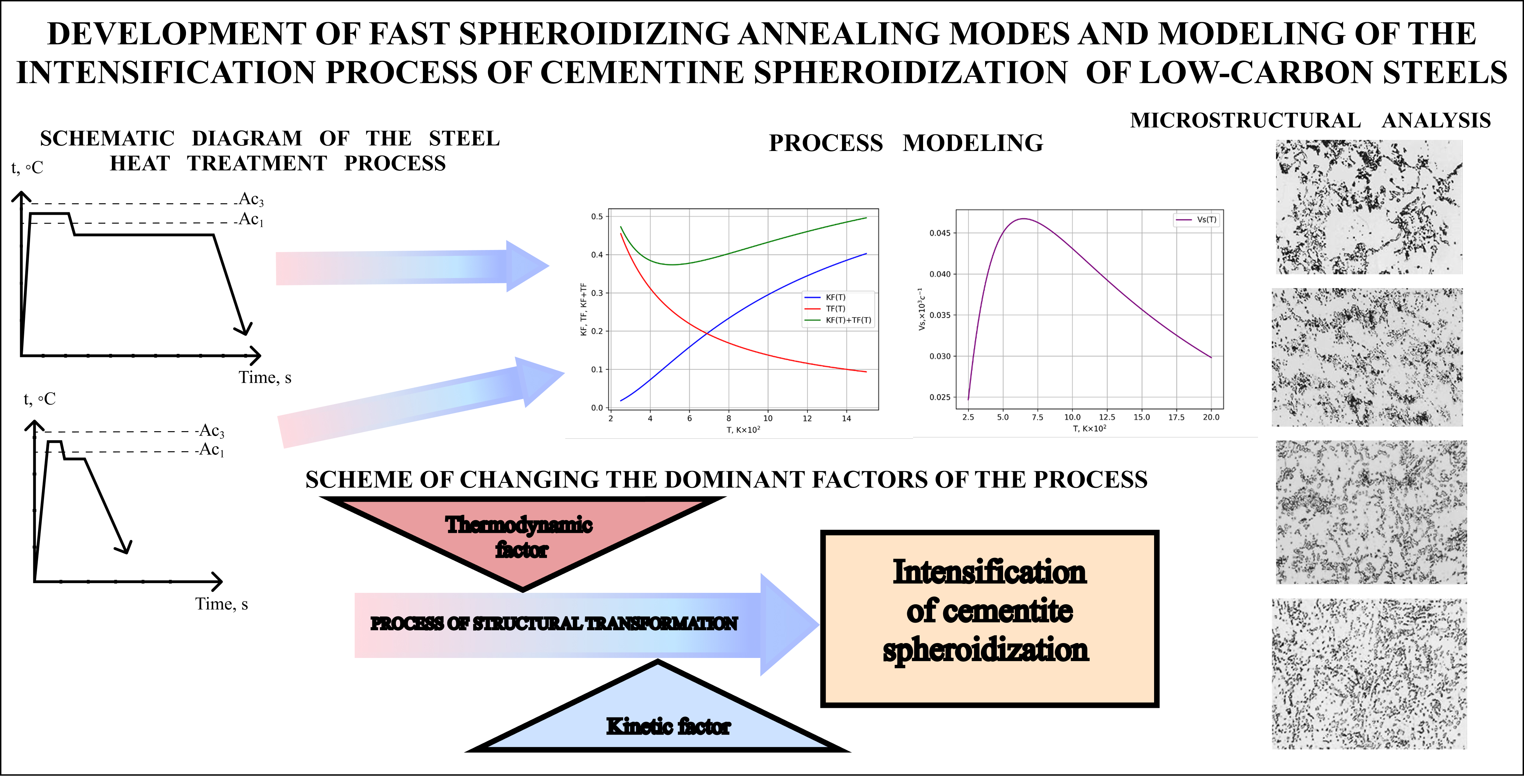
Development of fast spheroidizing annealing modes and modeling of the intensification process of cementite spheroidization of low-carbon steels
DOI:
https://doi.org/10.15587/2706-5448.2026.362711Keywords:
spheroidization, thermodynamics, kinetics, structural transformations, non-isothermal holding, microstructure, process modelingAbstract
The object of research is the process of cementite spheroidization of 20Г2Р low-carbon steel 2during heat treatment, in particular spheroidizing annealing.
Special attention in conducting research is paid to the influence of the initial structural state of the steel, temperature regimes and heating methods on the formation of the microstructure of the workpiece.
Traditional methods of spheroidizing annealing are characterized by a significant duration of the regime, which reaches more than 10 hours and, in connection with this, energy costs, which limits the efficiency of the technological process. This is especially true for low-carbon steels with a relatively weak thermodynamic stimulus for spheroidization.
The research problem is the need to reduce the duration of spheroidizing annealing of steel and reduce energy costs while ensuring a uniform distribution of cementite globules in the ferrite matrix.
The scientific novelty of the obtained results lies in the development of high-speed regimes of spheroidizing annealing of 20Г2Р steel using the initial ferritic-bainite structure and non-isothermal holding with increasing temperature, in contrast to known studies based on long isothermal holdings. It is shown that the total duration of spheroidizing annealing of low-carbon steels significantly depends on the initial structural state of the workpiece. It is established that the transition from ferritic-pearlitic to ferritic-bainite initial structural state provides a reduction in the duration of cementite spheroidization from 1500–1800 s to 200–450 s.
The features of the intensification of spheroidizing annealing of low-carbon steels have been studied and the influence of changes in the values of thermodynamic and kinetic factors during structural transformation has been established. The effectiveness of using non-isothermal holding with increasing temperature in a certain temperature range and optimization of spheroidizing treatment parameters has been proven.
The practical significance of the results obtained lies in the implementation of the developed high-speed modes of spheroidizing annealing of 20Г2Р low-carbon steel for the production of coiled strip and wire with a diameter of 6.0–20.0 mm. The obtained structural states of the blanks provide the necessary set of properties for the subsequent manufacture of metal products by cold drawing, in particular products of complex configuration. The proposed approaches are fully suitable and meet the requirements for technological and mechanical properties of blanks for the manufacture of metal products by cold drawing.
References
- Christian, J. W. (2002). The Theory of Transformations in Metals and Alloys. Oxford: Pergamon Press, 1200. https://doi.org/10.1016/b978-0-08-044019-4.x5000-4
- Dolzhenkov, I. Ye. (2011). Shliakhy suttievoho skorochennia chasu (tryvalosti) ta pokrashchennia yakosti sferoidyzatsii karbidiv stalevoi metaloproduktsii. Budivnytstvo, materialoznavstvo, mashynobudivnytstvo, 58, 262–267. Available at: http://nbuv.gov.ua/UJRN/smmsc_2011_58_39
- Ivashchenko, V. P., Shvachych, H. H., Sobolenko, M. O., Hul, Yu. P., Sobolenko, O. V., Kokashynska, H. V., Moroz, D. M. (2020). Pat. No. 143971 UA. Ustanovka dlia intensyfikatsii sferoidyzuiuchoho vidpaliuvannia stali. MPK C21D 1/26 (2006.01). No. u202000940; declareted: 14.02.2020; published: 25.08.2020, Bul. No. 16. Available at: https://sis.nipo.gov.ua/media/UTILITY_MOD/2020/u202000940/published_description.pdf?utm_source
- Nasiri, Z., Mirzadeh, H. (2019). Spheroidization heat treatment and intercritical annealing of low carbon steel. Journal of Mining and Metallurgy, Section B: Metallurgy, 55 (3), 405–411. https://doi.org/10.2298/jmmb180813033n
- Zhuchkov, S. M., Baryshev, E. V., Lokhmatov, O. P., Lutsenko, V. O., Kliuchnikov, K. Yu. (2009). Creation of energy saving and ecologically pure metal preparation site for cold deformation in the shapes of simple and complex sections. Nauka ta innovatsii, 6 (5), 36–47. Available at: http://scinn.org.ua/sites/default/files/pdf/2009/N6/Zjuchkov.pdf
- Hul, Yu. P., Sobolenko, M. O. (2012). Osnovy shvydkisnoi sferoidyzatsii tsementytu v nyzkovuhletsevykh staliakh dlia kholodnoi vysadky. Construction, materials science, mechanical engineering, 64, 128–136. Available at: http://smm.pgasa.dp.ua/article/view/63052
- Kaputkin, D. E. (2005). Correlation between the thermokinetic parameters of difusional decomposition and the activation energy of difusion in steels and nonferrous alloys. Physics of Metals and Metallography, 4 (99), 343–347. Available at: https://www.researchgate.net/publication/289844078_Correlation_between_the_thermokinetic_parameters_of_diffusional_decomposition_and_the_activation_energy_of_diffusion_in_steels_and_nonferrous_alloys =
- DSTU 3684-98. Prokat iz yakisnoi konstruktsiinoi nelehovanoi ta lehovanoi stali dlia kholodnoho vydavliuvannia ta vysadzhuvannia. Tekhnichni umovy. (ISO 4954-93). (2022). Kyiv: Derzhavnyi standart Ukrainy, 16.
- Brown, M. E., Gallagher, P. K. (2003). Handbook of Thermal Analysis and Calorimetry. Vol. 2. Applications to Inorganic and Miscellaneous Materials. Amsterdam: Elsevier, 905. Available at: https://www.sciencedirect.com/handbook/handbook-of-thermal-analysis-and-calorimetry/vol/2/suppl/C
- Gul, Yu. P., Sobolenko, M. A. (2024). Investigation of the patterns of structure formation and mechanical properties of steels during heat treatment. Ukrainian Journal of Civil Engineering and Architecture, 6 (24), 64–69. https://doi.org/10.30838/ujcea.2312.271224.64.1112
- Sobolenko, M. O., Alieksieiev, M. O. (2024). Investigation of the influence of technological parameters on the kinetics of austenite decomposition in boron-containing steel. Zbirnyk naukovykh prats NHU, 78, 217–224. http://doi.org/10.33271/crpnmu/78.217
- Python Software Foundation. Python Programming Language. Available at: https://www.python.org
- Okonogi, M., Yamazaki, K. (2017). Development of Medium Carbon Steel Wire Rods for Cold Heading by Isothermal Transformation Treatment. Nippon Steel and Sumitomo Metal Technical Report, 116, 65–70. Available at: https://www.nipponsteel.com/en/tech/report/nssmc/pdf/116-13.pdf
- Hauserova, D., Dlouhy, J., Novy, Z. (2014). Accelerated carbide spheroidisation and Refinement (ASR) of the C45 Steel during Controlled Rolling. Materials and technology, 48 (5), 797–800. Available at: https://www.researchgate.net/publication/282726155_Accelerated_carbide_spheroidisation_and_refinement_ASR_of_the_C45_steel_during_controlled_rolling
- Vakulenko, I. O. (2008). Structural changes in carbon steel for a long exposures at subcritical temperatures. Science and Transport Progress, 21, 263–265. https://doi.org/10.15802/stp2008/15829
Downloads
Published
How to Cite
Issue
Section
License
Copyright (c) 2026 Hennadii Shvachych, Mariia Sobolenko, Valeriy Ivashchenko, Tamara Manko, Borys Moroz, Leonid Meshcheriakov

This work is licensed under a Creative Commons Attribution 4.0 International License.
The consolidation and conditions for the transfer of copyright (identification of authorship) is carried out in the License Agreement. In particular, the authors reserve the right to the authorship of their manuscript and transfer the first publication of this work to the journal under the terms of the Creative Commons CC BY license. At the same time, they have the right to conclude on their own additional agreements concerning the non-exclusive distribution of the work in the form in which it was published by this journal, but provided that the link to the first publication of the article in this journal is preserved.