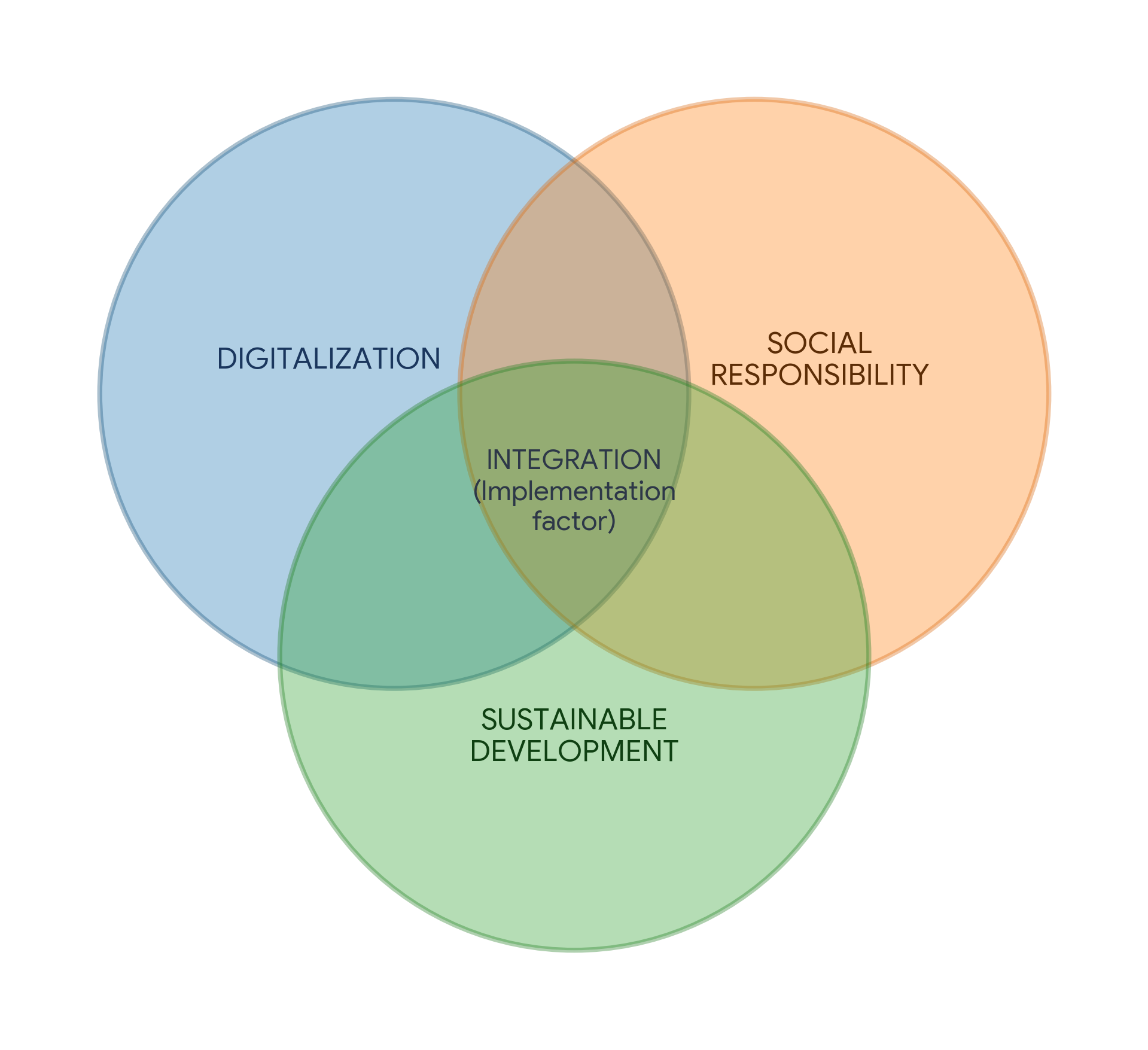
The integration of digitalisation and social responsibility as a factor in achieving sustainable development
DOI:
https://doi.org/10.15587/2706-5448.2026.363740Keywords:
social responsibility, digital transformation, sustainable development, production capabilities, ESG criteria, environmental sustainability, ethical standardsAbstract
The object of this research is the management of social responsibility in the context of digitalization and sustainable development. The problem to be solved is the stems from the lack of tools to assess the synergistic effect of combining digitalization and corporate social responsibility (CSR), as current approaches treat these factors in isolation, creating a gap in our understanding of them as factors influencing sustainable development. The paper describes the economic and social effects of digital transformations. An analysis of CSR transformations in the post-war period and during post-war reconstruction was conducted. It was noted that national business entities currently do not make sufficient use of existing production reserves when implementing sustainable development initiatives. The existence of a certain gap between the achieved digitization of nationwide processes and the business sector’s orientation towards responsible digitalization is substantiated. The paper identifies existing sustainability reserves and proposes measures to enhance social responsibility among entrepreneurs based on modern digital tools.
The work was carried out using methods such as comparison and systematic evaluation of phenomena and processes, as well as methods of logical generalization. It has been demonstrated that the practical application of cloud computing and artificial intelligence for monitoring social and environmental data can serve as a significant operational resource for Ukrainian enterprises. It has been substantiated that the implementation of online transparency is a key factor in enhancing the trust of partners, investors and customers. The recommendations presented may be of practical significance to business entities and senior company managers when implementing CSR initiatives, and to regional and national government bodies when formulating digitalization strategies that take into account socio-environmental rules, regulations and standards.
References
- Porter, M. E., Kramer, M. R. (2011). Creating Shared Value. Harvard Business Review. Available at: https://hbr.org/2011/01/the-big-idea-creating-shared-value
- Liu, W., Liu, T., Tang, O., Lee, P. T. W., Chen, Z. (2023). The impact of digital supply chain announcements disclosing corporate social responsibility information on stock market value. Industrial Management & Data Systems, 124 (2), 724–760. https://doi.org/10.1108/imds-03-2023-0189
- Carroll, A. B. (1991). The pyramid of corporate social responsibility: Toward the moral management of organizational stakeholders. Business Horizons, 34 (4), 39–48. https://doi.org/10.1016/0007-6813(91)90005-g
- Scherer, A. G., Palazzo, G. (2011). The New Political Role of Business in a Globalized World: A Review of a New Perspective on CSR and its Implications for the Firm, Governance, and Democracy. Journal of Management Studies, 48 (4), 899–931. Portico. https://doi.org/10.1111/j.1467-6486.2010.00950.x
- Reinsberg, B., Steinert, C. V. (2025). The French duty of vigilance law: reconciling human rights and firm profitability. Review of International Political Economy, 32 (6), 2213–2245. https://doi.org/10.1080/09692290.2025.2519189
- Responsible investment Government Pension Fund Global 2025 (2026). Norges Bank Investment Management. Available at: https://www.nbim.no/contentassets/99fa5525f1a947d6b7231101832bfb40/responsible-investment-2025.pdf
- Moroz, Y., Nagirniak, M. (2023). Fictitious business transactions in the field of taxation as objects of accounting. Efektyvna Ekonomika, 11. https://doi.org/10.32702/2307-2105.2023.11.23
- Kucher, A., Moskvyak, Y., Fedorchak, O. (2025). Improving the approach to assessing the impact of financial market digitalization on the rationality of financial decisions. Technology Audit and Production Reserves, 3 (4 (83)), 64–75. https://doi.org/10.15587/2706-5448.2025.331165
- Skliarenko, O., Vilianskyi, A. (2025). Modeling the impact of industry 4.0 technologies on the innovative development of industrial enterprises. Economics and Management, 2. https://doi.org/10.32782/2312-7872.2.2025.6
- Chervinska, L., Kalina, I., Chervinska, T., Benedysiuk, M., Parfentieva, O., Milenkii, V. (2025). Digital employment: modern realities and financial and economic risks. Financial and Credit Activity Problems of Theory and Practice, 3 (62), 481–494. https://doi.org/10.55643/fcaptp.3.62.2025.4715
- Tsili staloho rozvytku: Ukraina. Monitorynhova dopovid 2023 (2023). Ministerstvo ekonomiky Ukrainy. Kyiv, 144. Available at: https://me.gov.ua/download/17228c37-95e0-4a6d-bbc0-119826a9f032/file.pdf
- Rezultaty tsyfrovoi transformatsii v rehionakh Ukrainy za 2024 rik (2025). Ministerstvo tsyfrovoi transformatsii Ukrainy. Available at: https://thedigital.gov.ua/news/regions/rezultati-tsifrovoi-transformatsii-v-regionakh-ukraini-za-2024-rik
- Rezultaty tsyfrovoi transformatsii v rehionakh Ukrainy za 2023 rik (2024). Ministerstvo tsyfrovoi transformatsii Ukrainy. Available at: https://thedigital.gov.ua/news/regions/rezultati-tsifrovoi-transformatsii-v-regionakh-ukraini-za-2023-rik
- Report on the state of the Digital Decade 2024 (2024). European Commission. Available at: https://digital-strategy.ec.europa.eu/en/library/report-state-digital-decade-2024
- DESI Methodological Note – Digital Decade report 2023 (2023). European Commission. Available at: https://digital-strategy.ec.europa.eu/en/library/desi-methodological-note-digital-decade-report-2023
- Sustainable development. MHP. Available at: https://mhp.com.ua/uk/stalyy-rozvytok
- Zvit pro upravlinnia TOV “Nova Poshta” za 2024 rik. Available at: https://site-assets.novapost.com/7c3a6fb4-89be-417b-918e-c55da1a31d23.pdf
- Sotsialna vidpovidalnist. Kyivstar. Available at: https://kyivstar.ua/about/responsibility
- Our research. Corporate Social Responsibility. Available at: https://csr-ukraine.org/category/our-research/
- Global Skills Report (2024). Coursera. Available at: https://www.coursera.org/skills-reports/global
- Sustainability in Action (2024). DTEK. Available at: https://dtek.com/content/upload/Sustainability_in_Action_report.pdf
Downloads
Published
How to Cite
Issue
Section
License
Copyright (c) 2026 Tetiana Chervinska, Hanna Bratus, Liubov Chervinska, Iryna Kalina, Kyrylo Hanhanov

This work is licensed under a Creative Commons Attribution 4.0 International License.
The consolidation and conditions for the transfer of copyright (identification of authorship) is carried out in the License Agreement. In particular, the authors reserve the right to the authorship of their manuscript and transfer the first publication of this work to the journal under the terms of the Creative Commons CC BY license. At the same time, they have the right to conclude on their own additional agreements concerning the non-exclusive distribution of the work in the form in which it was published by this journal, but provided that the link to the first publication of the article in this journal is preserved.