Development of a mathematical model for gas hydrate synthesis and dissociation processes in a gas pipeline under microwave radiation
DOI:
https://doi.org/10.15587/2706-5448.2026.363759Keywords:
gas hydrates, ultrahigh-frequency electromagnetic radiation, dissociation, mathematical modeling, gas pipeline, energy efficiency, heat balanceAbstract
The object of research is the heat and mass transfer processes that occur on the surface of a gas hydrate granule moving in a gas pipeline.
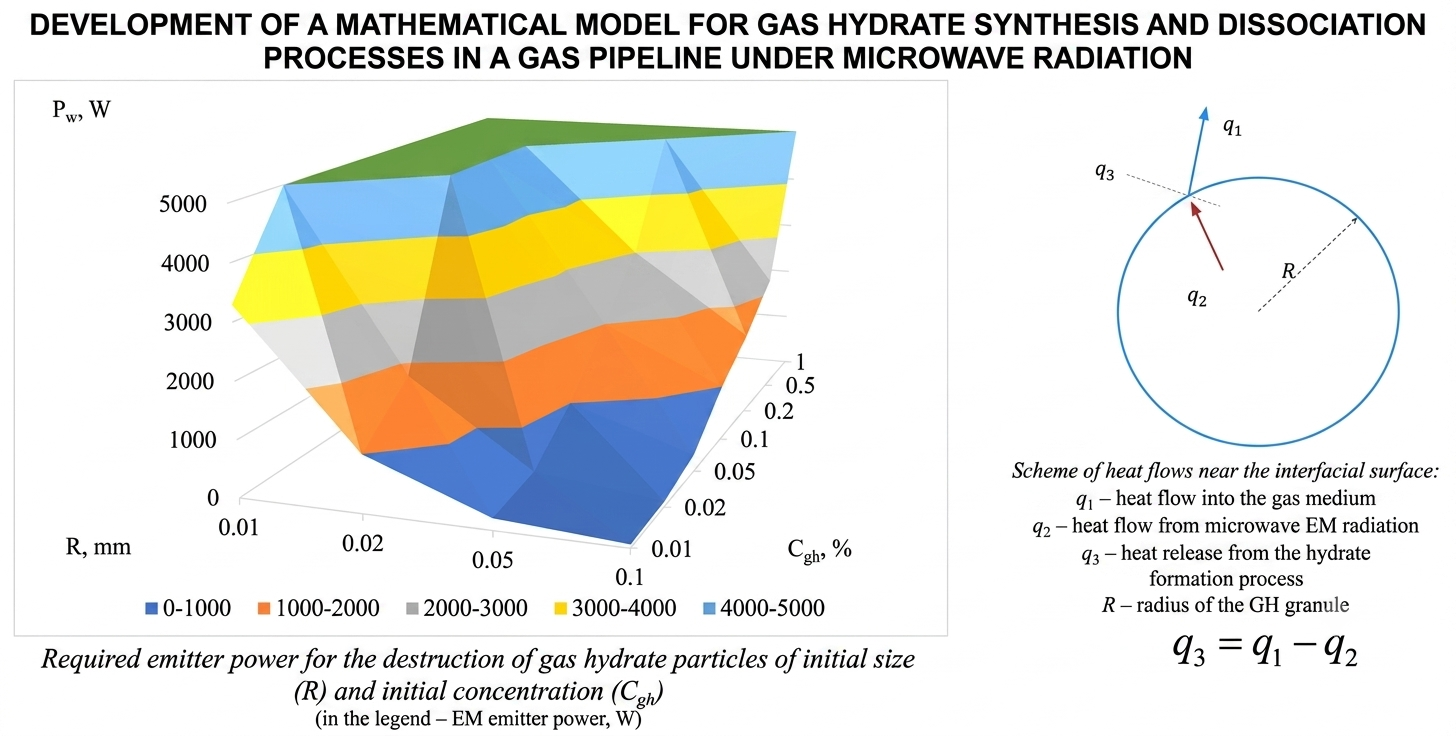
The research solved the problem of the oil and gas industry – the fight against the formation of gas hydrates (GH) in hydrocarbon production and transportation systems. A promising approach to the intensification of hydrate dissociation by using microwave electromagnetic radiation is proposed. The features of the results obtained consist in the development of a mathematical model that combines two processes of synthesis and dissociation of gas hydrates, taking into account hydrodynamic processes in the pipeline. The main differences of the proposed mathematical model are: simultaneous consideration of two mutually opposing processes of synthesis and dissociation of gas hydrate on the surface of the granule; these processes occur during the movement of the gas hydrate granule inside the gas pipeline; heating of the gas hydrate granule occurs as a result of its absorption of direct and reflected multimode microwave electromagnetic radiation.
A complex approximation dependence was obtained for determining the required emitter power Pw = 124Cgh/R1.7, which allows one to quickly calculate the required minimum magnetron power to combat hydrate formation.
It was established that for the destruction of small particles (<0.01 mm) even if their concentration is low (0.01–0.02%), a relatively high-power emitter (3–5 kW) is required. The same was observed in the case of GH accumulation to high concentrations (>0.1%) with particle sizes of 0.05–0.1 mm. Therefore, the most advantageous strategy for combating GH accumulation is its active destruction when it reaches sizes of 0.02–0.05 mm, which do not harm the course of the main technological process.
The obtained dependences are the basis for improving gas preparation technologies under hydrate formation conditions by using microwave radiation energy.
References
- Dmytrenko, V. I., Zezekalo, I. G., Vynnykov, Y. L. (2022). The use of bischofite in the gas industry as an inhibitor of hydrate formation. IOP Conference Series: Earth and Environmental Science, 1049 (1), 12052. https://doi.org/10.1088/1755-1315/1049/1/012052
- Pedchenko, M. M.; Biletskyi, V. S. (Ed.) (2014). Hidratoutvorennia vuhlevodnevykh haziv. Poltava: PoltNTU, 182. Available at: https://www.researchgate.net/publication/338117028_Pedcenko_MM_Gidratoutvorenna_vuglevodnevih_gaziv_monografia_MM_Pedcenko_za_red_VS_Bileckogo_-_Poltava_PoltNTU_2014_-_182_s_ISBN_978-966-616-129-4
- Dmytrenko, V., Podoliak, T. (2024). Research of methanol content in technological flows of facilities that process gas preparation by low-temperature separation method. Technology Audit and Production Reserves, 6 (1 (80)), 46–53. https://doi.org/10.15587/2706-5448.2024.318926
- Sloan, E. D. (1998). Clathrate hydrates of natural gases. Marcel Dekker. Available at: https://www.abebooks.com/9780824799373/Clathrate-Hydrates-Natural-Gases-Second-0824799372/plp
- Li, D.-L., Liang, D.-Q., Fan, S.-S., Li, X.-S., Tang, L.-G., Huang, N.-S. (2008). In situ hydrate dissociation using microwave heating: Preliminary study. Energy Conversion and Management, 49 (8), 2207–2213. https://doi.org/10.1016/j.enconman.2008.01.031
- Dreus, A. Y., Bondarenko, V. I., Biletskyi, V., Lysenko, R. (2020). Mathematical simulation of heat and mass exchange processes during dissociation of gas hydrates in a porous medium. Naukovyi Visnyk Natsionalnoho Hirnychoho Universytetu, 5, 33–39. https://doi.org/10.33271/nvngu/2020-5/033
- Rebai, N., Hadjadj, A., Benmounah, A., Berrouk, A. S., Boualleg, S. M. (2019). Prediction of natural gas hydrates formation using a combination of thermodynamic and neural network modeling. Journal of Petroleum Science and Engineering, 182, 106270. https://doi.org/10.1016/j.petrol.2019.106270
- Fatykhov, M. A., Akchurina, V. A., Stolpovsky, M. V. (2020). Numbrigal simulation of a thermodynamic process to decompose gas hydrate in a gas production well using, radiofrequency electromagnetic radiation. IOP Conference Series: Materials Science and Engineering, 862 (6), 62075. https://doi.org/10.1088/1757-899x/862/6/062075
- Shi, M., Yang, L., Gao, S., Wang, G. (2022). Small-Diameter Tube Wall Damage-Detection Method Based on TE01 Mode Microwave. Sensors, 22 (17), 6476. https://doi.org/10.3390/s22176476
- Yang, H., Liu, X., Yue, J., Tang, X. (2022). Analysis of factors affecting microwave heating of natural gas hydrate combined with numerical simulation method. Petroleum, 8 (3), 391–402. https://doi.org/10.1016/j.petlm.2021.12.003
- Bera, A., Babadagli, T. (2017). Effect of native and injected nano-particles on the efficiency of heavy oil recovery by radio frequency electromagnetic heating. Journal of Petroleum Science and Engineering, 153, 244–256. https://doi.org/10.1016/j.petrol.2017.03.051
- Kutnyi, B., Pavlenko, A., Cherednikova, O. (2023). Theoretical Foundations of Gas Hydrate Synthesis Intensification. Environmental and Climate Technologies, 27 (1), 666–682. https://doi.org/10.2478/rtuect-2023-0049
- Zhang, X., Wang, Y., Wang, H., Fan, S., Meng, X., Xu, H. (2024). Structural parameters optimization of microwave radiation antenna in hydrate reservoir based on multiphysical coupling model. Case Studies in Thermal Engineering, 64, 105449. https://doi.org/10.1016/j.csite.2024.105449
- Dreus, A. Y., Gubin, O. I., Bondarenko, V. I., Liu, B., Batuta, V. I. (2022). Numerical study of microwave impact on gas hydrate plugs in a pipeline. Naukovyi Visnyk Natsionalnoho Hirnychoho Universytetu, 4, 28–33. https://doi.org/10.33271/nvngu/2022-4/028
- Runborg, O. (2007). Mathematical models and numerical methods for high frequency waves. Communications in Computational Physics, 2 (5), 827–880. Available at: https://www.csc.kth.se/~olofr/Publications/runborg-cicp.pdf
- Gear, C. W. (1971). Numerical initial value problems in ordinary differential equations. Prentice-Hall. Available at: https://www.scribd.com/doc/28941688/Numerical-Initial-Value-Problems-in-Ordinary-Differential-Equations#google_vignette
- Abu-Nab, A. K., Koldoba, A. V., Koldoba, E. V., Poveshchenko, Y. A., Podryga, V. O., Rahimly, P. I., Bakeer, A. E. (2023). On the Theory of Methane Hydrate Decomposition in a One-Dimensional Model in Porous Sediments: Numerical Study. Mathematics, 11 (2), 341. https://doi.org/10.3390/math11020341
Downloads
Published
How to Cite
Issue
Section
License
Copyright (c) 2026 Taras Podoliak, Victoriia Dmytrenko

This work is licensed under a Creative Commons Attribution 4.0 International License.
The consolidation and conditions for the transfer of copyright (identification of authorship) is carried out in the License Agreement. In particular, the authors reserve the right to the authorship of their manuscript and transfer the first publication of this work to the journal under the terms of the Creative Commons CC BY license. At the same time, they have the right to conclude on their own additional agreements concerning the non-exclusive distribution of the work in the form in which it was published by this journal, but provided that the link to the first publication of the article in this journal is preserved.