Development of a coordinated system for automatic control of the combustion process of a boiler unit with correction for oxygen content
DOI:
https://doi.org/10.15587/2706-5448.2026.363894Keywords:
automatic control system, Simulink, simulation model, boiler unit, fuel-air ratioAbstract
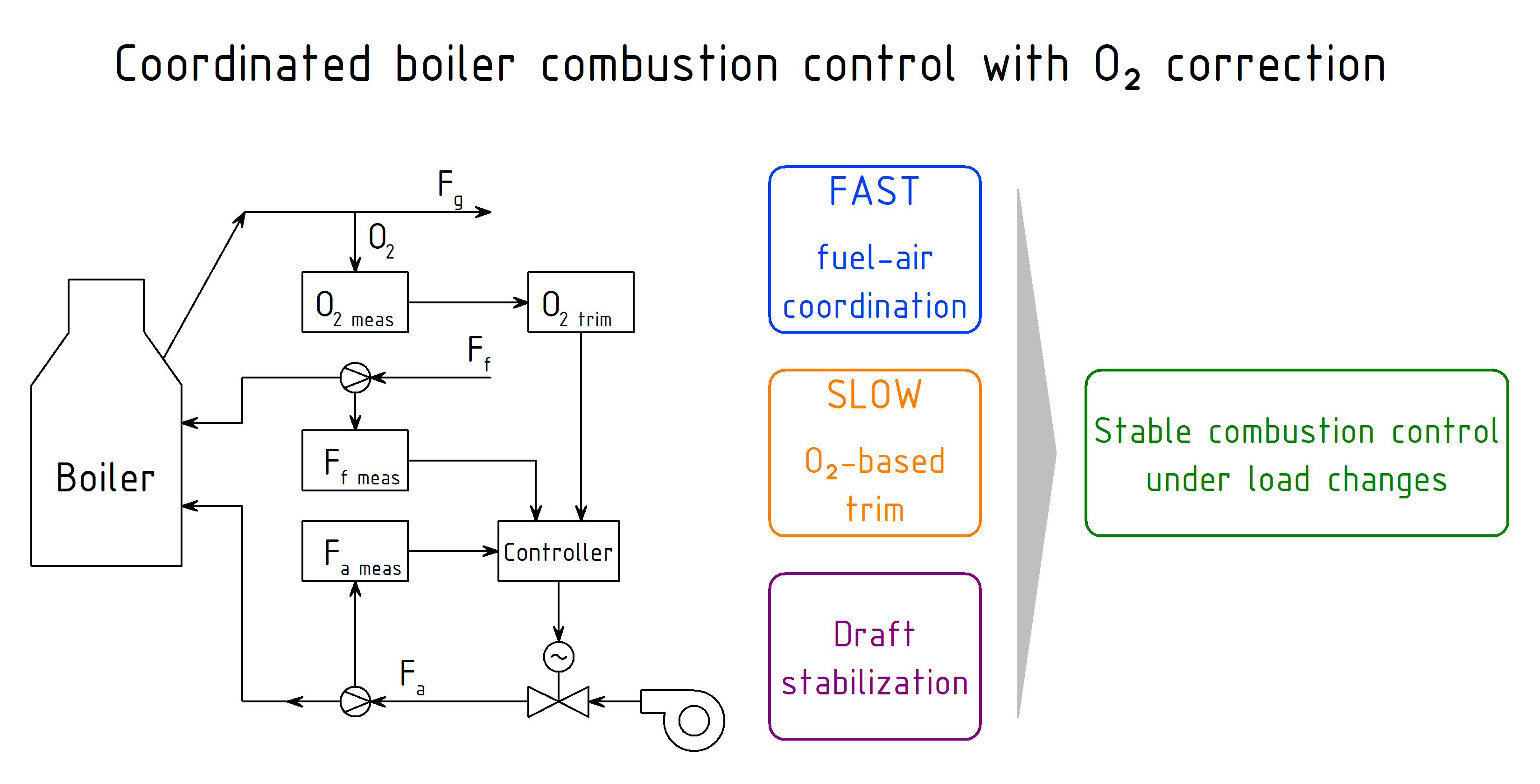
The object of research is the automatic control system for the boiler-unit combustion process, which coordinates fuel and air supply, stabilizes furnace draft, and provides slow correction of excess air based on the measured oxygen content in flue gases. The system coordinates the supply of fuel and air, applying a gradual correction of excess air based on the measured oxygen content in the flue gases. The main problem is to ensure coordinated control of the fuel, air and draft channels under the conditions of plant inertia, transport delays, actuator limitations, changes in fuel properties and load effects. To solve this problem, a control structure is proposed with a division into fast and slow levels, coordinated with each other. In this structure, the fast control level generates a setpoint air flow rate using the fuel flow rate signal. The slower control level applies a limited correction of the fuel-air ratio coefficient in accordance with the deviation of the oxygen concentration from its setpoint. The proposed control structure was tested using simulation in MATLAB/Simulink (The MathWorks, Inc., USA). The obtained transient characteristics demonstrate the system's response to a change in the set value of the thermal load. The control signal of the fuel channel remained within the permissible range, which confirms the correct operation of the constraints and the absence of accumulation of the integral component beyond the physically permissible limits. The system shows effective compensation of load disturbances and restoration of the required oxygen level without persistent fluctuations. The obtained results demonstrate a clear separation between fast flow coordination and slow oxygen-based correction. Thanks to this separation, the gas analyzer channel does not degrade the dynamic characteristics of the faster control loops. The research results can be used for modernization and tuning of combustion control systems in boiler units of thermal power plants and industrial boiler houses.
References
- Gilman, G. F. (2010). Boiler control systems engineering. Isa. Available at: https://kh.aquaenergyexpo.com/wp-content/uploads/2023/06/boiler-control-system-engineering.pdf
- Ganapathy, V. (2002). Industrial boilers and heat recovery steam generators: design, applications, and calculations. CRC Press. https://doi.org/10.1201/9780203910221
- Lindsley, D., Grist, J., Parker, D. (2018). Thermal power plant control and instrumentation: the control of boilers and HRSGs. Institution of Engineering and Technology, 330. https://doi.org/10.1049/PBPO119E
- Chernyak, O., Svitiy, I. (2024). To problem of boiler DKVr-10-13 automation in food enterprises’ boiler-houses. Automation of Technological and Business Processes, 16 (2), 29–38. https://doi.org/10.15673/atbp.v16i2.2839
- Bhowmick, M., Bera, S. C. (2012). An approach to optimum combustion control using parallel type and cross-limiting type technique. Journal of Process Control, 22 (1), 330–337. https://doi.org/10.1016/j.jprocont.2011.06.016
- Lee, T., Han, E., Moon, U.-C., Lee, K. Y. (2020). Supplementary Control of Air-Fuel Ratio Using Dynamic Matrix Control for Thermal Power Plant Emission. Energies, 13 (1), 226. https://doi.org/10.3390/en13010226
- Kilicaslan, I., Ozdemir, E. (2005). Energy Economy With a Variable Speed Drive in an Oxygen Trim Controlled Boiler House. Journal of Energy Resources Technology, 127 (1), 59–65. https://doi.org/10.1115/1.1849227
- Dukelow, S. G. (1986). The control of boilers. ISA. Available at: https://www.scribd.com/document/394874797/Sam-G-Dukelow-the-Control-of-Boilers
- Seborg, D. E., Edgar, T. F., Mellichamp, D. A., Doyle III, F. J. (2016). Process dynamics and control. John Wiley & Sons. Available at: https://elmoukrie.com/wp-content/uploads/2022/06/process-dynamics-and-control-dale-e.-seborg-thomas-f.-edgar-etc.-z-lib.org_.pdf
- Shinskey, F. G. (1979). Process control systems. McGraw-Hill, Inc. Available at: https://skoge.folk.ntnu.no/puublications_others/books/Shinskey-1967-Process%20Control%20Systems.pdf
- Novikov, P., Shtifzon, O., Bunke, O., Batiuk, S. (2022). Selecting a method for the parametric adaptation of pi-controller in the control systems of boiler assemblies at thermal power stations with supercritical parameters. Eastern-European Journal of Enterprise Technologies, 2 (2 (116)), 61–68. https://doi.org/10.15587/1729-4061.2022.254116
- Astrom, K. J. (1995). PID controllers: theory, design, and tuning. The international society of measurement and control. Available at: https://www.ucg.ac.me/skladiste/blog_2146/objava_92847/fajlovi/Astrom.pdf
Downloads
Published
How to Cite
Issue
Section
License
Copyright (c) 2026 Petro Kachanov, Mykola Tarasenko

This work is licensed under a Creative Commons Attribution 4.0 International License.
The consolidation and conditions for the transfer of copyright (identification of authorship) is carried out in the License Agreement. In particular, the authors reserve the right to the authorship of their manuscript and transfer the first publication of this work to the journal under the terms of the Creative Commons CC BY license. At the same time, they have the right to conclude on their own additional agreements concerning the non-exclusive distribution of the work in the form in which it was published by this journal, but provided that the link to the first publication of the article in this journal is preserved.