Improving the development process of two hydrodynamically isolated layers with different permeabilities under joint development conditions using a single well grid
DOI:
https://doi.org/10.15587/2706-5448.2026.363907Keywords:
field, modeling, permeability, gas recovery coefficient, layer pressure, gas flow rate, impermeable membraneAbstract
The object of research is the filtration processes observed in the process of joint development of two hydrodynamically isolated different permeability layers by a single well grid. The subject of research is the interaction of different permeability, hydrodynamically isolated layers (upper low permeability k1 and lower high permeability k2) in the process of development of a two-layer deposit in the presence of an impermeable membrane between the layers.
The research solved the problem of the influence of the permeability ratio on the final values of gas flow rates, layer pressure, gas recovery coefficients and the duration of the deposit development.
The work is aimed at studying the features of gas recovery from two different permeability layers with an impermeable membrane, which are developed by a single well grid.
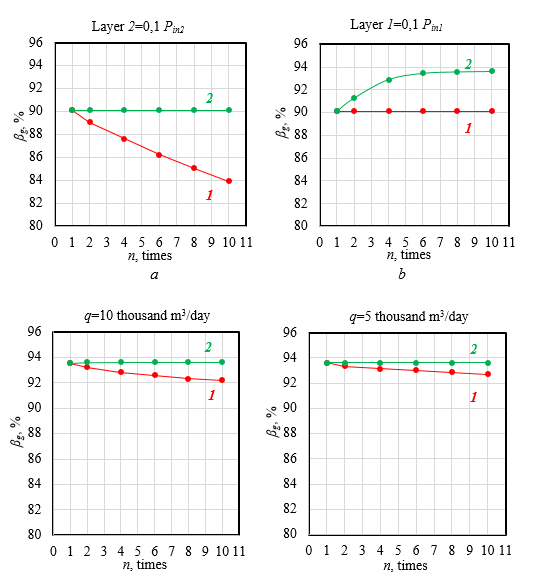
During the research, the influence of the permeability ratio of the layers (n = k2/k1) of the two-layer deposit on the final gas recovery coefficient was determined. It was established that with an increase in the value of n, the high permeability layer is depleted more intensively and is disconnected from development faster. Thus, at the final stage of development for n = 10 in a high-permeability layer, the layer pressure is 3.00 MPa, and in a low-permeability layer – 4.77 MPa. The gas recovery coefficient for a low-permeability layer for n = 10 is only 83.94%, and for a high-permeability layer – 90.11%. Increasing gas recovery can be achieved by transferring wells to simultaneous-separate operation at a certain stage of development, by carrying out treatments of bottomhole zones of low-permeability layers.
The results obtained can be effectively used in the joint development of two hydrodynamically isolated different-permeability layers with joint development by a single well grid. This allows to increase the gas recovery coefficient and the efficiency of further development of two different-permeability layers with an impermeable membrane.
References
- Kondrat, R. M., Kondrat, O. R. (2017). Prohnozuvannia tekhnolohichnykh pokaznykiv rozrobky dvoplastovoho hazovoho rodovyshcha v umovakh hazovoho rezhymu spilnoiu sitkoiu sverdlovyn za postiinoho debitu hazu. Rozvidka ta rozrobka naftovykh i hazovykh rodovyshch, 2, 7–12. Available at: http://nbuv.gov.ua/UJRN/rrngr_2017_2_2
- Kondrat, O. R. (2015). Enhancement of efficiency for further development of a depleted gas condensate fields. Heotekhnichna mekhanika, 122. Available at: https://www.geotm.dp.ua/attachments/article/2904/17.pdf
- Kondrat, R., Dremliukh, N., Kondrat, O., Matiishyn, L. (2023). Determination of predictive technological indicators for the development of a two-seam gas field in the gas mode by a common well grid and their operation with constant wellhead pressure. Prospecting and Development of Oil and Gas Fields, 3, 34–41. https://doi.org/10.69628/pdogf/3.2023.34
- Kondrat, R., Matiishyn, L. (2022). Improving the efficiency of production wells at the final stage of gas field development. Mining of Mineral Deposits, 16 (2), 1–6. https://doi.org/10.33271/mining16.02.001
- Lefkovits, H. C., Hazebroek, P., Allen, E. E., Matthews, C. S. (1961). A Study of the Behavior of Bounded Reservoirs Composed of Stratified Layers. Society of Petroleum Engineers Journal, 1 (1), 43–58. https://doi.org/10.2118/1329-g
- Fetkovlch, M. J., Bradley, M. D., Works, A. M., Thrasher, T. S. (1990). Depletion Performance of Layered Reservoirs Without Crossflow. SPE Formation Evaluation, 5 (3), 310–318. https://doi.org/10.2118/18266-pa
- El-Banbi, A. H., Wattenbarger, R. A. (1996). Analysis of Commingled Tight Gas Reservoirs. SPE Annual Technical Conference and Exhibition. Denver. https://doi.org/10.2118/36736-ms
- Kuppe, F., Chugh, S., Connell, P. (2000). Material Balance for Multi-Layered, Commingled, Tight Gas Reservoirs. SPE/CERI Gas Technology Symposium. Calgary. https://doi.org/10.2118/59760-ms
- Hedong, S., Yujin, W., Shimin, Z., Liangren, L. (2008). Discussion on Dynamic Reserves Estimation of Multilayer Gas Reservoir With Material Balance Method. CIPC/SPE Gas Technology Symposium 2008 Joint Conference. Calgary. https://doi.org/10.2118/113665-ms
- Yujin, W., Yong, H. (2015). The Key Factors Affecting the Deliverability and OGIP of Multi-layer Gas Reservoirs. Abu Dhabi International Petroleum Exhibition and Conference. https://doi.org/10.2118/177647-ms
- Juell, A., Whitson, C. H. (2011). Backpressure Equation for Layered Gas Reservoirs. SPE Annual Technical Conference and Exhibition. Denver. https://doi.org/10.2118/146066-ms
- Fetkovich, M. J., Ebbs, D. J., Voelker, J. J. (1994). Multiwell, Multilayer Model To Evaluate Infill-Drilling Potential in the Oklahoma Hugoton Field. SPE Reservoir Engineering, 9 (3), 162–168. https://doi.org/10.2118/20778-pa
- Artun, E., Canbolat, S., Yildirim, E. C., Acikgoz, C., Yuruker, O. (2024). An Integrated Workflow for Data Analytics-Assisted Reservoir Management with Incomplete Well Log Data. SPE Journal, 30 (2), 486–506. https://doi.org/10.2118/223633-pa
- Kondrat, R. M., Kondrat, O. R., Matiishyn, L. I. (2023). Rozrobka ta ekspluatatsiia hazovykh i hazokondensatnykh rodovyshch. Ivano-Frankivsk: FOLIANT, 568.
Downloads
Published
How to Cite
Issue
Section
License
Copyright (c) 2026 Roman Kondrat, Liliia Matiishyn

This work is licensed under a Creative Commons Attribution 4.0 International License.
The consolidation and conditions for the transfer of copyright (identification of authorship) is carried out in the License Agreement. In particular, the authors reserve the right to the authorship of their manuscript and transfer the first publication of this work to the journal under the terms of the Creative Commons CC BY license. At the same time, they have the right to conclude on their own additional agreements concerning the non-exclusive distribution of the work in the form in which it was published by this journal, but provided that the link to the first publication of the article in this journal is preserved.