Modeling of resource provision of economic security of corporate culture in public administration
DOI:
https://doi.org/10.15587/2706-5448.2026.364320Keywords:
company culture, civil service, institutional sustainability, resources, optimization, security, management, personnel, potentialAbstract
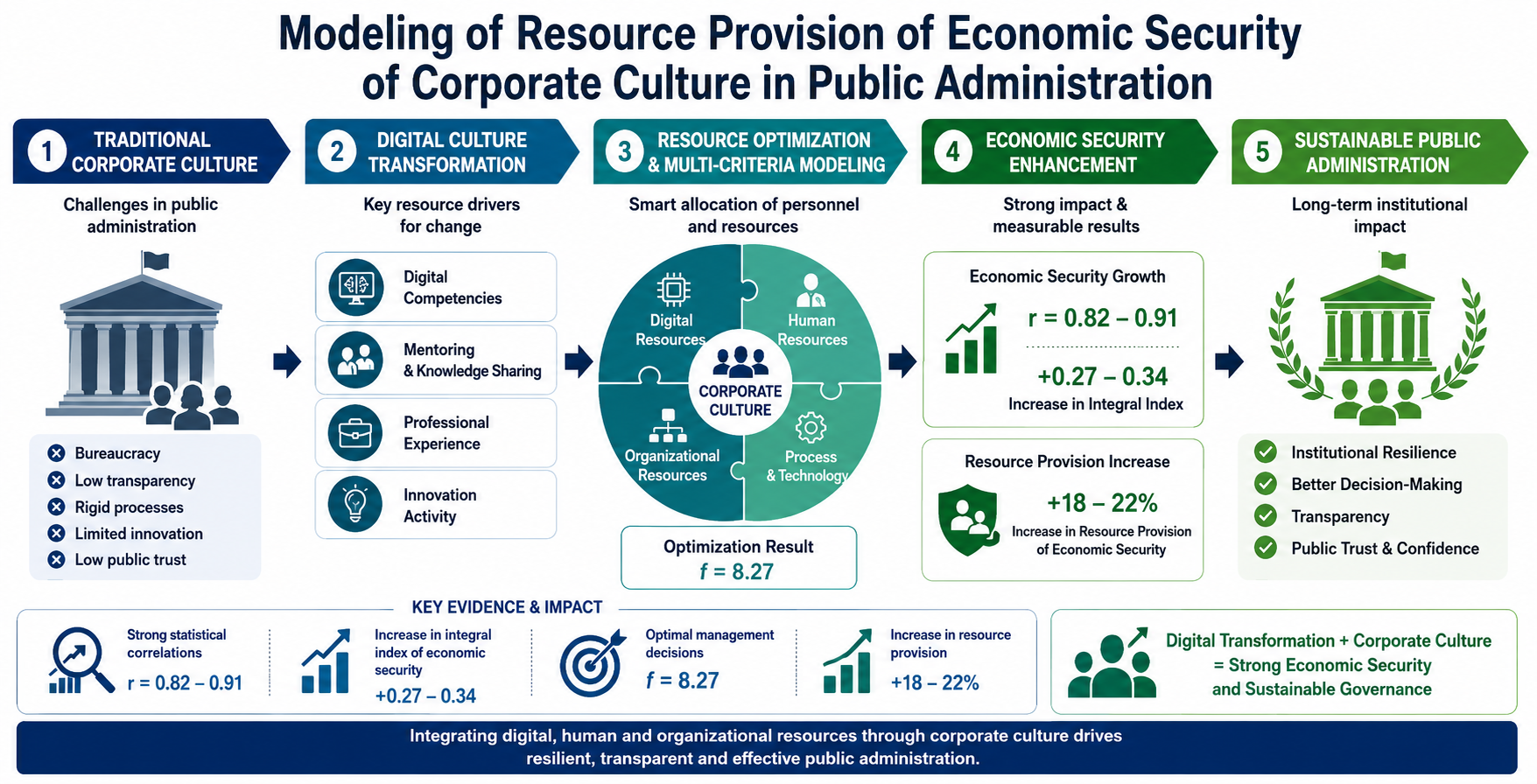
The object of research is the resource provision of economic security of corporate culture in public administration in the context of digital transformation. The problem being solved is to form a comprehensive approach to the specified object. Currently, the implementation of digital transformation tools is forming new requirements for organizational behavior, personnel stability and the management apparatus of state institutions. A generalization and justification of the place of corporate culture as a component of an intangible asset, which creates opportunities for authorities to ensure an appropriate level of economic security. The paper proposes a mathematical model for assessing the impact of corporate culture on economic security based on sequential actions: assignment, normalization of weight coefficients and multi-criteria assessment of subordinates. The methodological basis is the use of tools for correlation and regression analysis, index method, expert assessment and adaptive modelling. Resource elements of corporate culture are identified, such as digital competencies, mentoring, experience, and innovative activity. All of them have an impact on the aggregate indicator of economic security (r = 0.82–0.91). The results obtained indicate a transition to a digital cultural environment, which provides an increase in the indicator of the integral index of economic security by 0.27–0.34 units. Optimization of card distribution contributes to increasing the efficiency of managerial decision-making (f = 8.27). It is substantiated that further implementation of digital practices into corporate culture will increase resource provision indicators by 18–22% and enhance management transparency. The results can be used in the formation of a strategy for resource provision of economic security of public administration by improving corporate culture.
References
- Collins, S., Lawford-Smith, H. (2021). We the People: Is the Polity the State? Journal of the American Philosophical Association, 7 (1), 78–97. https://doi.org/10.1017/apa.2020.15
- Harutyunyan, A. (2022). Some Philosophical and Legal Problems of Qualification of Crimes Against Political Rights in Modern Legal States. Wisdom, 23 (3), 244–253. https://doi.org/10.24234/wisdom.v23i3.684
- Kolisnichenko, R., Tsumariev, M., Melnyk, N., Gorban, I., Marushko, N. (2022). Philosophical and Legal Essence of Control in Terms of Ensuring National Security. Wisdom, 23 (3), 254–261. https://doi.org/10.24234/wisdom.v23i3.832
- Kryshtanovych, M., Dragan, I., Grytsyshen, D., Sergiienko, L., Baranovska, T. (2022). The Public and Environmental Aspect of Restoring Sustainable Regional Development in the Face of the Negative Impact of Military Actions on the Territory of the Country. International Journal of Sustainable Development and Planning, 17 (5), 1645–1651. https://doi.org/10.18280/ijsdp.170530
- Pokataiev, P., Teteruk, K. Andriushchenko, A. (2023). A Biotechnological Business Incubator as an Instrument of Innovation Entrepreneurship. Recent Trends in Business and Entrepreneurial Ventures, 37–60. Available at: https://novapublishers.com/shop/recent-trends-in-business-and-entrepreneurial-ventures/
- Shevchuk, I. (2019). Methodological bases for assessing the state’s economic security. Law and Public Administration, 2 (2), 160–164. https://doi.org/10.32840/pdu.2-2.24
- Amoa-Gyarteng, K., Dhliwayo, S. (2024). Cultivating success: organizational culture’s influence on innovation and performance in SMEs. Cogent Business & Management, 11 (1). https://doi.org/10.1080/23311975.2024.2397070
- Tapia-Espinoza, N. J. (2025). Organizational culture and legitimacy: mediation of the process of knowledge sharing and knowledge creation. Cogent Business & Management, 12 (1). https://doi.org/10.1080/23311975.2025.2583742
- Abawa, A., Obse, H. (2024). Organizational culture and organizational performance: does job satisfaction mediate the relationship? Cogent Business & Management, 11 (1). https://doi.org/10.1080/23311975.2024.2324127
- Adeoye, O., Ran, B. (2023). Government transparency: paradoxes and dilemmas. Public Management Review, 26 (8), 2194–2217. https://doi.org/10.1080/14719037.2023.2181981
- Dinh Thanh, S., Nguyen, C. P., Duy-Tung, B., Binh, N. Q., Van, D. T. B. (2022). Spatial spillover effects of fiscal decentralization on governance and public administration quality. Regional Studies, 57 (3), 478–496. https://doi.org/10.1080/00343404.2022.2078801
- Andriushchenko, K., Liezina, A., Vasylchak, S., Manylich, M., Shterma, T., Petrynyak, U. (2022). Management of the Development of the Innovative Potential of the Region. TEM Journal, 11 (1), 339–347. https://doi.org/10.18421/tem111-43
- Tomkinson, S. (2023). Power and Public Administration: Applying a Transformative Approach to Freedom of/Access to Information Research. Public Integrity, 26 (6), 786–797. https://doi.org/10.1080/10999922.2023.2262156
- Andriushchenko, K., Lavruk, V., Uliganets, S., Kovtun, V., Matviienko, H. (2019). Reputation Risk Management Companies Based on Competence Approach. TEM Journal, 8 (2), 516–524. https://doi.org/10.18421/tem82-27
- Gao, Y., Jin, Z., Wang, K., Wang, J., Khurshid, A. (2026). Transparency, accountability, and the SDGs: A European e-governance perspective. Public Money & Management, 1–5. https://doi.org/10.1080/09540962.2026.2629575
- Szedmák, B., Varga, L., Szabó, R. Z. (2025). Digital Transformation of Public Services: The Case of the Document Management Application. International Journal of Public Administration, 1–18. https://doi.org/10.1080/01900692.2025.2520522
- Liezina, A., Lavruk, A., Matviienko, H., Ivanets, I., Tseluiko, O., Kuchai, O. (2023). Impact of econometric modeling and perspectives of economic security of the cross-industry complex. Acta Innovations, 47, 73–83. https://doi.org/10.32933/actainnovations.47.7
- Wang, Q., Zhou, Y., Alofaysan, H. (2026). New development: E-governance, public policies, and sustainability. Public Money & Management, 1–5. https://doi.org/10.1080/09540962.2026.2614326
- Giacomelli, G., Micacchi, M., Micacchi, L. (2024). Performance shall not live by results alone: organizational subcultures and perceived performance in public administration. Public Money & Management, 44 (6), 500–514. https://doi.org/10.1080/09540962.2023.2295366
- Andriushchenko, K., Khaletska, A., Ushenko, N., Zholnerchyk, H., Ivanets, I., Petrychuk, S., Uliganets, S. (2021). Education process digitalization and its impact on human capital of an enterprise. Journal of Management Information and Decision Sciences, 24 (5), 1–9. Available at: https://www.abacademies.org/articles/Education-process-digitalization-and-its-impact-on-human-capital-of-an-enterprise-1532-5806-24-5-271.pdf
- Sadik-Zada, E. R., Gatto, A., Niftiyev, I. (2022). E-government and petty corruption in public sector service delivery. Technology Analysis & Strategic Management, 36 (12), 3987–4003. https://doi.org/10.1080/09537325.2022.2067037
- Buriachenko, A., Zakhozhay, K., Liezina, A., Lysak, V. (2022). Sustainability and security of public budget of the Visegrad Group countries. Acta Innovations, 42, 71–88. https://doi.org/10.32933/actainnovations.42.6
- Andriushchenko, A., Liezina, A., Kolybo, D., Gurina, G., Havrysh, K., Mazur, N. et al. (2026). Determining the investment attractiveness of the biohacking and bioinnovation market based on market trends in the pharmaceutical business. Technology Audit and Production Reserves, 1 (4 (87)), 21–33. https://doi.org/10.15587/2706-5448.2026.352711
- Peters, B. G., Torfing, J. (2025). Theoretical Framing of Public Administration Research. International Journal of Public Administration, 48 (5-6), 306–320. https://doi.org/10.1080/01900692.2024.2446901
- Andriushchenko, K., Liezina, A., Lavruk, V., Sliusareva, L., Rudevska, V. (2022). Intelligent enterprise capital control based on Markov chain. Acta Innovations, 45, 18–30. https://doi.org/10.32933/actainnovations.45.2
- Maestripieri, L. (2023). Women’s Involuntary Part-Time Employment and Household Economic Security in Europe. Feminist Economics, 29 (4), 223–251. https://doi.org/10.1080/13545701.2023.2251991
- Kondarevych, V., Andriushchenko, K., Pokotylska, N., Ortina, G., Zborovska, O., Budnyak, L. (2020). Digital Transformation of Business Processes of an Enterprise. TEM Journal, 9 (4), 1800–1808. https://doi.org/10.18421/tem94-63
- Gao, X., Qiu, M., Wang, Y., Wang, X. (2022). Information security investment with budget constraint and security information sharing in resource-sharing environments. Journal of the Operational Research Society, 74 (6), 1520–1535. https://doi.org/10.1080/01605682.2022.2096506
- Mekinc, J., Repnik, S. (2025). Corporate security in Spa – Slovenia case. International Journal of Spa and Wellness, 8 (2), 333–349. https://doi.org/10.1080/24721735.2025.2524278
- Cort, T., Park, S. K., Nascimento, D. (2025). Disclosure of corporate risk from socio-economic inequality. Journal of Sustainable Finance & Investment, 15 (3), 714–732. https://doi.org/10.1080/20430795.2025.2452643
- Ikeda, E., Yamazaki, S. (2026). Economic security-defense sector nexus: Japan and India’s strategic complementarity. The Pacific Review, 1–33. https://doi.org/10.1080/09512748.2026.2646559
- Mun, K. G., Cai, W., Rodgers, M., Choi, S. (2023). A data-driven viable supply network for energy security and economic prosperity. International Journal of Production Research, 62 (24), 8988–9010. https://doi.org/10.1080/00207543.2023.2254414
- Li, J., Wang, Y., Su, E. (2026). Digital economy and energy security risk: global impacts and mechanisms. Applied Economics, 1–17. https://doi.org/10.1080/00036846.2026.2653728
- Pokataiev, P., Liezina, A., Petukhova, H., Andriushchenko, A. (2022). The role of biotechnology in the development of the bioeconomy. Acta Innovations, 46, 19–34. https://doi.org/10.32933/actainnovations.46.2
- Pham, T. B. C., Nguyen, H. L., Vu, T. M. T., Truong, V. T. (2022). Corporate governance and earnings management struggles: responses to adapt a modern capital mobilisation in the transitional economy. Cogent Business & Management, 9 (1). https://doi.org/10.1080/23311975.2022.2108216
- Thi Lan Anh, P., Thi Hai Yen, D. (2025). Unpacking the moderating role of corporate governance in the foreign ownership and corporate risk-taking relationship: insights from fsQCA. Cogent Business & Management, 12 (1). https://doi.org/10.1080/23311975.2025.2468370
- Urtado, F., Machado Filho, C. (2024). Corporate governance in startups: a classification model for agtechs in Brazil. Cogent Business & Management, 12 (1). https://doi.org/10.1080/23311975.2024.2437149
- Andriushchenko, K., Datsii, O., Lavruk, O., Dmytrenko, R., Kutashev, I., Vіnіchenko, I. et al. (2021). Development of а matrix of food industry capacity for making management decisions in the formation of sustainable development of agroecosystems. Eastern-European Journal of Enterprise Technologies, 2 (13 (110)), 16–27. https://doi.org/10.15587/1729-4061.2021.227805
- Kovtun, V., Andriushchenko, K., Horbova, N., Lavruk, O., Muzychka, Y. (2020). Features of the Management Process of Ambidextrous Companies. TEM Journal, 9 (1), 221–226. https://doi.org/10.18421/tem91-31
- Hammond, P., Opoku, M. O., Kwakwa, P. A., Berko, D. (2023). Comparison of going concern models with and without corporate governance. Cogent Business & Management, 10 (2). https://doi.org/10.1080/23311975.2023.2234152
- Domina, O., Andriushchenko, K., Liezina, A., Tsymbalenko, Y., Titova, O., Kyryliuk, O., Vylgin, Y. (2025). The Impact of Artificial Intelligence on the Formation of a Teacher’s Digital Twin in the Metaverse. Journal of Vasyl Stefanyk Precarpathian National University, 12 (3), 169–185. https://doi.org/10.15330/jpnu.12.3.169-185
- Saraswati, Rr. S., Yadiati, W., Suharman, H., Soemantri, R. (2024). Corporate governance, intellectual capital, and organizational culture: their influence on lean manufacturing and firm value. Cogent Business & Management, 11 (1). https://doi.org/10.1080/23311975.2024.2382335
- Haneda, S., Ono, A. (2023). Corporate culture and product innovation: evidence from a firm survey. Applied Economics Letters, 31 (21), 2312–2316. https://doi.org/10.1080/13504851.2023.2227411
- Li, T., Li, Z., Tian, Z., Zhao, S. (2025). Corporate culture and R&;D activities: empirical evidence from Chinese listed companies. Applied Economics, 1–18. https://doi.org/10.1080/00036846.2025.2526180
- Eriqat, I. O. A., Tahir, M., Zulkafli, A. H. (2024). The impact of corporate social responsibility disclosure on corporate reputation: the moderating role of national culture in financial industries of MENA region. Cogent Business & Management, 11 (1). https://doi.org/10.1080/23311975.2024.2391120
- Andriushchenko, K., Datsii, O., Aleinikova, O., Mohamed Abdulla, A., Mohammed Ali, A. (2019). Improvement of the water resources management system at the territorial level. Problems and Perspectives in Management, 17 (3), 421–437. https://doi.org/10.21511/ppm.17(3).2019.34
- Intara, P., Sangwichitr, K., Sattayarak, O.-A. (2024). Earnings quality and firm value: Does corporate governance matter? Cogent Business & Management, 11 (1). https://doi.org/10.1080/23311975.2024.2386158
- Lone, R. R., Mollah, S., Yin, S., Simsek, R. (2026). Risk culture, board gender-diversity and bank risk. The European Journal of Finance, 1–28. https://doi.org/10.1080/1351847x.2026.2661757
- Kelly, E., Kelly, C. J., MacCarthaigh, M. (2026). The legacy of ‘cash for ash’ in Northern Ireland: instrumental, cultural, and myth perspectives. Public Money & Management, 1–10. https://doi.org/10.1080/09540962.2026.2628844
- Mahmud, R. (2026). Citizens’ trust in public institutions in the global South: empirical evidence from Bangladesh, Nepal, and Sri Lanka. Asia Pacific Journal of Public Administration, 48 (2), 169–193. https://doi.org/10.1080/23276665.2026.2615440
- Siemers, O., Duygulu, Ş. (2025). Intra-governmental collaborative transformation in the UK: Paving the way forward. Public Money & Management, 1–12. https://doi.org/10.1080/09540962.2025.2558869
- Shalko, M., Domina, O., Korobko, I., Melnyk, D., Andriushchenko, A. (2024). The transformative impact of large language models in healthcare. Technology Audit and Production Reserves, 6 (4 (80)), 32–42. https://doi.org/10.15587/2706-5448.2024.319006
- Almaqtari, F. A., Farhan, N. H. S., Yahya, A. T., Al-Dalaien, B. O. A., Shamim, M. (2022). The mediating effect of IT governance between corporate governance mechanisms, business continuity, and transparency & disclosure: An empirical study of Covid-19 Pandemic in Jordan. Information Security Journal: A Global Perspective, 32 (1), 39–57. https://doi.org/10.1080/19393555.2022.2053001
Downloads
Published
How to Cite
Issue
Section
License
Copyright (c) 2026 Yana Tsymbalenko, Volodymyr Koval, Maksym Boiko, Mariia Tepliuk, Anna Zimina, Lesia Skurinevska, Andrii Blyznyuk, Andrii Biliuk, Natalia Lavruk, Oksana Lavruk

This work is licensed under a Creative Commons Attribution 4.0 International License.
The consolidation and conditions for the transfer of copyright (identification of authorship) is carried out in the License Agreement. In particular, the authors reserve the right to the authorship of their manuscript and transfer the first publication of this work to the journal under the terms of the Creative Commons CC BY license. At the same time, they have the right to conclude on their own additional agreements concerning the non-exclusive distribution of the work in the form in which it was published by this journal, but provided that the link to the first publication of the article in this journal is preserved.