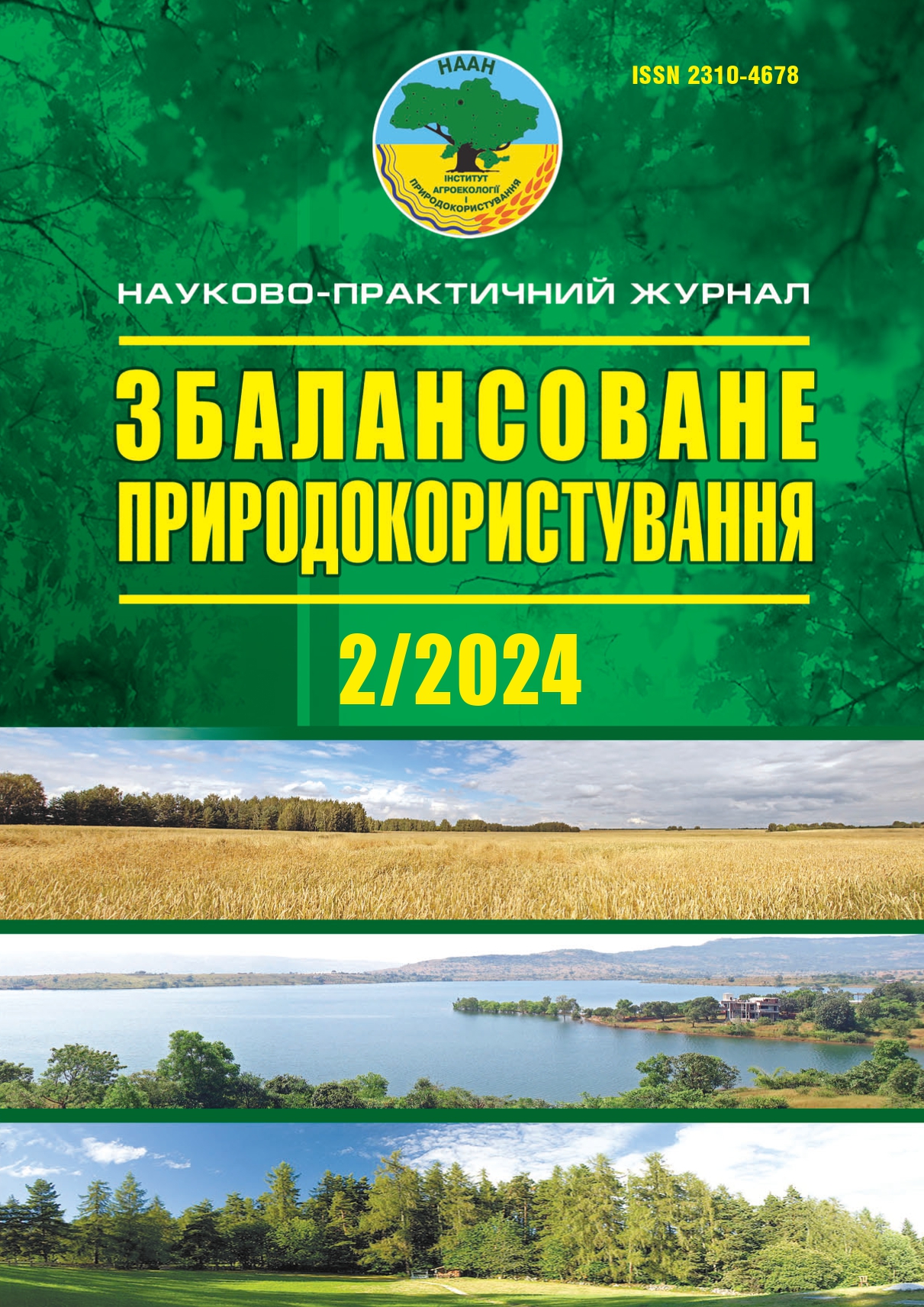
КУЛЬТУРА СОЯ ТА ЇЇ ЗНАЧЕННЯ У СУЧАСНОМУ СВІТОВОМУ І ВІТЧИЗНЯНОМУ АГРОВИРОБНИЦТВІ
DOI:
https://doi.org/10.33730/2310-4678.2.2024.309929Ключові слова:
зернобобова та олійна культура, площа посіву, урожайність, валовий збірАнотація
Мета досліджень — проаналізувати динаміку посівних площ сої, її урожайності та валового збору насіння у світі й Україні за тривалий період, встановити місце України у світовому виробництві насіння культури в умовах військової агресії рф. Для дослідження використано методи порівняння, узагальнення та аналізу цифрового матеріалу. Проведений аналіз статистичних даних і сучасних наукових публікацій дав можливість дослідити динаміку зростання посівних площ сої та її урожайності у світі й Україні, встановити місце України у світовому виробництві насіння культури. Визначено регіони України з максимальною посівною площею сої, урожайністю та валовим збором її насіння. Світовими лідерами виробництва сої у 2023 р. є Бразилія, Сполучені Штати Америки та Аргентина, які сукупно виробили 318,344 млн тонн, що становить 81% від загального світового виробництва. Україна займає дев’яту позицію у світовому рейтингу із часткою 1% у загальному обсязі виробництва сої, виробивши 5,2 млн тонн.
Посилання
- AMIS. (2022). Market Database. Agricultural Market Information System. USDA. URL: https:// data.nal.usda.gov/dataset/amis-market-database [іn English].
- Kyrychenko, V.V., Riabukha, S.S., Kobyzieva, L.N., Posylaieva, O.O., & Chernyshenko, P.V. (2016). Soia (Glycine max (L.) Merr.): monohrafiia [Soy (Glycine max (L.) Merr.): monograph]. Kharkiv [in Ukrainian].
- Hartman, G.L., West, E.D., & Herman, T.K. (2011). Crops that feed the World 2. Soybean — worldwide production, use, and constraints caused by pathogens and pests. Food Secur, 3, 5–17. DOI: 10.1007/s12571-010-0108-x [іn English].
- Messina, M. (2022). Perspective: Soybeans Can Help Address the Caloric and Protein Needs of a Growing Global Population. Front. Nutr, 9, 909464. DOI: 10.3389/fnut.2022.909464 [іn English].
- Hughes, G.J., Ryan, D.J., Mukherjea, R., Schasteen, C.S. (2011). Protein digestibility-corrected amino acid scores (PDCAAS) for soy protein isolates and concentrate: criteria for evaluation. J Agric Food Chemistry, 59, 12707–12712. DOI: 10.1021/jf203220v [іn English].
- Gonzalez, A.D., Frostell, B., & Carlsson-Kanyama, A. (2011). Protein efficiency per unit energy and per unit greenhouse gas emissions: potential contribution of diet choices to climate change mitigation. Food Policy, 36, 562–70. DOI: 10.1016/j.foodpol.2011.07.003 [іn English].
- Baraibar Norberg, M., & Deutschi, L. (2023). The Soybean Through World History. Lessons for Sustainable Agrofood Systems. London and New York. DOI: 10.4324/9780367822866 [іn English].
- Schmutz, J., Cannon, S.B., Schlueter, J. et al. (2010). Genome sequence of the palaeopolyploid soybean. Nature, 463, 178–183. DOI: 10.1038/nature08670 [іn English].
- Hymowitz, T. (1970). On the domestication of the soybean. Economic Botany, 24, 408–421. DOI: 10.1007/BF02860745 [іn English].
- Li, Y., Guan, R., Liu, Z. et al. (2008). Genetic structure and diversity of cultivated soybean (Glycine max (L.) Merr.) landraces in China. Theor Appl Genet, 117, 857–871. DOI: 10.1007/s00122-008-0825-0 [іn English].
- Hou, Z., Fang, C., Liu, B., Yang, H., & Kong, F. (2023). Origin, variation, and selection of natural alleles controlling flowering and adaptation in wild and cultivated soybean. Mol Breed, 43 (5), 36. DOI: 10.1007/s11032-023-01382-4 [іn English].
- Wilson, R.F. (2008). Soybean: market driven research needs in genetics and genomics of soybean. DOI: 10.1007/978-0-387-72299-3_1 [іn English].
- Kim, M.Y., Van, K., Kang, Y.J., Kim, K.H., & Lee, S.-H. (2012). Tracing soybean domestication history: from nucleotide to genome. Breeding Science, 61, 445–452. DOI: 10.1270/jsbbs.61.445 [іn English].
- Sedivy, E.J., Wu, F., & Hanzawa, Y. (2017). Soybean domestication: the origin, genetic architecture and molecular bases. New Phytologist, 214 (2), 539–553. DOI: https://doi.org/10.1111/nph.14418 [іn English].
- Lee, K.Y., Rahman, M.S., Kim, A.N. et al. (2019). Quality characteristics and storage stability of low-fat tofu prepared with defatted soy flours treated by supercritical-CO2 and hexane. LWT Food Sci. Technol, 100, 237–243 [іn English].
- Song, H., Taylor, D.C., & Zhang, M. (2023). Bioengineering of Soybean Oil and Its Impact on Agronomic Traits. Int J Mol Sci, 24 (3), 2256. DOI: 10.3390/ijms24032256 [іn English].
- Xu, R., Hu, W., Zhou, Y. et al. (2020). Use of near-infrared spectroscopy for the rapid evaluation of soybean [Glycine max (L.) Merri.] water soluble protein content. Spectrochim. Acta A Mol Biomol Spectrosc, 224, 117400. DOI: 10.1016/j.saa.2019.117400 [іn English].
- Bellaloui, N., Reddy, K.N., Bruns, H.A., Gillen A. (Ed.) et al. (2011). Soybean seed composition and quality: Interactions of environment, genotype, and management practices. In Soybeans: Cultivation, Uses and Nutrition, 1st ed. Nova Science Publishers, Inc.: New York, NY, USA [іn English].
- Diers, B., Specht, J., Rainey, K.M. et al. (2018). Genetic Architecture of Soybean Yield and Agronomic Traits. G3. Genes, Genomes, Genetics, 8 (10), 3367–3375. DOI: https://doi.org/10.1534/g3.118.200332 [іn English].
- Islam, S.M., & Muhyidiyn, I. (2022). Rafiqul Islam et al. Soybean and Sustainable Agriculture for Food Security. IntechOpen. DOI: 10.5772/intechopen.104129 [іn English].
- Ritchie, H. (2021). Is our appetite for soy driving deforestation in the Amazon? Our World in Data. URL: https://ourworldindata.org/soy [іn English].
- Food and Agriculture Organization of the United Nations. Food Balance Sheets. FAOSTAT (n.d.). URL: http://www.fao.org/faostat/en/#data/FBS [іn English].
- Woyengo, T.A., Beltranena, E., & Zijlstra, R.T. (2017). Effect of anti-nutritional factors of oilseed co-products on feed intake of pigs and poultry. Animal Feed Science and Technology, 233, 76–86. DOI: 10.1016/j.anifeedsci.2016.05.006 [іn English].
- Petrychenko, V.F., & Kots, S.Ia. (2014). Symbiotychni systemy u suchasnomu silskohospodarskomu vyrobnytstvi. Visnyk NAN Ukrainy, 3, 57–66 [in Ukrainian].
- Sichkar, V.I. (2016). Suchasnyi stan i perspektyvy vyroshchuvannia zernobobovykh kultur na nashii planeti [The current state and prospects of growing legumes on our planet]. Zernobobovi kultury ta soia dlia staloho rozvytku ahrarnoho vyrobnytstva Ukrainy: materialy mizhnar. nauk. konf. (11–12 serpnia 2016 r.) — Legumes and soybeans for the sustainable development of agricultural production in Ukraine: materials of the international scientific conference (p. 14–15). Vinnytsia [in Ukrainian].
- Faе, G.S., Kemanian, A.R., Roth, G.W., White, C., & Watson, J.E. (2020). Soybean Yield in Relation to Environmental and Soil Properties. Eur. J. Agron, 118, 126070. DOI: https://doi.org/10.1016/j.eja.2020.126070 [іn English].
- Ladha, J.K., Peoples, M.B., Reddy, P.M. et al. (2022). Biological nitrogen fixation and prospects for ecological intensification in cereal-based cropping systems. Field Crops Research, 283, 108541. DOI: https://doi.org/10.1016/j.fcr.2022.108541 [іn English].
- Patyka, V.P., Kots, S.Ya., Volkohon, V.V., & Sherstoboieva, O.V. (2003). Biolohichnyi azot: monohrafiia [Biological nitrogen: monograph]. Kyiv: Svit [in Ukrainian].
- Balboa, G.R., Sadras, V.O., & Ciampitti, I.A. (2018). Shifts in soybean yield, nutrient uptake, and nutrient stoichiometry: a historical synthesis-analysis. Crop Sci, 58 (1), 43–54. DOI: https://doi.org/10.2135/cropsci2017.06.0349 [іn English].
- Ciampitti, I.A., Salvagiotti, F. (2018). New insights into soybean biological nitrogen fixation. Agronomy J., 110 (4), 1185–1196. DOI: https://doi.org/10.2134/agronj2017.06.0348 [іn English].
- Fraanje, W., & Garnett, T. (2020). Soy: Food, feed, and land use change (Foodsource: Building Blocks). Food Climate Research Network. URL: https://tabledebates.org/sites/default/files/2021-12/FCRN%20Building%20Block%20-%20Soy_food%2C%20feed%2C%20and%20land%20 use%20change%20%281%29.pdf [іn English].
- Voora, V., Bermudez, S., Le, H., Larrea, C., Luna, E. (2024). Global Market Report. Soybean prices and sustainability. IISD. URL: https://www.iisd.org/system/files/2024-02/2024-global-market-report-soybean.pdf [іn English].
- FAOSTAT. (2022). FAOSTAT Statistical Database. HD9000.4. Library of Congress Online Catalog (1,343,705).Rome: FAO [іn English].
- Global Soybean Market Growth, Analysis, Trends, Forecast: By Nature: Organic, Conventional; By Application: Animal Feed, Human Food, Biodiesel and Lubricants, Others; Regional Analysis; Market Dynamics: SWOT Analysis, Porter’s Five Forces Analysis; Competitive Landscape; Key Trends and Developments in the Market. Р. [іn English].
- Sauer, S. (2024). Soy expansion into the agricultural frontiers of the Brazilian — 2032. URL: https://www.expertmarketresearch.com/reports/soybean-market/requestsample [іn English].
- USDA. Soybean 2023. World Production. URL: https://ipad.fas.usda.gov/cropexplorer/cropview/commodityView.aspx?cropid=2222000 [іn English].
- Food and Agriculture Organization of the United Nations. (2023). Soybean production. URL: https://ourworldindata.org/grapher/soybean-production?tab=chart&country=UKR~OWID_WRL [іn English].
- Baraibar Norberg, М. (2022). Sojización as a New First Movement: A Polanyian Analysis of the South American Soybean Boom. In: The Age of the Soybean: An Environmental History of the Soyacene during the Great Acceleration. Еd. by da Silva, and de Majo. Winwick, Cambridgeshire: The White Horse Press [іn English].
- Alfonso, M. (2020). Improving soybean seed oil without poor agronomics. J. Exp. Bot, 71, 6857–6860. DOI: 10.1093/jxb/eraa407 [іn English].
- Bindraban, P.S., Franke, A.C., Ferrar, D.O. et al. (2009). GM-related sustainability: agro-ecological impacts, risk and opportunities of soy production in Argentina and Brazil. Plant Research International. URL: https://edepot.wur.nl/7954 [іn English].
- Fehlenberg, V. Baumann, M., Gasparri, N.I. et al. (2017). The role of soybean production as an underlying driver of deforestation in the South American Chaco. Global Environmental Change, 45, 24–34. DOI: 10.1016/j.gloenvcha.2017.05.001 [іn English].
- Gasparri, N.I., & de Waroux, Y. le P. (2015). The Coupling of South American Soybean and Cattle Production Frontiers: New Challenges for Conservation Policy and Land Change Science. Conservation Letters, 8, 290–298. doi: 10.1111/conl.12121 [іn English].
- Sauer, S. (2018). Soy expansion into the agricultural frontiers of the Brazilian Amazon: the agribusiness economy and its social and environmental conflicts. Land use policy, 79, 326–338 [іn English].
- ISAAA. (2019). Global Status of Commercialized Biotech/GM Crops in 2019: Biotech Crops Drive SocioEconomic Development and Sustainable Environment in the New Frontier. ISAAA Brief No. 55. Ithaca, NY: Cornell University [іn English].
- Silske hospodarstvo Ukrainy 2022. Statystychnyi zbirnyk [Agriculture of Ukraine 2022. Statistical collection]. (2023). Kyiv: State Statistics Service of Ukraine [in Ukrainian].
- Ofitsiinyi vebsait Derzhavnoi sluzhby statystyky Ukrainy [Official website of the State Statistics Service of Ukraine]. (n.d.). URL: http://ukrstat.gov.ua [in Ukrainian].
- Korobko, A.A. (2021). Dynamika vyrobnytstva soi v Ukraini ta sviti [Dynamics of soybean production in Ukraine and the world]. Zbalansovane pryrodokorystuvannia — Balanced nature management, 4, 125–134. doi: 10.33730/2310-4678.4. 253098 [in Ukrainian].
- Petrychenko, V.F., & Voronetska, I.S. (2017). Vyrobnytstvo oliinykh kultur v Ukraini: suchasni vyklyky ta perspektyvy [Production of oil crops in Ukraine: modern challenges and prospects]. Ekonomika APK — Economy of APC, 10, 32–40 [in Ukrainian].
- Pro vnesennia zmin do Podatkovoho kodeksu Ukrainy ta deiakykh zakonodavchykh aktiv Ukrainy shchodo zabezpechennia zbalansovanosti biudzhetnykh nadkhodzhen u 2018 rotsi: Zakon Ukrainy vid 21 hrudnia 2017 roku № 2245-VIII [On amendments to the Tax Code of Ukraine and some legislative acts of Ukraine on ensuring the balance of budget revenues in 2018: Law of Ukraine dated December 21, 2017 No 2245-VIII]. (2017). URL: https://zakon.rada.gov.ua/laws/show/2245-19#Text [in Ukrainian].
- Coman, V., Oprea, I., Leopold, L.F., Vodnar, D.C., & Coman, C. (2019). Soybean Interaction with Engineered Nanomaterials: A Literature Review of Recent Data. Nanomaterials (Basel), 9 (9), 1248. DOI: 10.3390/nano9091248 [іn English].
- Yusefi-Tanha, E., Fallah, S., Pokhrel, L.R., & Rostamnejadi, A. (2023). Addressing global food insecurity: Soil-applied zinc oxide nanoparticles promote yield attributes and seed nutrient quality in Glycine max L. Sci Total Environ, 876, 162762. DOI: 10.1016/j.scitotenv.2023.162762 [іn English].
- Zhang, M., Liu, S., Wang, Z. et al. (2022). Progress in soybean functional genomics over the past decade. Plant Biotechnol. J., 20, 256–282. DOI: 10.1111/pbi.13682 [іn English].
##submission.downloads##
Опубліковано
Номер
Розділ
Ліцензія
- Автори залишають за собою право на авторство своєї роботи та передають журналу право першої публікації цієї роботи на умовах ліцензії Creative Commons Attribution License, котра дозволяє іншим особам вільно розповсюджувати опубліковану роботу з обов'язковим посиланням на авторів оригінальної роботи та першу публікацію роботи у цьому журналі.
- Автори мають право укладати самостійні додаткові угоди щодо неексклюзивного розповсюдження роботи у тому вигляді, в якому вона була опублікована цим журналом (наприклад, розміщувати роботу в електронному сховищі установи або публікувати у складі монографії), за умови збереження посилання на першу публікацію роботи у цьому журналі.
- Політика журналу дозволяє і заохочує розміщення авторами в мережі Інтернет (наприклад, у сховищах установ або на особистих веб-сайтах) рукопису роботи, як до подання цього рукопису до редакції, так і під час його редакційного опрацювання, оскільки це сприяє виникненню продуктивної наукової дискусії та позитивно позначається на оперативності та динаміці цитування опублікованої роботи (див. The Effect of Open Access).