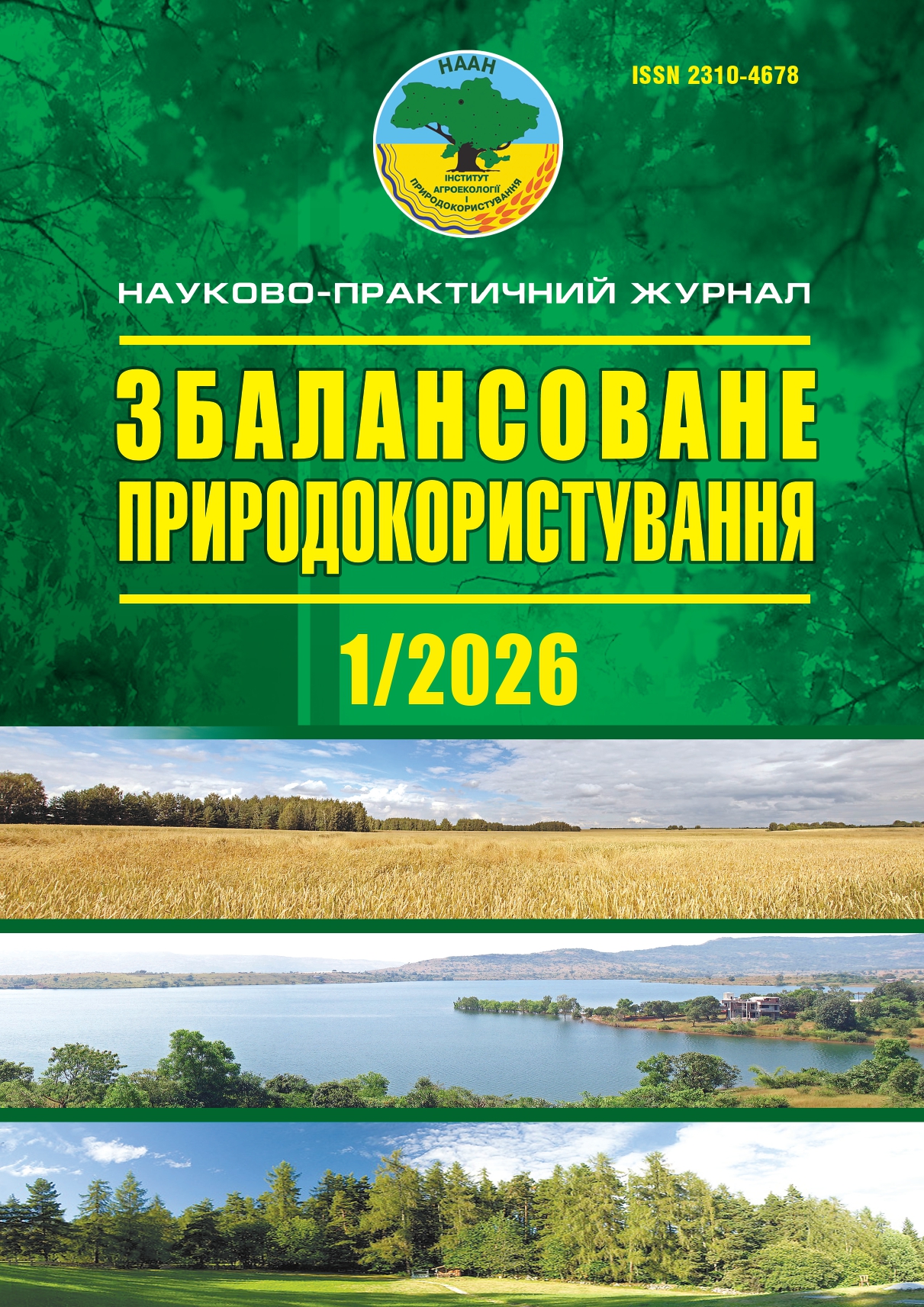
Compensatory ecological and economic mechanism in the system of balanced spatial development of forestry
DOI:
https://doi.org/10.33730/2310-4678.1.2026.359900Keywords:
balanced space, structure, compensatory financial mechanisms/instruments, eco-destructive costs, ecological risk, forest ecosystemAbstract
Contemporary transformational eco-destructive challenges (global climate change, military and corruption challenges, pollution, man-made emergencies, the low ecological, economic, and organizational level of forest use) in the system of spatial forestry development necessitate deepening the theoretical and organizational foundations for the formation of a comprehensive compensation mechanism aimed at eliminating disturbances to the ecological balance in forest ecosystems, as well as restoring the resource, ecosystem, and socio-ecological potential of forests at various hierarchical levels of spatial forest management. The purpose of this study is to deepen the organizational and economic foundations for the development of a compensatory ecological and economic mechanism for ensuring the balanced spatial development of forestry. The essential and substantive basis of the compensation mechanism for eco-destructive costs (losses, damages) resulting from the action of identified anthropogenic factors (inefficient, environmentally hazardous management, targeted pollution, removal of forestry lands, war damage, etc.) is characterized through the following components: the mechanism of economic and legal environmental responsibility (including a system of contractual relations), public-private partnerships, a system of forest environmental insurance, a mechanism of social and environmental responsibility, and the environmentally oriented activities of social enterprises and non-profit organizations. Emphasis is placed on the formation of the space for compensation for eco-destructive costs. For the first time, the structural components of a comprehensive compensatory ecological and economic mechanism for ensuring balanced spatial forest management have been substantiated in the following format: a compensation mechanism for minimizing the environmental risks of forest management, a comprehensive mechanism for compensating for eco-destructive costs (losses), and a compensation mechanism for preserving and restoring the ecosystem potential (capital) of forests. The essential and substantive basis of the compensation mechanism for minimizing the environmental risks of forest management is revealed.
References
- Бублик, М. І. (2008). Особливості оцінки збитків від надзвичайних ситуацій у лісовому господарстві. Науковий вісник НЛТУ України, 18.5, 230–238. Взято з https://nv.nltu.edu.ua/Archive/2008/18_5/230_Bublyk_18_5.pdf
- Веклич, О. О. (2018). Екосистемний підхід оцінювання економічного збитку від забруднення навколишнього природного середовища: українська автентичність. Економіка України, 4(677), 63–75. doi: 10.15407/economyukr.2018.04.063
- Дубас, Р. Г. (2011). Методичні підходи еколого-економічної оцінки лісових ресурсів. Ефективна економіка, 11, 39–43. Взято з http://www.economy.nayka.com.ua/?op=1&z=761
- Коваль, Я. В., & Антоненко, І. Я. (2004). Економічна (грошова) оцінка природних ресурсів лісового фонду України: теорія, методологія, методика. Київ: РВПС України НАН України.
- Дребот, О. І., Шершун, М. Х., & Шкуратов, О. І. (2014). Збалансований розвиток лісового сектору економіки в контексті європейської інтеграції України (О. І. Фурдичко, Ред.). Київ: Аграрна наука.
- Ткач, В. П., Висоцька, Н. Ю., Торосов, А. С., Букша, І. Ф., Пастернак, В. П., Лось, С. А., … Бондар, О. Б. (2023). Економічна оцінка екосистемних послуг лісів України. Харків: УкрНДІЛГА. Взято з https://uriffm.org.ua/static/main/files/EcoSys.pdf
- Мельник, Л. Г., & Карінцева, О. І. (Ред.). (2004). Методи оцінки екологічних втрат. Суми: ВТД “Університетська книга”.
- Мішенін, Є. В., Мішеніна, Н. В., & Ярова, І. Є. (2016). Системна оцінка рекреаційного землегосподарювання у механізмі екосистемного управління природоохоронними територіями. Збалансоване природокористування, 3, 126–132.
- Соловій, І. П. (2016). Оцінка послуг екосистем, забезпечуваних лісами України, та пропозиції щодо механізмів плати за послуги екосистем. Взято з https://d2ouvy59p0dg6k.cloudfront.net/downloads/evaluation_of_forest_ecosystem_services_and_proposals_on_pes_mechanisms.pdf
- Костецька, К. О. (2011). Формування компенсаційного механізму природокористування в транскордонному контексті (Дис. канд. екон. наук, Ін-т проблем ринку та екон.-екол. досл. НАН України). Одеса. Взято з http://www.irbis-nbuv.gov.ua/
- Купінець, Л. Є., & Жавнерчик, О. В. (2016). Екологічна безпека аграрного землекористування: теорія і механізми забезпечення. Одеса: ІПРЕЕД НАНУ.
- Мішенін, Є. В. (1998). Еколого-економічні проблеми природокористування у лісовому комплексі (Я. В. Коваль, Ред.). Суми: ВВП “Мрія-1” ЛТД.
- Веклич, О. О. (2019). Структура сучасного механізму екологічної компенсації (механізму еко-компенсації). Ефективна економіка, 8. doi: 10.32702/2307-2105-2019.8.3
- Веклич, О. О., Кобзар, О. М., Колмакова, В. М., & Патока, І. М. (2019). Екосистемні засади оцінювання збитків від забруднення навколишнього природного середовища. Київ: ДУ ІЕПСР НАН України.
- Сай, В., & Хавар, Ю. (2022). Механізм відшкодування втрат лісогосподарського виробництва для ефективного ведення кадастру лісових земель. Cучасні досягнення геодезичної науки та виробництва, 2(44), 113–120. Взято з https://ena.lpnu.ua/bitstreams/6eac4fa9-1577-41e4-b84a-6352b857cec1/download
- Ярошенко, А. С., Дума, А. А., & Марочко, А. А. (2021). Організаційно-правовий механізм охорони лісових ресурсів. Науковий вісник Ужгородського національного університету. Серія: Право, 67, 169–173. doi: 10.24144/2307-3322.2021.67.33
- Закон України “Про охорону навколишнього природного середовища” № 1264-XII. (1991, 25 червня). Взято з http://zakon2.rada.gov.ua/laws/show/1264-12/page4
- Alfaro, R. I., Fady, B., Vendramin, G. G., Dawson, I. K., Fleming, R. A., Saenz-Romero, C., Lindig-Cisneros, R. A., Murdock, T., Vinceti, B., & Navarro, C. M. (2014). The role of forest genetic resources in responding to biotic and abiotic factors in the context of anthropogenic climate change. Forest Ecology and Management, 333, 76–87. doi: 10.1016/j.foreco.2014.04.006
- Barbier, E. B., Burgess, J. C., & Dean, T. J. (2018). How to pay for saving biodiversity. Science, 360(6388), 486–488. doi: 10.1126/science.aar3454
- Буркінський, Б. В., & Галушкіна, Т. П. (2006). Глобалізація економіки та національна екологічна доктрина. Економіст, 9, 20–23.
- Li, J., & Wang, Y. (2022). Ecosystem services assessment from capacity to flow: A review. Transactions in Earth, Environment, and Sustainability, 1(1), 80–93. doi: 10.1177/2754124X221141991
Downloads
Published
Issue
Section
License
- The authors reserve the right to authorship their work and pass the journal the right to publish this work under a Creative Commons Attribution License license, which allows other persons to freely distribute the published work with the obligatory The authors of the original work and the first publication of this magazine.
- The authors have the right to make independent additional agreements on the nonexclusive dissemination of the work in the form in which it was published by this magazine (for example, to post work in the company's electronic storage or to publish as a monograph) , subject to the first publication of the link to this journal.
- Journal policy allows and encourages the placement of authors on the Internet (for example, in the repositories of institutions or on personal websites) manuscript work as to the presentation of this manuscript to the editorial board and during its editorial processing, as it contributes to The productive scientific discussion and positively affects the efficiency and dynamics of citation published work (see The Effect of Open Access).