The use of fecal calprotectin in the diagnosis of symptomatic uncomplicated diverticular disease in carbohydrate metabolism disorders
DOI:
https://doi.org/10.15587/2519-4798.2026.361768Keywords:
fecal calprotectin, diverticular disease, inflammatory markers, type 2 diabetes, gastroenterology, microangiopathy, diagnostic accuracyAbstract
Aim. To investigate the diagnostic value of fecal calprotectin levels in patients with isolated colonic diverticular disease and its combination with type 2 diabetes.
Materials and methods. An open comparative cohort study was conducted, involving 60 individuals. The patients were divided into the following groups: 20 patients with verified colonic diverticular disease combined with type 2 diabetes, 10 patients with type 2 diabetes without intestinal lesions, 19 patients with isolated colonic diverticular disease, and a control group of 11 practically healthy individuals. To assess local inflammation in the intestinal wall, the level of fecal calprotectin was measured in all participants. Statistical processing included ROC analysis with the calculation of the Youden index to determine the optimal diagnostic accuracy thresholds.
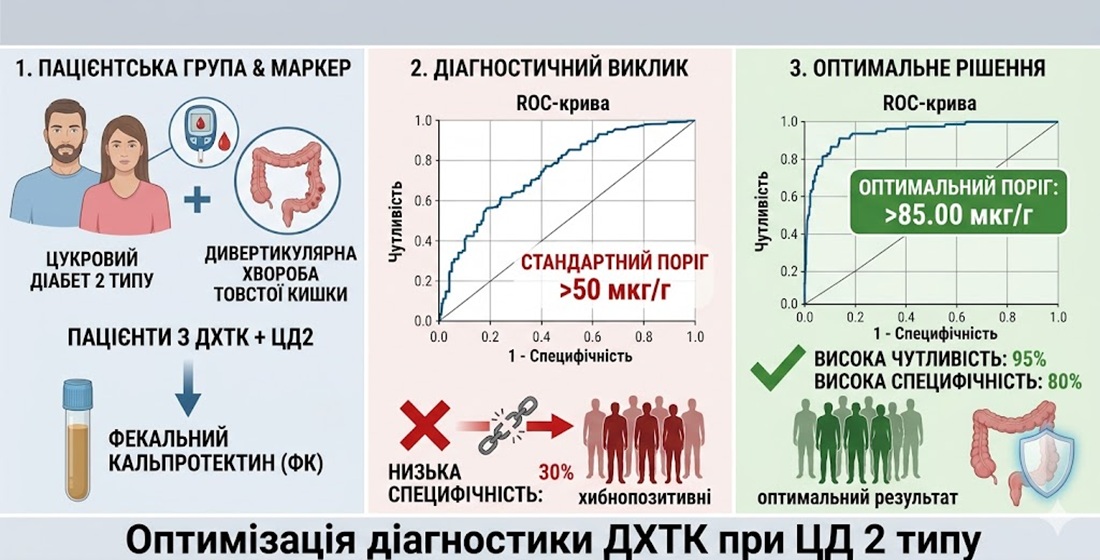
Results. It was established that the mean fecal calprotectin level in patients with colonic diverticular disease and concomitant type 2 diabetes was 152.90±57.14 μg/g, which significantly exceeded the values in patients with type 2 diabetes without colonic diverticular disease (68.40±24.65 μg/g). In the group of individuals with isolated colonic diverticular disease, the fecal calprotectin level was 125.26±46.13 μg/g. According to the ROC analysis, the use of the standard fecal calprotectin threshold value (>50.00 μg/g) in patients with concomitant type 2 diabetes leads to a sharp decrease in diagnostic specificity to 30.00 % while maintaining sensitivity at
100.00 %. The calculation of the Youden index demonstrated that increasing the threshold to 85.00 μg/g is optimal for this patient cohort. This increase allows for diagnostics with a sensitivity of 95.00% and a specificity of 80.00 %. For patients without concomitant metabolic pathology, using the 85.00 μg/g threshold also contributes to an increase in specificity to 90.91 %.
Conclusions. The course of colonic diverticular disease with concomitant type 2 diabetes is accompanied by more pronounced local inflammation compared to the isolated form of the disease. To optimize diagnostics and prevent false-positive results in patients with concomitant carbohydrate metabolism disorders, it is advisable to increase the fecal calprotectin threshold value. Shifting the threshold to 85.00 μg/g ensures the restoration of the optimal balance of high sensitivity and specificity in both comorbid patients and individuals with isolated pathology
References
- Brown, R. F., Lopez, K., Smith, C. B., Charles, A. (2025). Diverticulitis. Jama, 334 (13), 1180. https://doi.org/10.1001/jama.2025.10234
- Hashi, R., Thamer, R., Hassan, A., Canna, K., Ahmed, M., Hassan, M. T. et al. (2025). A Contemporary Multifaceted Insight into the Association Between Diabetes Mellitus and Diverticular Disease: An Update About Geriatric Syndrome. Geriatrics, 10 (1), 30. https://doi.org/10.3390/geriatrics10010030
- Völkerer, A., Semmler, G., Flamm, M., Ausserwinkler, M., Koch, G., Thöne, P. et al. (2025). Association between diabetes mellitus and diverticulosis: a cross-sectional analysis. Wiener Klinische Wochenschrift, 138 (9-10), 301–311. https://doi.org/10.1007/s00508-025-02633-4
- Tursi, A., Piovani, D., Brandimarte, G., Di Mario, F., Elisei, W., Picchio, M. et al. (2025). Bowel movement alterations predict the severity of diverticular disease and the risk of acute diverticulitis: a prospective, international study. Intestinal Research, 23 (1), 96–106. https://doi.org/10.5217/ir.2024.00046
- Tursi, A., Piovani, D., Brandimarte, G., Di Mario, F., Elisei, W., Picchio, M. et al. (2023). Diverticular Inflammation and Complication Assessment classification, CODA score and fecal calprotectin in clinical assessment of patients with diverticular disease: A decision curve analysis. United European Gastroenterology Journal, 11 (7), 642–653. https://doi.org/10.1002/ueg2.12369
- Tursi, A., Rodinò, S., Sebkova, L., Furfaro, F., Danese, S. (2025). Evaluation of the Effect of a Cranberry Formulation in Reducing the Inflammatory State and Improving the Management of Symptoms in Patients with Symptomatic Uncomplicated Diverticular Disease: A Prospective, Open-Label, Single-Arm, Multi-Center, Pilot Study. Pharmaceutics, 18 (1), 42. https://doi.org/10.3390/pharmaceutics18010042
- Sargautiene, V., Gavars, D., Ligere, R. (2024). Fecal Calprotectin, Serum Ferritin, and C-Reactive Protein Levels in Individuals with Inflammatory Bowel Disease Concomitant with Type 2 Diabetes: A Retrospective Study. Clinical Diabetology, 13 (2), 106–115. https://doi.org/10.5603/cd.99017
- Bergmann, K., Stefańska, A., Kuligowska-Prusińska, M., Krintus, M. (2025). Serum Calprotectin is Associated with Overweight and Laboratory Markers of Glucose Metabolism in Apparently Healthy Young Adults – A Cross-Sectional Descriptive Study. Metabolites, 15 (12), 756. https://doi.org/10.3390/metabo15120756
- Gallo, A., Covino, M., Baroni, S., Camilli, S., Ibba, F., Andaloro, S. et al. (2024). Diagnostic Accuracy of Fecal Calprotectin in Discriminating Organic-Inflammatory Gastrointestinal Diseases and Functional Gastrointestinal Disorders in Older Patients. Journal of Personalized Medicine, 14 (3), 227. https://doi.org/10.3390/jpm14030227
- Lee, S. Y., Han, K., Kwon, H.-S., Koh, E. S., Chung, S. (2025). Fecal Calprotectin as a Prognostic Biomarker for Mortality and Renal Outcomes in Chronic Kidney Disease. Biomolecules, 15 (4), 557. https://doi.org/10.3390/biom15040557
- Bourgonje, A. R., Bourgonje, M. F., Sokooti, S., la Bastide-van Gemert, S., Nilsen, T., Hidden, C. et al. (2024). Plasma Calprotectin and New-onset Type 2 Diabetes in the General Population: A Prospective Cohort Study. The Journal of Clinical Endocrinology & Metabolism, 110 (1), e150–e159. https://doi.org/10.1210/clinem/dgae130
- Coleman, M. J., Espino, L. M., Lebensohn, H., Zimkute, M. V., Yaghooti, N., Ling, C. L. et al. (2022). Individuals with Metabolic Syndrome Show Altered Fecal Lipidomic Profiles with No Signs of Intestinal Inflammation or Increased Intestinal Permeability. Metabolites, 12 (5), 431. https://doi.org/10.3390/metabo12050431
- Bamias, G., Fessatou, S., Kapizioni, C., Kitsou, K., Kokkotis, G., Kourti, A. et al. (2026). Expert recommendations regarding the use of fecal calprotectin in daily clinical practice: statements of a taskforce process from the Hellenic Group for the Study of Inflammatory Bowel Disease (EOMIFNE). Annals of Gastroenterology, 39. https://doi.org/10.20524/aog.2026.1040
- Bencardino, S., D’Amico, F., Zilli, A., Parigi, T. L., Allocca, M., Fiorino, G. et al. (2024). Fecal, Blood, and Urinary Biomarkers in Inflammatory Bowel Diseases. Journal of Translational Gastroenterology, 2 (2), 61–75. https://doi.org/10.14218/jtg.2024.00001
- Heinzel, S., Jureczek, J., Kainulainen, V., Nieminen, A. I., Suenkel, U., von Thaler, A.-K. et al. (2024). Elevated fecal calprotectin is associated with gut microbial dysbiosis, altered serum markers and clinical outcomes in older individuals. Scientific Reports, 14 (1). https://doi.org/10.1038/s41598-024-63893-0
- Løfblad, L., Hov, G. G., Åsberg, A., Videm, V. (2023). Calprotectin and CRP as biomarkers of cardiovascular disease risk in patients with chronic kidney disease: a follow-up study at 5 and 10 years. Scandinavian Journal of Clinical and Laboratory Investigation, 83 (4), 258–263. https://doi.org/10.1080/00365513.2023.2211779
Downloads
Published
How to Cite
Issue
Section
License
Copyright (c) 2026 Valentyna Dzvonkovska, Vasyl Neiko, Tetiana Salyzhyn, Nazar Feshovets

This work is licensed under a Creative Commons Attribution 4.0 International License.
Our journal abides by the Creative Commons Attribution 4.0 International License copyright rights and permissions for open access journals.
Authors, who are published in this journal, agree to the following conditions:
1. The authors reserve the right to authorship of the work and pass the first publication right of this work to the journal under the terms of a Creative Commons Attribution 4.0 International License, which allows others to freely distribute the published research with the obligatory reference to the authors of the original work and the first publication of the work in this journal.
2. The authors have the right to conclude separate supplement agreements that relate to non-exclusive work distribution in the form in which it has been published by the journal (for example, to upload the work to the online storage of the journal or publish it as part of a monograph), provided that the reference to the first publication of the work in this journal is included.
3. Authors have the right to store the final accepted version of the article in an institutional, thematic, or any other repository to ensure visibility and accessibility.


