Blood pressure monitoring in pregnant women at risk of developing preeclampsia
DOI:
https://doi.org/10.15587/2519-4798.2026.362854Keywords:
pregnancy, preeclampsia, ambulatory blood pressure monitoring, hemodynamics, nocturnal hypertension, blood pressure variability, endothelial dysfunctionAbstract
The aim of research - to determine the hemodynamic patterns of preeclampsia development in pregnant women based on ambulatory blood pressure monitoring.
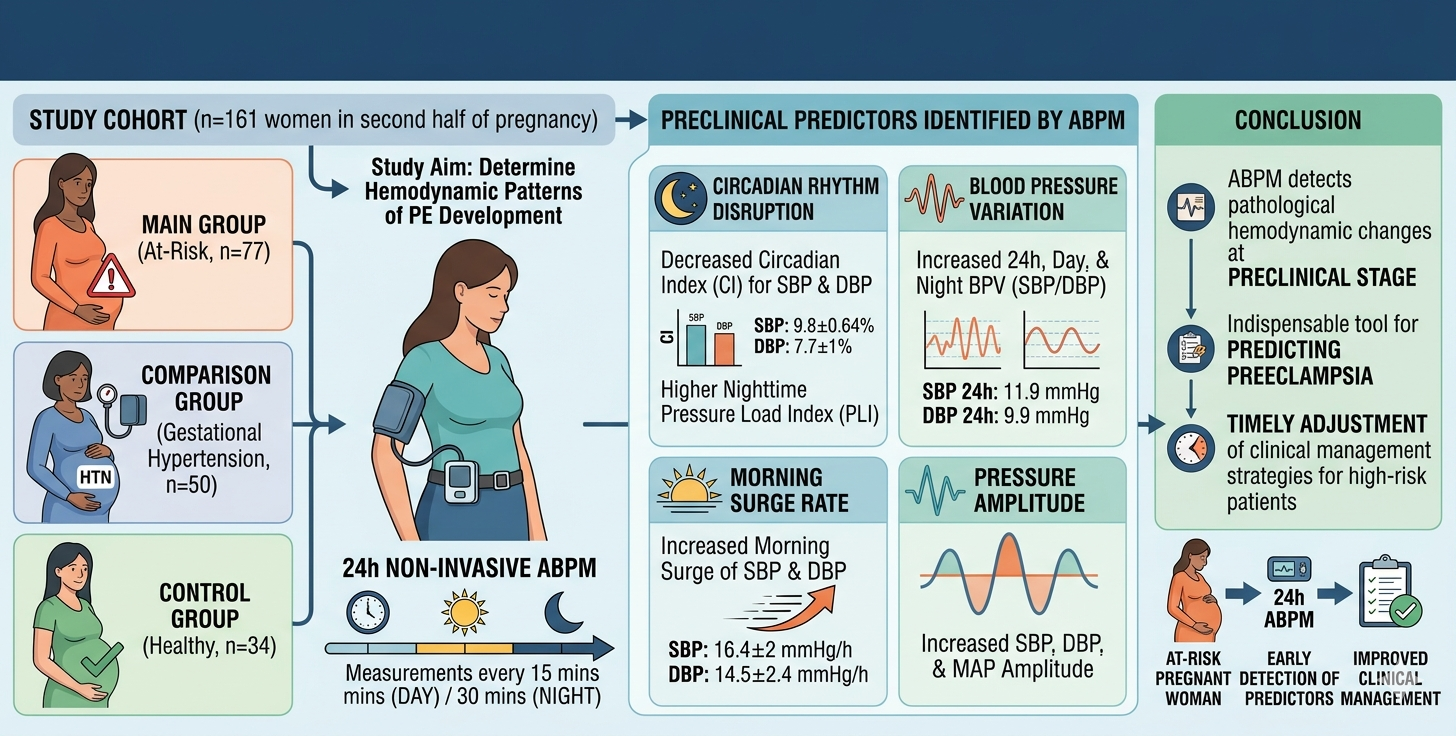
Material and methods. A prospective cohort study included 161 women in the second half of pregnancy. The main group consisted of 77 pregnant women at risk for preeclampsia; the comparison group included 50 women with gestational hypertension; the control group consisted of 34 healthy pregnant women. Blood pressure was sampled by using a non-invasive automatic ambulatory blood pressure monitoring machine for 24h.
Results. Although the average 24-hour BP is lower than the established level of 140/90 mmHg, a more detailed evaluation during ambulatory blood pressure monitoring (ABPM) in pregnant women at high risk of developing gestational hypertension and preeclampsia at the preclinical stage allows to identify following predictors: an increase systolic (SBP), diastolic (DBP), and mean arterial pressure and their amplitude; an increase the rate of the morning surge of SBP to 16.4 ± 2 and DBP to 14.5 ± 2.4 mmHg/hour; a decrease circadian index of SBP to 9.8 ± 0.64% and DBP to 7.7 ± 1%; an increase SBP variability (day/night) = 12.2 ± 0.6 / 9.77 ± 0.4 and DBP variability (day/night) = 9.1 ± 0.44 / 8.41 ± 0.45; the occurrence of elevated blood pressure episodes during the daytime (SBP up to 2.0 ± 0.53%, DBP up to 2.15 ± 0.36%) and during the nighttime period (SBP up to 5.6 ± 1.4%, DBP up to 7.85 ± 0.36%).
Conclusions. ABPM allows to detect pathological hemodynamic changes (specifically isolated nocturnal hypertension and increased BP variability) at the preclinical stage. This makes the method indispensable for predicting preeclampsia and the timely adjustment of clinical management strategies for high-risk patients.
References
- Thomopoulos, C., Hitij, J. B., De Backer, T., Gkaliagkousi, E., Kreutz, R., Lopez-Sublet, M. et al. (2024). Management of hypertensive disorders in pregnancy: a Position Statement of the European Society of Hypertension Working Group ‘Hypertension in Women’. Journal of Hypertension, 42 (7), 1109–1132. https://doi.org/10.1097/hjh.0000000000003739
- Sіusіuka, V. H., Belenichev, I. F., Kyrychenko, M. M., Deinichenko, O. V., Sergienko, M. Y., Kyryliuk, O. D. (2025). Hypertensive disorders during pregnancy: current aspects of pathogenesis, screening and prevention. Reproductive health of woman, 6, 106–113. https://doi.org/10.30841/2708-8731.6.2025.341011
- Fang, Y., Zuo, L., Li, J., Shi, H., Zhang, R., Han, C. et al. (2025). Optimization of Ambulatory Blood Pressure Monitoring during Pregnancy: A Path Toward Risk Stratification Improvement and Management of Hypertensive Disorders. Reviews in Cardiovascular Medicine, 26 (5). https://doi.org/10.31083/rcm27235
- Oku, M., Ohno, S., Metoki, H., Arai, E., Ito, M., Shiozaki, A. et al. (2026). Prediction Model of Hypertensive Disorders of Pregnancy Based on Home Blood Pressure Monitoring. Journal of the American Heart Association, 15 (5). https://doi.org/10.1161/jaha.125.047093
- Espeche, W. G., Salazar, M. R. (2023). Ambulatory Blood Pressure Monitoring for Diagnosis and Management of Hypertension in Pregnant Women. Diagnostics, 13 (8), 1457. https://doi.org/10.3390/diagnostics13081457
- Tarca, A. L., Taran, A., Romero, R., Jung, E., Paredes, C., Bhatti, G. et al. (2022). Prediction of preeclampsia throughout gestation with maternal characteristics and biophysical and biochemical markers: a longitudinal study. American Journal of Obstetrics and Gynecology, 226 (1), 126. https://doi.org/10.1016/j.ajog.2021.01.020
- Gupta, H. P., Singh, R. K., Singh, U., Mehrotra, S., Verma, N. S., Baranwal, N. (2011). Circadian Pattern of Blood Pressure in Normal Pregnancy and Preeclampsia. The Journal of Obstetrics and Gynecology of India, 61 (4), 413–417. https://doi.org/10.1007/s13224-011-0062-3
- Salazar, M. R., Espeche, W. G., Minetto, J., Cerri, G., Torres, S., Grassi, F. et al. (2025). Nocturnal systolic and diastolic blood pressure across gestational periods and the risk of preeclampsia. Journal of Human Hypertension, 39 (8), 541–548. https://doi.org/10.1038/s41371-025-01046-0
- Unifikovanyi klinichnyi protokol pervynnoi, vtorynnoi (spetsializovanoi) ta tretynnoi (vysokospetsializovanoi) medychnoi dopomohy «Hipertenzyvni rozlady pid chas vahitnosti, polohiv ta u pisliapolohovomu periodi» (2022). Nakaz Ministerstva okhorony zdorovia Ukrainy No. 151. 24.01.2022. Available at: https://www.dec.gov.ua/wp-content/uploads/2022/01/2022_151_ykpmd_giprozlvagitn.pdf
- Kattah, A. G., Coutinho, T. D., Vermunt, J., Vaughan, L. E., Suvakov, S., Butler Tobah, Y. S. et al. (2025). Blood Pressure Thresholds for Hypertension in Pregnancy and Future Cardiovascular Risk. Mayo Clinic Proceedings, 100 (10), 1745–1757. https://doi.org/10.1016/j.mayocp.2025.04.028
- Bello, N. A., Miller, E., Cleary, K., Wapner, R., Shimbo, D., Tita, A. T. (2018). Out of Office Blood Pressure Measurement in Pregnancy and the Postpartum Period. Current Hypertension Reports, 20 (12). https://doi.org/10.1007/s11906-018-0901-z
- Roberts, J. M., Alexeeff, S. E., Sun, B., Greenberg, M., King, A., Nguyen-Huynh, M. N. et al. (2025). Early Pregnancy Blood Pressure Trajectories and Hypertension Years After Pregnancy. Hypertension, 82 (5). https://doi.org/10.1161/hypertensionaha.125.24649
- Savur, Ü., İbişoğlu, E., Güneş, H. M., Güneş, S., Hakgor, A., Akhundova, A. (2026). Association of Non-Dipping Blood Pressure Patterns with Fetal Growth Restriction and Postpartum Chronic Hypertension in Gestational Hypertension. Medicina, 62 (2), 414. https://doi.org/10.3390/medicina62020414
- Zhang, R., Fang, Y., Ma, Y., Zuo, L., Duan, H., Li, J. et al. (2026). Morning Blood Pressure and Adverse Pregnancy Outcomes in High-Risk Pregnancies. Hypertension Research, 49 (4), 1193–1203. https://doi.org/10.1038/s41440-026-02577-w
- Xintong, L., Ning, L., Yanhong, G., Meili, P., Yu, J., Yuliang, Z. (2025). Beyond clinic readings: Twenty‐four hour ambulatory blood pressure monitoring profiling enhances preterm delivery risk stratification in hypertensive pregnancies. International Journal of Gynecology & Obstetrics, 172 (3), 1597–1609. https://doi.org/10.1002/ijgo.70515
- Jung, Y. J., Kim, T., Kim, Y.-H. (2025). Elevated Pre-Pregnancy Blood Pressure and the Risk of Adverse Pregnancy Outcomes: Evidence From a Nationwide Population-Based Study. Journal of Korean Medical Science, 40 (46). https://doi.org/10.3346/jkms.2025.40.e302
Downloads
Published
How to Cite
Issue
Section
License
Copyright (c) 2026 Tetiana Loskutova, Albina Petulko

This work is licensed under a Creative Commons Attribution 4.0 International License.
Our journal abides by the Creative Commons Attribution 4.0 International License copyright rights and permissions for open access journals.
Authors, who are published in this journal, agree to the following conditions:
1. The authors reserve the right to authorship of the work and pass the first publication right of this work to the journal under the terms of a Creative Commons Attribution 4.0 International License, which allows others to freely distribute the published research with the obligatory reference to the authors of the original work and the first publication of the work in this journal.
2. The authors have the right to conclude separate supplement agreements that relate to non-exclusive work distribution in the form in which it has been published by the journal (for example, to upload the work to the online storage of the journal or publish it as part of a monograph), provided that the reference to the first publication of the work in this journal is included.
3. Authors have the right to store the final accepted version of the article in an institutional, thematic, or any other repository to ensure visibility and accessibility.


