Culture of dignity as the foundation of organizational culture of humanistic management. Modern research in the IT industry
DOI:
https://doi.org/10.15587/2706-5448.2025.327079Keywords:
dignity, humanistic management, IT engineering, organizational culture, behavioral economics, intrinsic motivation, ESG strategiesAbstract
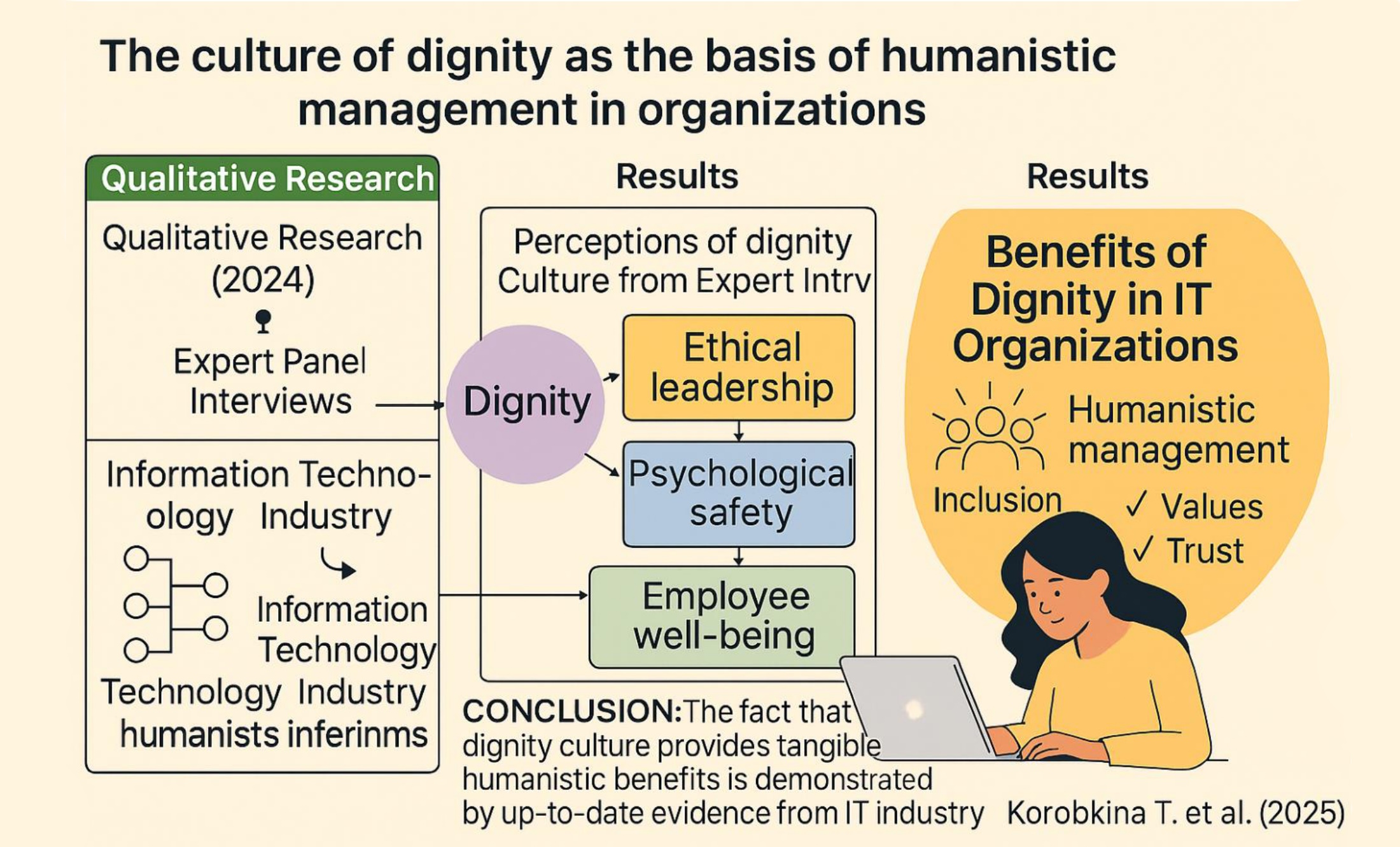
The object of research is the cognitive and structural parameters of the formation and transformation of the organizational culture of IT teams. Particular attention is paid to the influence of dignity as a humanistic construct on the dynamics of intragroup communications. The problem lies in the lack of interdisciplinary verified theoretical models that would allow integrating the principle of dignity into the strategic management system. Existing approaches mostly do not take into account cognitive distortions, moral autonomy, the influence of affective states and psychological resilience in a team environment. The article develops a conceptual model of the corporate culture of dignity in IT engineering, which is based on a synthesis of the provisions of cognitive psychology, behavioral economics, neuroethics and humanistic management. The model covers three levels: micro-level (executive control, intrinsic motivation, psychological security), meso-level (empathetic leadership, reflective practices, communication ethics), and macro-level (value coherence, institutional trust, cultural justice). The structure is presented as a dynamic process: cognitive factors – behavioral mechanisms – organizational results. The theoretical provisions can be applied to HRMS, agile processes, ESG strategies, and cognitive-sensitive management systems. The model is relevant in conditions of high dynamics, digital burnout, fragmented interaction and organizational turbulence, in particular, in times of war. The proposed model is an innovative approach to the construction of a culture of dignity in an intellectually saturated environment where traditional management paradigms are ineffective. Its application allows to reduce transaction costs of communication, increase the level of internal consistency and ensure ethical integration of cognitively complex practices into the daily activities of IT teams. This approach creates a new framework for studying behavioral mechanisms in digital organizations and opens up prospects for multi-agent culture modelling using data analytics, artificial intelligence, and neurobehavioral interpretation.
References
- Deci, E. L., Ryan, R. M. (2017). Self-Determination Theory: Basic Psychological Needs in Motivation, Development, and Wellness. New York: Guilford Publications. https://doi.org/10.1521/978.14625/28806
- Lakhyzha, R. M. (2025). Spetsifika diialnosti IT-kompanii yak factor formuvannia yikh korporatyvnoi kultury. Problems of Modern Transformations. Series: Economics and Management, 17. https://doi.org/10.54929/2786-5738-2025-17-04-01
- Sadowski, C., Stolee, K. T., Elbaum, S. (2015). How developers search for code: a case study. Proceedings of the 2015 10th Joint Meeting on Foundations of Software Engineering. https://doi.org/10.1145/2786805.2786855
- McCausland, T. (2023). Creating Psychological Safety in the Workplace. Research-Technology Management, 66 (2), 56–58. https://doi.org/10.1080/08956308.2023.2164439
- Gallup. (2024). Global indicator: Employee Retention & Attraction. Available at: https://www.gallup.com/467702/indicator-employee-retention-attraction.aspx
- Schein, E. H. (2017). Organizational Culture and Leadership. Wiley, 416.
- Cameron, K. S., Quinn, R. E. (2011). Diagnosing and Changing Organizational Culture: Based on the Competing Values Framework. Wiley.
- Kouzes, J. M., Posner, B. Z. (2017). The Leadership Challenge. Wiley.
- Bennis, W., Nanus, B. (2003). Leaders: The Strategies for Taking Charge. Harper Collins.
- Herzberg, F. (2003). One More Time, How Do You Motivate Employees? Harvard Business Review. Available at: https://hbr.org/2003/01/one-more-time-how-do-you-motivate-employees
- Destriani, R., Adhitama, R. Y., Sensuse, D. I., Hidayat, D. S., Purwaningsih, E. H. (2024). Challenges and Technology Trends in Implementing a Human Resource Management System: A Systematic Literature Review. Journal of Information Systems Engineering and Business Intelligence, 10 (3), 355–367. https://doi.org/10.20473/jisebi.10.3.355-367
- Islas-Calderón, S., Vázquez-Maguirre, M. (2024). Dignity, humanistic management, and the process of social innovation. Humanistic Management Journal, 9 (3), 313–326. https://doi.org/10.1007/s41463-024-00174-y
- Huijser, D., Nullens, P. (2024). An anatomy of human dignity; dissecting the heart of humanistic management. Humanistic Management Journal, 9, 203–230. https://doi.org/10.1007/s41463-024-00183-x
- Mazzetti, G., Schaufeli, W. B. (2022). The impact of engaging leadership on employee engagement and team effectiveness: A longitudinal, multi-level study on the mediating role of personal- and team resources. PLOS One, 17 (6), e0269433. https://doi.org/10.1371/journal.pone.0269433
- Pearson, M. (2023). Dignity, Humanistic Management and the Sustainable Development Goals. Journal of Management for Global Sustainability, 11 (2). https://doi.org/10.13185/2244-6893.1001
- Kabadayi, S., Alkire (née Nasr), L., Broad, G. M., Livne-Tarandach, R., Wasieleski, D., Puente, A. M. (2019). Humanistic management of social innovation in service (SIS): An interdisciplinary framework. Humanistic Management Journal, 4, 159–185. https://doi.org/10.1007/s41463-019-00063-9
- Hicks, D. (2018). Leading with Dignity: How to Create a Culture That Brings Out the Best in People. Yale University Press, 224. https://doi.org/10.2307/j.ctvqc6gvg
- Nussbaum, M. (2011). Creating Capabilities: The Human Development Approach. Harvard University Press, Belknap Press, 237.
Downloads
Published
How to Cite
Issue
Section
License
Copyright (c) 2025 Tetiana Korobkinа, Natalia Dashenkova

This work is licensed under a Creative Commons Attribution 4.0 International License.
The consolidation and conditions for the transfer of copyright (identification of authorship) is carried out in the License Agreement. In particular, the authors reserve the right to the authorship of their manuscript and transfer the first publication of this work to the journal under the terms of the Creative Commons CC BY license. At the same time, they have the right to conclude on their own additional agreements concerning the non-exclusive distribution of the work in the form in which it was published by this journal, but provided that the link to the first publication of the article in this journal is preserved.





