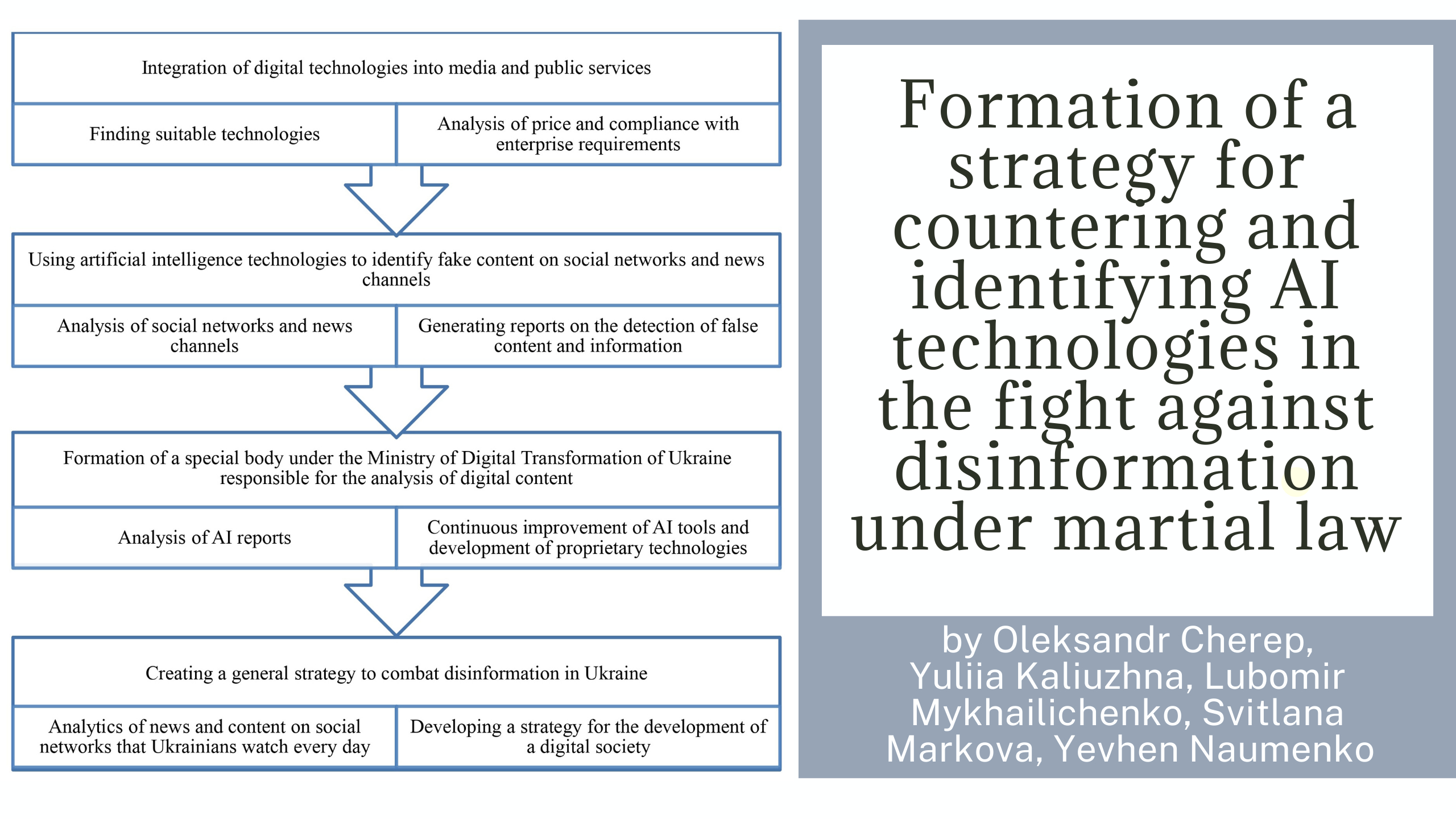
Formation of a strategy for countering and identifying AI technologies in the fight against disinformation under martial law
DOI:
https://doi.org/10.15587/2706-5448.2025.327157Keywords:
disinformation, artificial intelligence, fake news, social networks, deepfakes, information securityAbstract
The methodological basis of the study is a set of techniques, principles, general theoretical, special, interdisciplinary methods of scientific research. To achieve the set goal, the dialectical method of scientific knowledge was used – to study disinformation in martial law and determine the role of artificial intelligence (AI) in its detection and neutralization. The use of a systemic approach made it possible to determine the features of the spread of disinformation through social networks, traditional media and automated bot farms, for the manipulation of public opinion. The operations research method was used to determine the advantages and disadvantages of AI tools aimed at detecting disinformation. Methods of analogies and comparison – to determine modern methods of combating fake news, including machine learning algorithms, natural language processing and image analysis. It was established that the main problem for increasing the effectiveness of combating disinformation is the implementation of European experience in using AI.
The use of systemic and critical analysis allowed to explore the international experience of using AI tools in the field of information security, their effectiveness in detecting deepfakes and other forms of false content. A comprehensive strategy for countering disinformation in Ukraine is proposed. The proposed strategy, unlike the existing strategy, takes into account the use of artificial intelligence technologies to identify fake content in social networks and news channels, the formation of a special body to analyze digital content and the development of a digital society. The comprehensive strategy, unlike the existing ones, includes the expanded use of AI to monitor the information space, combining automated analysis with human control; the implementation of state initiatives to regulate fake content and increase the level of media literacy of the population. The research results will be useful for scientists, information security experts, journalists and state bodies involved in combating disinformation. The proposed approaches will contribute to strengthening the information protection of Ukraine and reducing the impact of fake news on society.
References
- Act is the Protection from Online Falsehoods and Manipulation (2019). Available at: https://sso.agc.gov.sg/Act/POFMA2019?ProvIds=P11-#pr1-
- Petriv, O. (2019). Shtuchnyi intelekt i dipfeiky: yak krainy reahuiut na zahrozy. Tsentr demokratii ta verkhovenstva prava. Available at: https://cedem.org.ua/analytics/shtuchnyi-intelekt-i-dipfeiky/
- Saakov, V., Kropman, V. (2024). Yevroparlament skhvalyv zakon pro shtuchnyi intelekt. Available at: https://www.dw.com/uk/evroparlament-shvaliv-zakon-pro-stucnij-intelekt/a-68516616
- Pershyi u sviti zakon pro ShI nabuv chynnosti u YeS (2024). UNN. Available at: https://unn.ua/news/pershyi-u-sviti-zakon-pro-shi-nabuv-chynnosti-u-yes
- European Council meeting (19 and 20 March 2015) – Conclusions. Available at: http://www.eesc.europa.eu/resources/docs/european-council-conclusions-19-20-march-2015-en.pdf
- IeS zapustyt novu platformu dlia borotby z dezinformatsiieiu Rosii ta Kytaiu (2023). Yevropeiska pravda. Available at: https://www.eurointegration.com.ua/news/2023/02/7/7155675/
- Holub, R. (2022). Onovlennia kodeksu YeS shchodo borotby z dezinformatsiieiu: osnovni polozhennia. Available at: https://jurliga.ligazakon.net/news/212519_onovlennya-kodeksu-s-shchodo-borotbi-z-deznformatsyu-osnovnpolozhennya
- Vaskiv, O. (2023). Bloomberg: Yevrosoiuz vyznav sotsmerezhu X naibilshym dzherelom dezinformatsii. Available at: https://suspilne.media/580681-bloomberg-evrosouz-viznav-socmerezu-x-najbilsim-dzerelom-dezinformacii/
- Pidkhid NATO u haluzi borotby z informatsiinymy zahrozamy (2025). Available at: https://www.nato.int/cps/uk/natohq/topics_219728.htm
- NATO vpershe zaiavylo pro zanepokoiennia dezinformatsiieiu iz zastosuvanniam shtuchnoho intelektu (2024). Henshtab ZSU. Available at: https://armyinform.com.ua/2024/07/13/nato-vpershe-zayavyla-pro-zanepokoyennya-dezinformacziyeyu-iz-zastosuvannyam-shtuchnogo-intelektu-genshtab-zsu/
- Dagar, D., Vishwakarma, D. K. (2022). A literature review and perspectives in deepfakes: generation, detection, and applications. International Journal of Multimedia Information Retrieval, 11 (3), 219–289. https://doi.org/10.1007/s13735-022-00241-w
- Zhang, X., Ghorbani, A. A. (2020). An overview of online fake news: Characterization, detection, and discussion. Information Processing & Management, 57 (2), 102025. https://doi.org/10.1016/j.ipm.2019.03.004
- Li, D., Guo, H., Wang, Z., Zheng, Z. (2021). Unsupervised fake news detection based on autoencoder. IEEE Access, 9, 29356–29365. https://doi.org/10.1109/ACCESS.2021.3058809
- Yang, J., Vega-Oliveros, D., Seibt, T., Rocha, A. (2021). Scalable fact-checking with human-in-the-loop. Proceedings of the IEEE International Workshop on Information Forensics and Security (WIFS). https://doi.org/10.1109/WIFS53200.2021.9648388
- Mitchell, T., Martin, E. (2023). Challenges of combating disinformation in the era of generative AI. Journal of Artificial Intelligence and Society, 15 (4), 527–542.
- News consumers who saw false or misleading information about key topics in the last week worldwide as of February 2024. Available at: https://www.statista.com/statistics/1317019/false-information-topics-worldwide/ Last accessed: 14.01.2025
- Special report: Ukraine. An overview of Russia’s cyberattack activity in Ukraine. Digital Security Unit. (2022). Available at: https://complexdiscovery.com/russian-cyberattack-activity-in-ukraine-a-special-report-from-microsoft/
- Overview and key findings of the 2024 Digital News Report (2024). Reuters. Available at: https://reutersinstitute.politics.ox.ac.uk/digital-news-report/2024/dnr-executive-summary Last accessed: 14.01.2025
- Disinformation Resilience in Central and Eastern Europe. Available at: https://prismua.org/en/dri-cee/ Last accessed: 14.01.2025
- Khandelwal, N. (2024). 10 Top AI Deepfake Detector Tools for 2024 & Beyond. Available at: https://vlinkinfo.com/blog/top-ai-deepfake-detector-tools/ Last accessed: 16.01.2025
- Center for AI Safety. Statement on AI risk. Available at: https://www.safe.ai/work/statement-on-ai-risk Last accessed: 17.01.2025
- Osavul. AI-powered platform for information environment assessment. Available at: https://www.osavul.cloud/ Last accessed: 17.01.2025
- Pro Stratehiiu informatsiinoi bezpeky (2021). Rishennia. Rada natsionalnoi bezpeky i oborony Ukrainy 15.10.2021. Available at: https://zakon.rada.gov.ua/laws/show/n0080525-21#Text
- Safarov, A. (2021). Analiz «Stratehii informatsiinoi bezpeky» v porivnianni z chynnoiu Doktrynoiu informatsiinoi bezpeky. Available at: https://imi.org.ua/monitorings/analiz-strategiyi-informatsijnoyi-bezpeky-v-porivnyanni-z-chynnoyu-doktrynoyu-informatsijnoyi-i38852
Downloads
Published
How to Cite
Issue
Section
License
Copyright (c) 2025 Oleksandr Cherep, Yuliia Kaliuzhna, Lubomir Mykhailichenko, Svitlana Markova, Yevhen Naumenko

This work is licensed under a Creative Commons Attribution 4.0 International License.
The consolidation and conditions for the transfer of copyright (identification of authorship) is carried out in the License Agreement. In particular, the authors reserve the right to the authorship of their manuscript and transfer the first publication of this work to the journal under the terms of the Creative Commons CC BY license. At the same time, they have the right to conclude on their own additional agreements concerning the non-exclusive distribution of the work in the form in which it was published by this journal, but provided that the link to the first publication of the article in this journal is preserved.