Determination of the influence of raw milk β-casein polymorphism on the efficiency of making cottage cheese
DOI:
https://doi.org/10.15587/2706-5448.2025.328936Keywords:
cottage cheese, cheese yield, quality, β-casein, A2 milk, raw milkAbstract
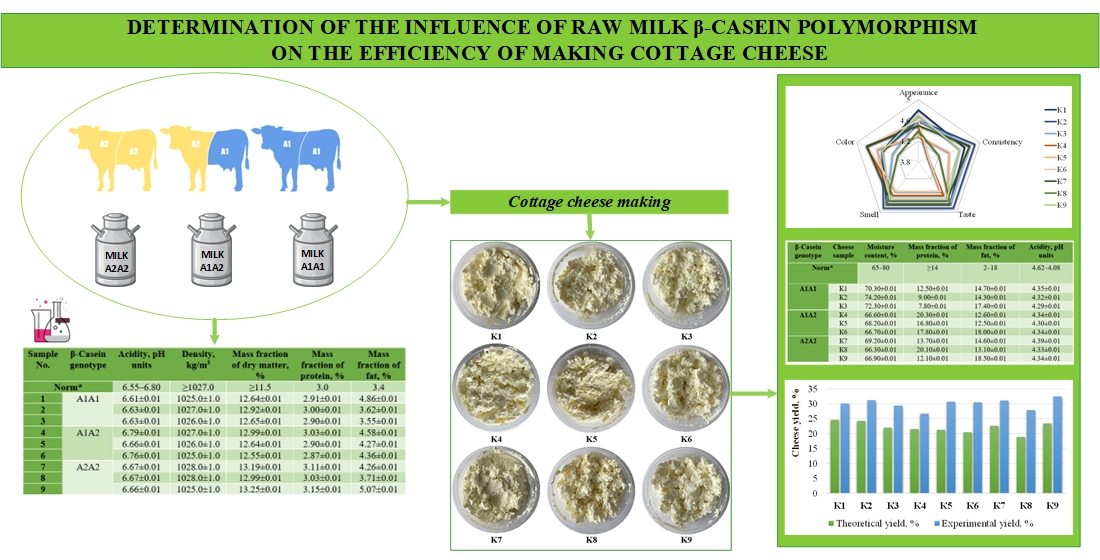
The positive functional features of A2 milk and the increase in the percentage of animals with the A2A2 genotype will contribute to expanding the choice of dairy products, in particular, cottage cheese. It is expected that determining the influence of the protein composition of raw milk on the quality and yield of cheese will allow for effective selection of dairy breeds of cows. The object of the study is the technological process of producing cottage cheese, produced by the classical acid method of coagulation of milk proteins from cows with different β-casein genotypes (A1A1, A1A2, A2A2). Subject of the study: physical and chemical characteristics of raw milk (A1A1, A1A2, A2A2); yield and quality of cottage cheese. It was experimentally established that the milk samples have a typical composition and comply with DSTU 3662:2018. The average dry matter content in milk from cows with the A1A1 genotype was 12.73 %, with the protein-to-fat ratio varying within 0.76–0.83. In raw material samples from animals with the A1A2 genotype, the average dry matter content was 12.72 %, and the protein-to-fat ratio was 0.66–0.68. For milk from cows with the A2A2 genotype, the average dry matter content was 13.14 %, and the protein-to-fat ratio was in the range of 0.62–0.82. A study of the quality indicators of cottage cheese samples showed that the genetic variation of β-casein does not affect the sensory properties of the final product. The moisture, protein, and fat contents in cheese from milk from cows with the A1A1 genotype were on average 72.27 %, 9.77 %, and 15.47 %, respectively. In samples of cheeses from cows’ milk with A1A2 genotype, the average moisture content was 67.17 %, protein – 18.30 %, fat – 14.37 %. For cheeses from cows’ milk with genotype A2A2, the average moisture content was 67.47 %, protein – 15.30 %, fat – 15.40 %. It was found that the efficiency of cheese production from cows’ milk with A2A2 genotype is the highest and on average is 141.26 %, which exceeds similar indicators for A1A1 milk by 13.18 % and A1A2 by 2.21 %.
References
- Bilyi, V., Merzlov, S., Narizhnyy, S., Mashkin, Y., Merzlova, G. (2022). Amino Acid Composition of Whey and Cottage Cheese Under Various Rennet Enzymes. Scientific Horizons, 24 (9), 19–25. https://doi.org/10.48077/scihor.24(9).2021.19-25
- Verdier-Metz, I., Coulon, J.-B., Pradel, P. (2001). Relationship between milk fat and protein contents and cheese yield. Animal Research, 50 (5), 365–371. https://doi.org/10.1051/animres:2001138
- Ladyka, V., Pavlenko, Y., Sklyarenko, Y. (2021). β-casein gene polymorphism use in terms of brown dairy cattle preservation. Archivos de Zootecnia, 70 (269), 88–94. doi: https://doi.org/10.21071/az.v70i269.5422
- Żbik, K., Onopiuk, A., Górska-Horczyczak, E., Wierzbicka, A. (2024). Trends and Opportunities in the Dairy Industry: A2 Milk and Processing Methods. Applied Sciences, 14 (15), 6513. https://doi.org/10.3390/app14156513
- Banerjee, S. (2018). A2 milk: the unknown story about a milk protein. Acta Scientific Nutritional Health, 2 (3), 28–31.
- Ladyka, V., Bolgova, N., Synenko, T., Skliarenko, Y., Vechorka, V. (2023). Determining the influence of raw milk protein composition on the yield of cheese and its nutrient content. Eastern-European Journal of Enterprise Technologies, 6 (11 (126)), 33–41. https://doi.org/10.15587/1729-4061.2023.292063
- Ladyka, V., Bolhova, N., Synenko, T., Skliarenko, Y., Vechorka, V. (2024). Determining the influence of raw milk β-casein polymorphism on the efficiency of making soft cheese. Eastern-European Journal of Enterprise Technologies, 5 (11 (131)), 33–42. https://doi.org/10.15587/1729-4061.2024.311236
- Heck, J. M. L., Schennink, A., van Valenberg, H. J. F., Bovenhuis, H., Visker, M. H. P. W., van Arendonk, J. A. M., van Hooijdonk, A. C. M. (2009). Effects of milk protein variants on the protein composition of bovine milk. Journal of Dairy Science, 92 (3), 1192–1202. https://doi.org/10.3168/jds.2008-1208
- Farrell, H. M., Jimenez-Flores, R., Bleck, G. T., Brown, E. M., Butler, J. E., Creamer, L. K. et al. (2004). Nomenclature of the Proteins of Cows’ Milk–Sixth Revision. Journal of Dairy Science, 87 (6), 1641–1674. https://doi.org/10.3168/jds.s0022-0302(04)73319-6
- Giribaldi, M., Lamberti, C., Cirrincione, S., Giuffrida, M. G., Cavallarin, L. (2022). A2 Milk and BCM-7 Peptide as Emerging Parameters of Milk Quality. Frontiers in Nutrition, 9. https://doi.org/10.3389/fnut.2022.842375
- Brooke-Taylor, S., Dwyer, K., Woodford, K., Kost, N. (2017). Systematic Review of the Gastrointestinal Effects of A1 Compared with A2 β-Casein. Advances in Nutrition, 8 (5), 739–748. https://doi.org/10.3945/an.116.013953
- Kay, S.-I. S., Delgado, S., Mittal, J., Eshraghi, R. S., Mittal, R., Eshraghi, A. A. (2021). Beneficial Effects of Milk Having A2 β-Casein Protein: Myth or Reality? The Journal of Nutrition, 151 (5), 1061–1072. https://doi.org/10.1093/jn/nxaa454
- Vigolo, V., Franzoi, M., Cendron, F., Salvadore, G., Penasa, M., Cassandro, M., De Marchi, M. (2022). Characterization of the genetic polymorphism linked to the β-casein A1/A2 alleles using different molecular and biochemical methods. Journal of Dairy Science, 105 (11), 8946–8955. https://doi.org/10.3168/jds.2022-22136
- Summer, A., Di Frangia, F., Ajmone Marsan, P., De Noni, I., Malacarne, M. (2020). Occurrence, biological properties and potential effects on human health of β-casomorphin 7: Current knowledge and concerns. Critical Reviews in Food Science and Nutrition, 60 (21), 3705–3723. https://doi.org/10.1080/10408398.2019.1707157
- Jeong, H., Park, Y.-S., Yoon, S.-S. (2023). A2 milk consumption and its health benefits: an update. Food Science and Biotechnology, 33 (3), 491–503. https://doi.org/10.1007/s10068-023-01428-5
- Cieślińska, A., Fiedorowicz, E., Zwierzchowski, G., Kordulewska, N., Jarmołowska, B., Kostyra, E. (2019). Genetic Polymorphism of β-Casein Gene in Polish Red Cattle – Preliminary Study of A1 and A2 Frequency in Genetic Conservation Herd. Animals, 9 (6), 377. https://doi.org/10.3390/ani9060377
- Dantas, A., Kumar, H., Prudencio, E. S., de Avila, L. B., Orellana-Palma, P., Dosoky, N. S. et al. (2023). An approach on detection, quantification, technological properties, and trends market of A2 cow milk. Food Research International, 167, 112690. https://doi.org/10.1016/j.foodres.2023.112690
- Gai, N., Uniacke-Lowe, T., O’Regan, J., Goulding, D. A., Kelly, A. L. (2023). Influence of β-casein genotype on physicochemical properties and functionality of bovine milk. Journal of Dairy Science, 106 (12), 8357–8367. https://doi.org/10.3168/jds.2023-23687
- Cipolat-Gotet, C., Cecchinato, A., De Marchi, M., Bittante, G. (2013). Factors affecting variation of different measures of cheese yield and milk nutrient recovery from an individual model cheese-manufacturing process. Journal of Dairy Science, 96 (12), 7952–7965. https://doi.org/10.3168/jds.2012-6516
- Stocco, G., Cipolat-Gotet, C., Gasparotto, V., Cecchinato, A., Bittante, G. (2018). Breed of cow and herd productivity affect milk nutrient recovery in curd, and cheese yield, efficiency and daily production. Animal, 12 (2), 434–444. https://doi.org/10.1017/s1751731117001471
- Bisutti, V., Pegolo, S., Giannuzzi, D., Mota, L. F. M., Vanzin, A., Toscano, A. et al. (2022). The β-casein (CSN2) A2 allelic variant alters milk protein profile and slightly worsens coagulation properties in Holstein cows. Journal of Dairy Science, 105 (5), 3794–3809. https://doi.org/10.3168/jds.2021-21537
- Niero, G., Franzoi, M., Manuelian, C. L., Visentin, G., Penasa, M., De Marchi, M. (2021). Protein profile of cow milk from multibreed herds and its relationship with milk coagulation properties. Italian Journal of Animal Science, 20 (1), 2232–2242. https://doi.org/10.1080/1828051x.2021.1996288
- Auldist, M. J., Johnston, K. A., White, N. J., Fitzsimons, W. P., Boland, M. J. (2004). A comparison of the composition, coagulation characteristics and cheesemaking capacity of milk from Friesian and Jersey dairy cows. Journal of Dairy Research, 71 (1), 51–57. https://doi.org/10.1017/s0022029903006575
- Vigolo, V., Franzoi, M., Penasa, M., De Marchi, M. (2022). β-Casein variants differently affect bulk milk mineral content, protein composition, and technological traits. International Dairy Journal, 124, 105221. https://doi.org/10.1016/j.idairyj.2021.105221
- Marko, R., Uros, G., Branislav, V., Milan, M., Danijela, K., Vlado, T., Zoran, S. (2020). Beta-Casein Gene Polymorphism in Serbian Holstein-Friesian Cows and Its Relationship with Milk Production Traits. Acta Veterinaria, 70 (4), 497–510. https://doi.org/10.2478/acve-2020-0037
- Ladyka, V., Bolhova, N., Huba, S., Sokolenko, V., Skliarenko, Y. (2024). Investigation of the influence of milk protein genotype on the process of fermentation of milk curds by mesophilic lactic acid streptococci. Scientific Horizons, 27 (8), 113–121. https://doi.org/10.48077/scihor8.2024.113
Downloads
Published
How to Cite
Issue
Section
License
Copyright (c) 2025 Volodymyr Ladyka, Tetiana Synenko, Nataliia Bolhova, Yuriy Skliarenko, Viktoriia Vechorka

This work is licensed under a Creative Commons Attribution 4.0 International License.
The consolidation and conditions for the transfer of copyright (identification of authorship) is carried out in the License Agreement. In particular, the authors reserve the right to the authorship of their manuscript and transfer the first publication of this work to the journal under the terms of the Creative Commons CC BY license. At the same time, they have the right to conclude on their own additional agreements concerning the non-exclusive distribution of the work in the form in which it was published by this journal, but provided that the link to the first publication of the article in this journal is preserved.