Influence of enriched ingredients on the functional properties and nutritional value of bread
DOI:
https://doi.org/10.15587/2706-5448.2025.329145Keywords:
enrichment, rye hulled flour, whole grain flour, gluten-free flour, functional additivesAbstract
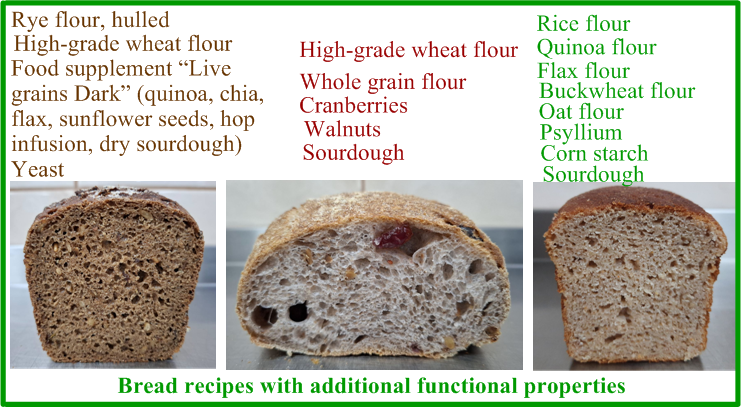
The object of research is the organoleptic properties and nutritional value of bread enriched with various functional additives. One of the most problematic areas in the technology of bread from refined types of flour is the low biological value of bread. Unrefined and gluten-free types of flour, which have a higher biological value, negatively affect the consumer properties of bread, the structural and mechanical properties of dough, and increase production costs. During the study, standard methods for analyzing the organoleptic and physicochemical parameters of bread were used. Enriched bread recipes were developed. Sample 1 – from rye hulled flour, premium wheat flour and the food supplement “Live Grains Dark”, containing quinoa, chia, flax, sunflower seeds, hop infusion and dry sourdough. Sample 2 – based on high-grade wheat flour, whole grain flour, dried cranberries and walnuts. Sample 3 was made from a mixture of gluten-free flour (quinoa, rice, flax, buckwheat, oat, psyllium). A positive assessment was received (“good” and “very good” for all organoleptic indicators). Sample 1, noted by the tasters, had well-developed uniform thin-walled porosity, regular shape and dark brown color, due to the type of main raw material. It contained the most fiber (6±0.05 g/100 g). Sample 2 had the highest nutritional value (859.2±0.05 kJ/100 g). This is due to the fact that it contains a significant amount of carbohydrates (45.87±0.05 g/100 g). Sample 3, made from gluten-free raw materials, contained more proteins (5.8±0.05 g/100 g) and fats (1.6±0.05 g/100 g), had the highest moisture content (46.7 %). But its nutritional value was the lowest (828.4±0.05 kJ/100 g). Due to the use of functional plant ingredients, the nutritional value of bread changes, it has unique organoleptic properties. Compared to bread made from refined flour, the proposed types have additional functional properties and contain more biologically active components.
Supporting Agency
- The study was conducted within the framework of scientific and technical work 0124U002836 “Development of technologies for the production of food products with added value on the principles of sustainable development” at the expense of the executors.
References
- Scappaticci, G., Mercanti, N., Pieracci, Y., Ferrari, C., Mangia, R., Marianelli, A. et al. (2024). Bread Improvement with Nutraceutical Ingredients Obtained from Food By-Products: Effect on Quality and Technological Aspects. Foods, 13 (6), 825. https://doi.org/10.3390/foods13060825
- Kaim, U., Goluch, Z. S. (2023). Health Benefits of Bread Fortification: A Systematic Review of Clinical Trials according to the PRISMA Statement. Nutrients, 15 (20), 4459. https://doi.org/10.3390/nu15204459
- Guiné, R. P. F., Florença, S. G. (2024). Development and Characterisation of Functional Bakery Products. Physchem, 4 (3), 234–257. https://doi.org/10.3390/physchem4030017
- Raman, M., Dinakaran, A., Ravindran, A., Sankar, T. V., Gopal, T. K. S. (2019). Dietary Supplementation of κ-Carrageenan to Improve the Physio-Chemical and Functional Properties of White Bread. Food and Nutrition Sciences, 10 (8), 997–1010. https://doi.org/10.4236/fns.2019.108071
- Amoah, I., Cairncross, C., Osei, E. O., Yeboah, J. A., Cobbinah, J. C., Rush, E. (2022). Bioactive Properties of Bread Formulated with Plant-based Functional Ingredients Before Consumption and Possible Links with Health Outcomes After Consumption- A Review. Plant Foods for Human Nutrition, 77 (3), 329–339. https://doi.org/10.1007/s11130-022-00993-0
- Axel, C., Zannini, E., Arendt, E. K. (2017). Mold spoilage of bread and its biopreservation: A review of current strategies for bread shelf life extension. Critical Reviews in Food Science and Nutrition, 57 (16), 3528–3542. https://doi.org/10.1080/10408398.2016.1147417
- Samilyk, M., Demidova, E., Nazarenko, Y., Tymoshenko, A., Ryzhkova, T., Severin, R. et al. (2023). Formation of the quality and shelf life of bread through the addition of rowanberry powder. Eastern-European Journal of Enterprise Technologies, 3 (11 (123)), 42–49. https://doi.org/10.15587/1729-4061.2023.278799
- Samilyk, M., Demidova, E., Bolgova, N., Savenko, O., Cherniavska, T. (2022). Development of bread technology with high biological value and increased shelf life. Eastern-European Journal of Enterprise Technologies, 2 (11 (116)), 52–57. https://doi.org/10.15587/1729-4061.2022.255605
- Qazi, M. W., de Sousa, I. G., Nunes, M. C., Raymundo, A. (2022). Improving the Nutritional, Structural, and Sensory Properties of Gluten-Free Bread with Different Species of Microalgae. Foods, 11 (3), 397. https://doi.org/10.3390/foods11030397
- Nudel, A., Cohen, R., Abbo, S., Kerem, Z. (2023). Developing a nutrient-rich and functional wheat bread by incorporating Moringa oleifera leaf powder and gluten. LWT, 187, 115343. https://doi.org/10.1016/j.lwt.2023.115343
- Samilyk, M., Nahornyi, Y., Tkachuk, S., Ryzhkova, T., Gurskyi, P., Savchuk, L. et al. (2024). Improving the technology of gluten-free bread with quinoa flour. Eastern-European Journal of Enterprise Technologies, 5 (11 (131)), 43–50. https://doi.org/10.15587/1729-4061.2024.313159
- Sadowska, A., Świderski, F., Siol, M., Niedziółka, D., Najman, K. (2022). Functional Properties of Fruit Fibers Preparations and Their Application in Wheat Bakery Products (Kaiser Rolls). Agriculture, 12 (10), 1715. https://doi.org/10.3390/agriculture12101715
- Witczak, T., Stępień, A., Gumul, D., Witczak, M., Fiutak, G., Zięba, T. (2021). The influence of the extrusion process on the nutritional composition, physical properties and storage stability of black chokeberry pomaces. Food Chemistry, 334, 127548. https://doi.org/10.1016/j.foodchem.2020.127548
- Ferreira, M. de P. K., Ribeiro, V. A. da G., Barros, J. H. T., Steel, C. J. (2025). Strategies to improve the quality of wheat flour in baking: a review. Brazilian Journal of Food Technology, 28. https://doi.org/10.1590/1981-6723.04624
- Murniece, R., Reidzane, S., Galoburda, R., Radenkovs, V., Klava, D. (2023). The Impact of Fermented Scald on Rye and Hull-Less Barley Dough and Bread Structure Formation. Foods, 12 (24), 4475. https://doi.org/10.3390/foods12244475
- Bieniek, A., Buksa, K. (2023). Properties and Functionality of Cereal Non-Starch Polysaccharides in Breadmaking. Applied Sciences, 13 (4), 2282. https://doi.org/10.3390/app13042282
- Kołodziejczyk, P., Michniewicz, J., Buchowski, M. S., Paschke, H. (2019). Effects of fibre-rich rye milling fraction on the functional properties and nutritional quality of wholemeal rye bread. Journal of Food Science and Technology, 57 (1), 222–232. https://doi.org/10.1007/s13197-019-04050-8
- Ewunetu, M. G., Atnafu, A. Y., Fikadu, W. (2023). Nutritional Enhancement of Bread Produced from Wheat, Banana, and Carrot Composite Flour. Journal of Food Quality, 2023, 1–7. https://doi.org/10.1155/2023/1917972
- Aguiar, E. V., Santos, F. G., Centeno, A. C. L. S., Capriles, V. D. (2022). Defining Amaranth, Buckwheat and Quinoa Flour Levels in Gluten-Free Bread: A Simultaneous Improvement on Physical Properties, Acceptability and Nutrient Composition through Mixture Design. Foods, 11 (6), 848. https://doi.org/10.3390/foods11060848
- Ramos-Pacheco, B. S., Choque-Quispe, D., Ligarda-Samanez, C. A., Solano-Reynoso, A. M., Palomino-Rincón, H., Choque-Quispe, Y. et al. (2024). Effect of Germination on the Physicochemical Properties, Functional Groups, Content of Bioactive Compounds, and Antioxidant Capacity of Different Varieties of Quinoa (Chenopodium quinoa Willd.) Grown in the High Andean Zone of Peru. Foods, 13 (3), 417. https://doi.org/10.3390/foods13030417
Downloads
Published
How to Cite
Issue
Section
License
Copyright (c) 2025 Maryna Samilyk, Yaroslav Nahornyi, Tatyana Marenkova, Serhii Bokovets

This work is licensed under a Creative Commons Attribution 4.0 International License.
The consolidation and conditions for the transfer of copyright (identification of authorship) is carried out in the License Agreement. In particular, the authors reserve the right to the authorship of their manuscript and transfer the first publication of this work to the journal under the terms of the Creative Commons CC BY license. At the same time, they have the right to conclude on their own additional agreements concerning the non-exclusive distribution of the work in the form in which it was published by this journal, but provided that the link to the first publication of the article in this journal is preserved.