Mitigating operational risks in critical infrastructure through integrated ERP-BPMS: a multi-case study
DOI:
https://doi.org/10.15587/2706-5448.2025.330660Keywords:
ERP, BPMS, integration, risk, management, infrastructure, data, governance, case, studyAbstract
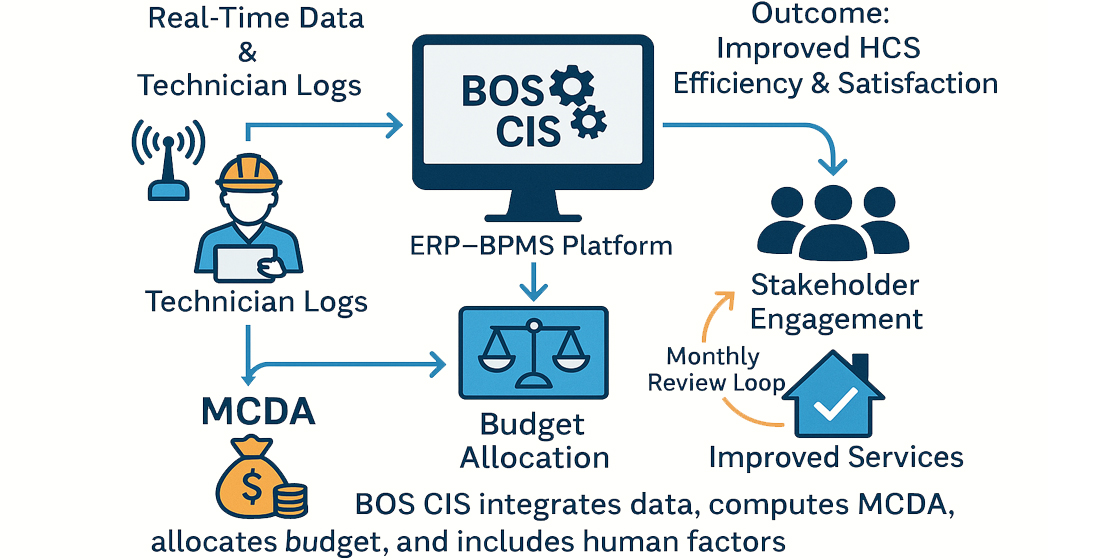
Operational risks in critical infrastructure sectors, from housing services and specialized construction to water technology and energy utilities, have significant socioeconomic implications. This study investigates how an integrated enterprise resource planning-business process management system (ERP-BPMS) supported by a dedicated information administrator (IA) can systematically mitigate these risks. Using a quasi-experimental, multi-case design, four anonymized organizations contributed baseline data (3–9 months) and post-implementation data (6–8 months). Six indicators were tracked: integral qualification score (IQS), cost prediction accuracy (CPA), system stability index (SSI), preventive maintenance ratio (PMR), sourcing score, and information utilization rate (IUR).
Results reveal that IQS increased substantially in all cases (e. g., from 9.5 to 42.1), while CPA values commonly exceeded 0.85. Preventive maintenance ratios increased by 15–20 percentage points, indicating a notable shift from reactive to proactive strategies. In the energy utility case, the SSI improved from 1.04 to 1.31, showing enhanced service reliability. The IA’s oversight proved instrumental in ensuring consistent data governance, standardizing metrics, and streamlining cross-departmental coordination. These improvements translated into measurable resource savings that significantly outweighed the costs of maintaining the IA role. Cross-case analysis suggests that a staged implementation, beginning with pilot phases for core modules, can reveal data inconsistencies early and inform tailored training programs. Managers in sectors where cost accuracy and project timelines are critical may benefit substantially from such phased rollout. Collectively, these findings highlight that a unified ERP-BPMS platform reinforced by structured human governance can significantly bolster risk management in mission-critical contexts. This research contributes to both information systems and project management fields by offering a tested framework for enhancing resilience and operational stability in high-stakes environments.
References
- Gorenstein, A., Kalech, M. (2022). Predictive maintenance for critical infrastructure. Expert Systems with Applications, 210, 118413. https://doi.org/10.1016/j.eswa.2022.118413
- Pestana, G., Sofou, S. (2024). Data Governance to Counter Hybrid Threats against Critical Infrastructures. Smart Cities, 7 (4), 1857–1877. https://doi.org/10.3390/smartcities7040072
- Chernenko, Y., Danchenko, O., Melenchuk, V. (2022). Conceptual model of risk management in development projects of providers of housing and utility services. Management of Development of Complex Systems, 51, 41–48. https://doi.org/10.32347/2412-9933.2022.51.41-48
- Maglaras, L., Kantzavelou, I., Ferrag, M. A. (2021). Digital Transformation and Cybersecurity of Critical Infrastructures. Applied Sciences, 11 (18), 8357. https://doi.org/10.3390/app11188357
- Moussa, A., Ezzeldin, M., El-Dakhakhni, W. (2024). Predicting and managing risk interactions and systemic risks in infrastructure projects using machine learning. Automation in Construction, 168, 105836. https://doi.org/10.1016/j.autcon.2024.105836
- Bernardo, B. M. V., Mamede, H. S., Barroso, J. M. P., dos Santos, V. M. P. D. (2024). Data governance & quality management – Innovation and breakthroughs across different fields. Journal of Innovation & Knowledge, 9 (4), 100598. https://doi.org/10.1016/j.jik.2024.100598
- Rahi, K., Bourgault, M., Preece, C. (2022). Risk and vulnerability management, project agility and resilience: a comparative analysis. International Journal of Information Systems and Project Management, 9 (4), 5–21. https://doi.org/10.12821/ijispm090401
- Varajão, J., Trigo, A., Pereira, J. L., Moura, I. (2022). Information systems project management success. International Journal of Information Systems and Project Management, 9 (4), 62–74. https://doi.org/10.12821/ijispm090404
- Loggen, T., Ravesteyn, P. (2023). How does BPM maturity affect process performance? Communications of the IIMA. https://doi.org/10.58729/1941-6687.1437
- Gavali, A., Halder, S. (2019). Identifying critical success factors of ERP in the construction industry. Asian Journal of Civil Engineering, 21 (2), 311–329. https://doi.org/10.1007/s42107-019-00192-4
- Hewavitharana, T., Nanayakkara, S., Perera, A., Perera, J. (2019). Impact of enterprise resource planning (ERP) systems to the construction industry. International Journal of Research in Electronics and Computer Engineering, 7 (2), 887–893. Available at: https://figshare.com/articles/journal_contribution/Impact_of_Enterprise_Resource_Planning_ERP_Systems_to_the_Construction_Industry/8868392?file=16257764
- Jayamaha, B. H. V. H., Perera, B. A. K. S., Gimhani, K. D. M., Rodrigo, M. N. N. (2023). Adaptability of enterprise resource planning (ERP) systems for cost management of building construction projects in Sri Lanka. Construction Innovation, 24 (5), 1255–1279. https://doi.org/10.1108/ci-05-2022-0108
- Pontoh, G. T., Indrijawati, A., Handayanto, A. B., Tahang, R. A., Supardi, T. S. (2024). Transforming public sector operations with enterprise resource planning: Opportunities, challenges, and best practices. Corporate Law and Governance Review, 6 (2), 8–24. https://doi.org/10.22495/clgrv6i2p1
- Szelągowski, M., Berniak-Woźny, J., Lupeikiene, A., Senkus, P. (2023). Paving the way for tomorrow: the evolution of erp and bpms systems. Scientific Papers of Silesian University of Technology. Organization and Management Series, 2023 (185), 481–510. https://doi.org/10.29119/1641-3466.2023.185.27
- Szelągowski, M., Lupeikiene, A., Berniak-Woźny, J. (2022). Drivers and Evolution Paths of BPMS: State-of-the-Art and Future Research Directions. Informatica, 33 (2), 399–420. https://doi.org/10.15388/22-infor487
- Martín-Navarro, A., Lechuga Sancho, M. P., Medina-Garrido, J. A. (2023). Determinants of BPMS use for knowledge management. Journal of Knowledge Management, 27 (11), 279–309. https://doi.org/10.1108/jkm-07-2022-0537
- Szelągowski, M., Berniak-Woźny, J., Lupeikiene, A. (2022). The Direction of the Future Development of ERP and BPMS: Towards a Single Unified Class? Digital Business and Intelligent Systems, 111–124. https://doi.org/10.1007/978-3-031-09850-5_8
- Szelągowski, M., Berniak-Woźny, J., Lupeikiene, A. (2022). The Future Development of ERP: Towards Process ERP Systems? Business Process Management: Blockchain, Robotic Process Automation, and Central and Eastern Europe Forum, 326–341. https://doi.org/10.1007/978-3-031-16168-1_21
- Ochoa Pacheco, P., Coello-Montecel, D., Tello, M., Lasio, V., Armijos, A. (2023). How do project managers’ competencies impact project success? A systematic literature review. PLOS ONE, 18 (12), e0295417. https://doi.org/10.1371/journal.pone.0295417
- ISO 31000:2018 Risk management – Guidelines (2018). International Organization for Standardization. Available at: https://www.iso.org/standard/65694.html
- Zubair, M. U., Farid, O., Hassan, M. U., Aziz, T., Ud-Din, S. (2024). Framework for Strategic Selection of Maintenance Contractors. Sustainability, 16 (6), 2488. https://doi.org/10.3390/su16062488
- Joshi, D., Pratik, S., Rao, M. P. (2021). Data governance in data mesh infrastructures: The Saxo Bank case study. Proceedings of the ICEB 2021 Conference. Available at: https://aisel.aisnet.org/iceb2021/52
- Papamichael, M., Dimopoulos, C., Boustras, G. (2024). Performing risk assessment for critical infrastructure protection: an investigation of transnational challenges and human decision-making considerations. Sustainable and Resilient Infrastructure, 9 (4), 367–385. https://doi.org/10.1080/23789689.2024.2340368
- Janssens, G., Kusters, R., Martin, H. (2021). Expecting the unexpected during ERP implementations: a complexity view. International Journal of Information Systems and Project Management, 8 (4), 68–82. https://doi.org/10.12821/ijispm080404
- Schuh, G., Jussen, P., Optehostert, F. (2019). Iterative Cost Assessment of Maintenance Services. Procedia CIRP, 80, 488–493. https://doi.org/10.1016/j.procir.2019.01.067
- Alexander, A., Li, Y., Plante, R. (2023). Comparative study of two menus of contracts for outsourcing the maintenance function of a process having a linear failure rate. IISE Transactions, 55 (12), 1230–1241. https://doi.org/10.1080/24725854.2023.2175939
- Stenström, C., Norrbin, P., Parida, A., Kumar, U. (2015). Preventive and corrective maintenance – cost comparison and cost–benefit analysis. Structure and Infrastructure Engineering, 12 (5), 603–617. https://doi.org/10.1080/15732479.2015.1032983
- Bouabdallaoui, Y., Lafhaj, Z., Yim, P., Ducoulombier, L., Bennadji, B. (2021). Predictive Maintenance in Building Facilities: A Machine Learning-Based Approach. Sensors, 21 (4), 1044. https://doi.org/10.3390/s21041044
- Rousso, B. Z., Do, N. C., Gao, L., Monks, I., Wu, W., Stewart, R. A. et al. (2024). Transitioning practices of water utilities from reactive to proactive: Leveraging Australian best practices in digital technologies and data analytics. Journal of Hydrology, 641, 131808. https://doi.org/10.1016/j.jhydrol.2024.131808
- Summers, D. J., Visser, J. K. (2021). Factors that influence the decision to outsource maintenance in the processing industry. South African Journal of Industrial Engineering, 32 (1), 10–20. https://doi.org/10.7166/32-1-2127
- Mostofi, F., Tokdemir, O. B., Bahadır, Ü., Toğan, V. (2024). Performance‐driven contractor recommendation system using a weighted activity-contractor network. Computer-Aided Civil and Infrastructure Engineering, 40 (3), 409–424. Portico. https://doi.org/10.1111/mice.13332
- Bilir, C., Yafez, E. (2022). Project success/failure rates in Turkey. International Journal of Information Systems and Project Management, 9 (4), 24–40. https://doi.org/10.12821/ijispm090402
- Parra, N., Giraldo, S., la Rotta, D., Gómez, B., Mejía, Y., Morales, L. et al. (2024). A step towards digital transformation within a utility company through process automation for a sustainable energy transition. The Journal of Engineering, 2024 (12). https://doi.org/10.1049/tje2.70036
- Saeed, S., Gull, H., Aldossary, M. M., Altamimi, A. F., Alshahrani, M. S., Saqib, M. et al. (2024). Digital Transformation in Energy Sector: Cybersecurity Challenges and Implications. Information, 15 (12), 764. https://doi.org/10.3390/info15120764
- Shaheen, B. W., Németh, I. (2022). Integration of Maintenance Management System Functions with Industry 4.0 Technologies and Features – A Review. Processes, 10 (11), 2173. https://doi.org/10.3390/pr10112173
- Pan, Y., Zhang, L. (2021). A BIM-data mining integrated digital twin framework for advanced project management. Automation in Construction, 124, 103564. https://doi.org/10.1016/j.autcon.2021.103564
- Chen, C., Fu, H., Zheng, Y., Tao, F., Liu, Y. (2023). The advance of digital twin for predictive maintenance: The role and function of machine learning. Journal of Manufacturing Systems, 71, 581–594. https://doi.org/10.1016/j.jmsy.2023.10.010
- van Dinter, R., Tekinerdogan, B., Catal, C. (2022). Predictive maintenance using digital twins: A systematic literature review. Information and Software Technology, 151, 107008. https://doi.org/10.1016/j.infsof.2022.107008
- Mohammed, A., Al Busaeedi, N., Mohamed, A. A., Saud, S. (2022). Smart Project Management System (SPMS) – An Integrated and Predictive Solution for Proactively Managing Oil & Gas client Projects. ADIPEC. https://doi.org/10.2118/210877-ms
- van Besouw, J., Bond-Barnard, T. (2021). Smart project management information systems (SPMIS) for engineering projects – Project performance monitoring & reporting. International Journal of Information Systems and Project Management, 9 (1), 78–97. https://revistas.uminho.pt/index.php/ijispm/article/view/4452
Downloads
Published
How to Cite
Issue
Section
License
Copyright (c) 2025 Yuri Chernenko, Dmytro Bedrii, Oksana Haidaienko, Oleh Meliksetov

This work is licensed under a Creative Commons Attribution 4.0 International License.
The consolidation and conditions for the transfer of copyright (identification of authorship) is carried out in the License Agreement. In particular, the authors reserve the right to the authorship of their manuscript and transfer the first publication of this work to the journal under the terms of the Creative Commons CC BY license. At the same time, they have the right to conclude on their own additional agreements concerning the non-exclusive distribution of the work in the form in which it was published by this journal, but provided that the link to the first publication of the article in this journal is preserved.