Пом’якшення операційних ризиків у критичній інфраструктурі за допомогою інтегрованого ERP-BPMS: дослідження кількох прикладів
DOI:
https://doi.org/10.15587/2706-5448.2025.330660Ключові слова:
ERP, BPMS, інтеграція, ризик, управління, інфраструктура, дані, врядування, кейс, дослідженняАнотація
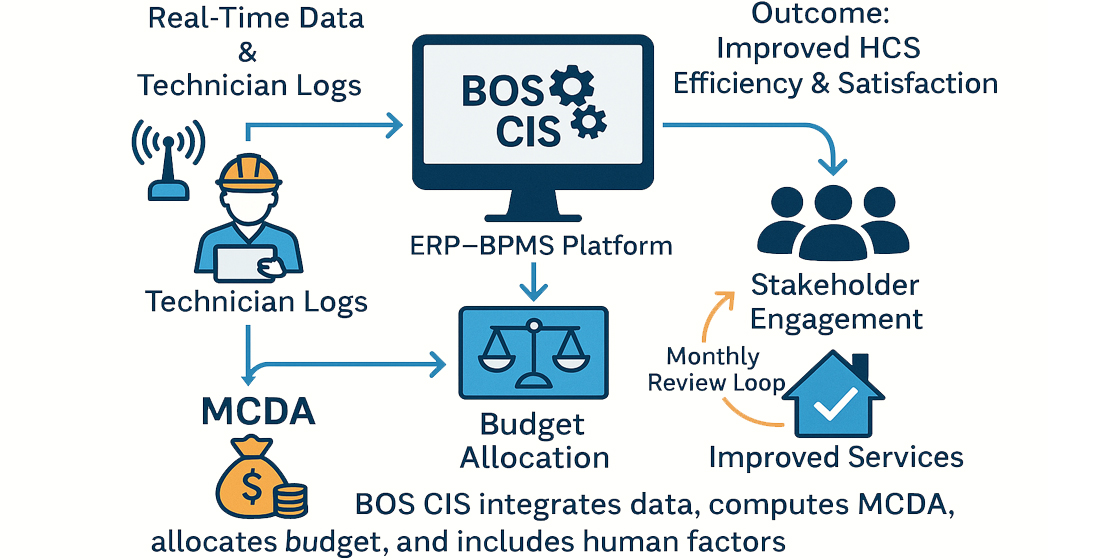
Операційні ризики в секторах критичної інфраструктури – від житлово-комунальних послуг та спеціалізованого будівництва до водних технологій та енергетики – мають значні соціально-економічні наслідки. У цьому дослідженні розглядається, як інтегрована система планування ресурсів підприємства та управління бізнес-процесами (ERP-BPMS), підтримана спеціальним Інформаційним Адміністратором (ІА), може систематично знижувати ці ризики. Використовуючи квазіекспериментальний багатокейсовий підхід, чотири анонімізовані організації надали базові дані (3–9 місяців) та дані після впровадження (6–8 місяців). Відстежувалися шість ключових показників ефективності: Інтегральний показник кваліфікації (IQS), Точність прогнозування витрат (CPA), Індекс стабільності системи (SSI), Співвідношення профілактичного обслуговування (PMR), Оцінка постачання та Коефіцієнт використання інформації (IUR).
Результати показують, що IQS суттєво зріс у всіх випадках (наприклад, з 9,5 до 42,1), тоді як значення CPA зазвичай перевищували 0,85. Коефіцієнти профілактичного обслуговування зросли на 15–20 процентних пунктів, що свідчить про помітний перехід від реактивних до проактивних стратегій. Ці поліпшення призвели до вимірюваної економії ресурсів, що значно перевищує витрати на підтримку ролі ІА, що підтверджує економічну доцільність цієї посади навіть в організаціях з обмеженими ресурсами. Нагляд ІА виявився вирішальним для забезпечення послідовного управління даними, стандартизації показників та оптимізації міжвідомчої координації. Міжкейсовий аналіз додатково свідчить, що поетапне впровадження, починаючи з пілотної фази для основних модулів, може виявити невідповідності даних на ранній стадії та інформувати про адаптовані програми навчання. Керівники в таких секторах, як будівництво та водні технології, де точність витрат і терміни проєктів є критичними, можуть значно виграти від такого поетапного впровадження. Загалом, ці висновки підкреслюють, що уніфікована платформа ERP-BPMS, підсилена структурованим управлінням, може значно посилити управління ризиками в критично важливих контекстах.
Посилання
- Gorenstein, A., Kalech, M. (2022). Predictive maintenance for critical infrastructure. Expert Systems with Applications, 210, 118413. https://doi.org/10.1016/j.eswa.2022.118413
- Pestana, G., Sofou, S. (2024). Data Governance to Counter Hybrid Threats against Critical Infrastructures. Smart Cities, 7 (4), 1857–1877. https://doi.org/10.3390/smartcities7040072
- Chernenko, Y., Danchenko, O., Melenchuk, V. (2022). Conceptual model of risk management in development projects of providers of housing and utility services. Management of Development of Complex Systems, 51, 41–48. https://doi.org/10.32347/2412-9933.2022.51.41-48
- Maglaras, L., Kantzavelou, I., Ferrag, M. A. (2021). Digital Transformation and Cybersecurity of Critical Infrastructures. Applied Sciences, 11 (18), 8357. https://doi.org/10.3390/app11188357
- Moussa, A., Ezzeldin, M., El-Dakhakhni, W. (2024). Predicting and managing risk interactions and systemic risks in infrastructure projects using machine learning. Automation in Construction, 168, 105836. https://doi.org/10.1016/j.autcon.2024.105836
- Bernardo, B. M. V., Mamede, H. S., Barroso, J. M. P., dos Santos, V. M. P. D. (2024). Data governance & quality management – Innovation and breakthroughs across different fields. Journal of Innovation & Knowledge, 9 (4), 100598. https://doi.org/10.1016/j.jik.2024.100598
- Rahi, K., Bourgault, M., Preece, C. (2022). Risk and vulnerability management, project agility and resilience: a comparative analysis. International Journal of Information Systems and Project Management, 9 (4), 5–21. https://doi.org/10.12821/ijispm090401
- Varajão, J., Trigo, A., Pereira, J. L., Moura, I. (2022). Information systems project management success. International Journal of Information Systems and Project Management, 9 (4), 62–74. https://doi.org/10.12821/ijispm090404
- Loggen, T., Ravesteyn, P. (2023). How does BPM maturity affect process performance? Communications of the IIMA. https://doi.org/10.58729/1941-6687.1437
- Gavali, A., Halder, S. (2019). Identifying critical success factors of ERP in the construction industry. Asian Journal of Civil Engineering, 21 (2), 311–329. https://doi.org/10.1007/s42107-019-00192-4
- Hewavitharana, T., Nanayakkara, S., Perera, A., Perera, J. (2019). Impact of enterprise resource planning (ERP) systems to the construction industry. International Journal of Research in Electronics and Computer Engineering, 7 (2), 887–893. Available at: https://figshare.com/articles/journal_contribution/Impact_of_Enterprise_Resource_Planning_ERP_Systems_to_the_Construction_Industry/8868392?file=16257764
- Jayamaha, B. H. V. H., Perera, B. A. K. S., Gimhani, K. D. M., Rodrigo, M. N. N. (2023). Adaptability of enterprise resource planning (ERP) systems for cost management of building construction projects in Sri Lanka. Construction Innovation, 24 (5), 1255–1279. https://doi.org/10.1108/ci-05-2022-0108
- Pontoh, G. T., Indrijawati, A., Handayanto, A. B., Tahang, R. A., Supardi, T. S. (2024). Transforming public sector operations with enterprise resource planning: Opportunities, challenges, and best practices. Corporate Law and Governance Review, 6 (2), 8–24. https://doi.org/10.22495/clgrv6i2p1
- Szelągowski, M., Berniak-Woźny, J., Lupeikiene, A., Senkus, P. (2023). Paving the way for tomorrow: the evolution of erp and bpms systems. Scientific Papers of Silesian University of Technology. Organization and Management Series, 2023 (185), 481–510. https://doi.org/10.29119/1641-3466.2023.185.27
- Szelągowski, M., Lupeikiene, A., Berniak-Woźny, J. (2022). Drivers and Evolution Paths of BPMS: State-of-the-Art and Future Research Directions. Informatica, 33 (2), 399–420. https://doi.org/10.15388/22-infor487
- Martín-Navarro, A., Lechuga Sancho, M. P., Medina-Garrido, J. A. (2023). Determinants of BPMS use for knowledge management. Journal of Knowledge Management, 27 (11), 279–309. https://doi.org/10.1108/jkm-07-2022-0537
- Szelągowski, M., Berniak-Woźny, J., Lupeikiene, A. (2022). The Direction of the Future Development of ERP and BPMS: Towards a Single Unified Class? Digital Business and Intelligent Systems, 111–124. https://doi.org/10.1007/978-3-031-09850-5_8
- Szelągowski, M., Berniak-Woźny, J., Lupeikiene, A. (2022). The Future Development of ERP: Towards Process ERP Systems? Business Process Management: Blockchain, Robotic Process Automation, and Central and Eastern Europe Forum, 326–341. https://doi.org/10.1007/978-3-031-16168-1_21
- Ochoa Pacheco, P., Coello-Montecel, D., Tello, M., Lasio, V., Armijos, A. (2023). How do project managers’ competencies impact project success? A systematic literature review. PLOS ONE, 18 (12), e0295417. https://doi.org/10.1371/journal.pone.0295417
- ISO 31000:2018 Risk management – Guidelines (2018). International Organization for Standardization. Available at: https://www.iso.org/standard/65694.html
- Zubair, M. U., Farid, O., Hassan, M. U., Aziz, T., Ud-Din, S. (2024). Framework for Strategic Selection of Maintenance Contractors. Sustainability, 16 (6), 2488. https://doi.org/10.3390/su16062488
- Joshi, D., Pratik, S., Rao, M. P. (2021). Data governance in data mesh infrastructures: The Saxo Bank case study. Proceedings of the ICEB 2021 Conference. Available at: https://aisel.aisnet.org/iceb2021/52
- Papamichael, M., Dimopoulos, C., Boustras, G. (2024). Performing risk assessment for critical infrastructure protection: an investigation of transnational challenges and human decision-making considerations. Sustainable and Resilient Infrastructure, 9 (4), 367–385. https://doi.org/10.1080/23789689.2024.2340368
- Janssens, G., Kusters, R., Martin, H. (2021). Expecting the unexpected during ERP implementations: a complexity view. International Journal of Information Systems and Project Management, 8 (4), 68–82. https://doi.org/10.12821/ijispm080404
- Schuh, G., Jussen, P., Optehostert, F. (2019). Iterative Cost Assessment of Maintenance Services. Procedia CIRP, 80, 488–493. https://doi.org/10.1016/j.procir.2019.01.067
- Alexander, A., Li, Y., Plante, R. (2023). Comparative study of two menus of contracts for outsourcing the maintenance function of a process having a linear failure rate. IISE Transactions, 55 (12), 1230–1241. https://doi.org/10.1080/24725854.2023.2175939
- Stenström, C., Norrbin, P., Parida, A., Kumar, U. (2015). Preventive and corrective maintenance – cost comparison and cost–benefit analysis. Structure and Infrastructure Engineering, 12 (5), 603–617. https://doi.org/10.1080/15732479.2015.1032983
- Bouabdallaoui, Y., Lafhaj, Z., Yim, P., Ducoulombier, L., Bennadji, B. (2021). Predictive Maintenance in Building Facilities: A Machine Learning-Based Approach. Sensors, 21 (4), 1044. https://doi.org/10.3390/s21041044
- Rousso, B. Z., Do, N. C., Gao, L., Monks, I., Wu, W., Stewart, R. A. et al. (2024). Transitioning practices of water utilities from reactive to proactive: Leveraging Australian best practices in digital technologies and data analytics. Journal of Hydrology, 641, 131808. https://doi.org/10.1016/j.jhydrol.2024.131808
- Summers, D. J., Visser, J. K. (2021). Factors that influence the decision to outsource maintenance in the processing industry. South African Journal of Industrial Engineering, 32 (1), 10–20. https://doi.org/10.7166/32-1-2127
- Mostofi, F., Tokdemir, O. B., Bahadır, Ü., Toğan, V. (2024). Performance‐driven contractor recommendation system using a weighted activity-contractor network. Computer-Aided Civil and Infrastructure Engineering, 40 (3), 409–424. Portico. https://doi.org/10.1111/mice.13332
- Bilir, C., Yafez, E. (2022). Project success/failure rates in Turkey. International Journal of Information Systems and Project Management, 9 (4), 24–40. https://doi.org/10.12821/ijispm090402
- Parra, N., Giraldo, S., la Rotta, D., Gómez, B., Mejía, Y., Morales, L. et al. (2024). A step towards digital transformation within a utility company through process automation for a sustainable energy transition. The Journal of Engineering, 2024 (12). https://doi.org/10.1049/tje2.70036
- Saeed, S., Gull, H., Aldossary, M. M., Altamimi, A. F., Alshahrani, M. S., Saqib, M. et al. (2024). Digital Transformation in Energy Sector: Cybersecurity Challenges and Implications. Information, 15 (12), 764. https://doi.org/10.3390/info15120764
- Shaheen, B. W., Németh, I. (2022). Integration of Maintenance Management System Functions with Industry 4.0 Technologies and Features – A Review. Processes, 10 (11), 2173. https://doi.org/10.3390/pr10112173
- Pan, Y., Zhang, L. (2021). A BIM-data mining integrated digital twin framework for advanced project management. Automation in Construction, 124, 103564. https://doi.org/10.1016/j.autcon.2021.103564
- Chen, C., Fu, H., Zheng, Y., Tao, F., Liu, Y. (2023). The advance of digital twin for predictive maintenance: The role and function of machine learning. Journal of Manufacturing Systems, 71, 581–594. https://doi.org/10.1016/j.jmsy.2023.10.010
- van Dinter, R., Tekinerdogan, B., Catal, C. (2022). Predictive maintenance using digital twins: A systematic literature review. Information and Software Technology, 151, 107008. https://doi.org/10.1016/j.infsof.2022.107008
- Mohammed, A., Al Busaeedi, N., Mohamed, A. A., Saud, S. (2022). Smart Project Management System (SPMS) – An Integrated and Predictive Solution for Proactively Managing Oil & Gas client Projects. ADIPEC. https://doi.org/10.2118/210877-ms
- van Besouw, J., Bond-Barnard, T. (2021). Smart project management information systems (SPMIS) for engineering projects – Project performance monitoring & reporting. International Journal of Information Systems and Project Management, 9 (1), 78–97. https://revistas.uminho.pt/index.php/ijispm/article/view/4452
##submission.downloads##
Опубліковано
Як цитувати
Номер
Розділ
Ліцензія
Авторське право (c) 2025 Yuri Chernenko, Dmytro Bedrii, Oksana Haidaienko, Oleh Meliksetov

Ця робота ліцензується відповідно до Creative Commons Attribution 4.0 International License.
Закріплення та умови передачі авторських прав (ідентифікація авторства) здійснюється у Ліцензійному договорі. Зокрема, автори залишають за собою право на авторство свого рукопису та передають журналу право першої публікації цієї роботи на умовах ліцензії Creative Commons CC BY. При цьому вони мають право укладати самостійно додаткові угоди, що стосуються неексклюзивного поширення роботи у тому вигляді, в якому вона була опублікована цим журналом, але за умови збереження посилання на першу публікацію статті в цьому журналі.