Assessment of deformation processes in backfill masses using crushed rock models
DOI:
https://doi.org/10.15587/2706-5448.2025.333869Keywords:
backfill mass, deformation, compaction, crushed rock, convergence, safe working conditionsAbstract
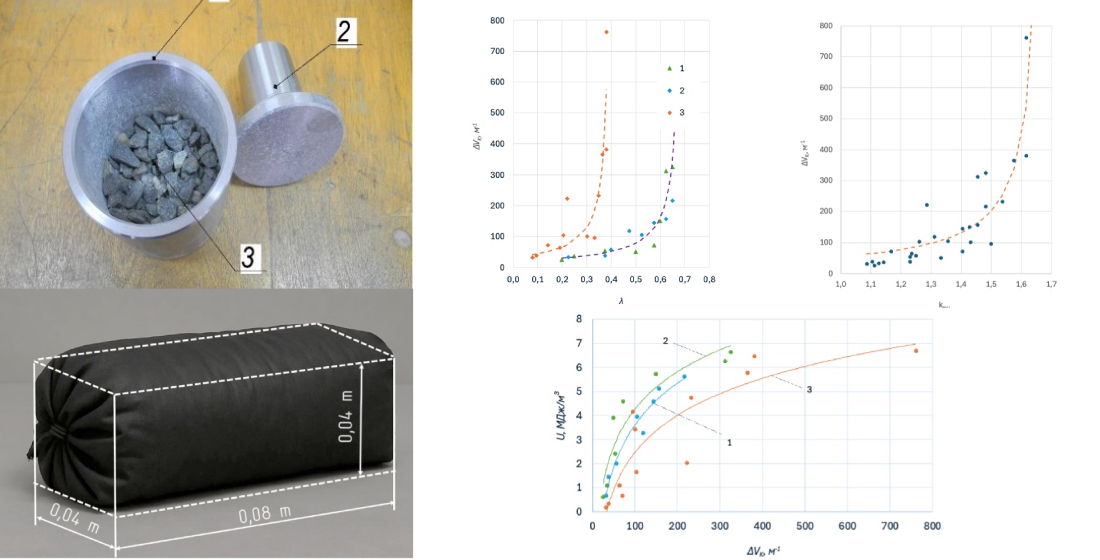
The object of the study was the deformation processes in backfill masses made of crushed rock, which are used for roof control in mining panels. The study addressed the issue of preventing sidewall collapses by ensuring the stability of the backfill masses. Deformation processes were investigated using experimental models made of crushed rock that simulated various backfill structures. The study considered uniaxial compression of crushed rock with lateral expansion capability, as well as compressive loading. Uniaxial compression was used to simulate partial backfilling of the gob area, while compressive loading represented complete backfilling. Under loading conditions, a hyperbolic relationship was established between the relative volume change of the backfill material per unit of side rock convergence, ΔVK (m–1), and the compaction coefficient of crushed rock. This relationship enables the prediction of the material's ultimate settlement. The determining factor in this relationship is the relative deformation of the backfill mass. Under loading of crushed rock and comparable compaction coefficient values, the difference in deformation properties reaches 2.5 to 3 times. This is recorded due to the transformation of shape or change in volume under different compression conditions. It is shown that with an increase in the parameter ΔVK, the specific potential energy of deformation of the backfill material changes according to a logarithmic relationship. The specific potential energy of deformation is determined by the mechanical properties and compression conditions of the crushed rock.
Maximum stability of gob-side retained entries can be ensured through complete backfilling of the gob area, while the expected subsidence of the backfill mass depends on the initial backfill density and the deformation properties of the crushed rock used for filling.
References
- Feng, X., Zhang, N., Gong, L., Xue, F., Zheng, X. (2015). Application of a Backfilling Method in Coal Mining to Realise an Ecologically Sensitive “Black Gold” Industry. Energies, 8 (5), 3628–3639. https://doi.org/10.3390/en8053628
- Jiang, H., Cao, Y., Huang, P., Fang, K., Li, B. (2015). Characterisation of coal-mine waste in solid backfill mining in China. Mining Technology, 124 (1), 56–63. https://doi.org/10.1179/1743286315y.0000000002
- Yıldız, T. D. (2020). Waste management costs (WMC) of mining companies in Turkey: Can waste recovery help meeting these costs? Resources Policy, 68, 101706. https://doi.org/10.1016/j.resourpol.2020.101706
- Bachurin, L. L., Iordanov, I. V., Simonova, Yu. I., Korol, A. V., Podkopaiev, Ye. S., Kayun, O. P. (2020). Experimental studies of the deformation characteristics of filling massifs. Technical Engineering, 2 (86), 136–149. https://doi.org/10.26642/ten-2020-2(86)-136-149
- KD 12.01.01.503-2001. Upravlenie krovlei i kreplenie v ochistnykh zaboiakh na ugolnykh plastakh s uglom padeniia do 35°(2002). Kyiv: Mintopenergo Ukrainy, DonUGI, 141.
- Jing, Y., Xu, Y., Bai, J., Li, Y., Li, J. (2025). Mechanism and Control Technology of Lateral Load-Bearing Behavior of a Support System Adjacent to Empty Roadways. Applied Sciences, 15 (3), 1200. https://doi.org/10.3390/app15031200
- Podkopaiev, S., Gogo, V., Yefremov, I., Kipko, O., Iordanov, I., Simonova, Y. (2019). Phenomena of stability of the coal seam roof with a yielding support. Mining of Mineral Deposits, 13 (4), 28–41. https://doi.org/10.33271/mining13.04.028
- Krupnik, L. A., Shaposhnik, Yu. N., Shaposhnik, S. N., Tursunbaeva, A. K. (2013). Backfilling technology in Kazakhstan mines. Journal of Mining Science, 49 (1), 82–89. https://doi.org/10.1134/s1062739149010103
- Zhukov, V. E., Vystorop, V. V., Kolchin, A. M., Grigoriuk, E. V. (1984). Malootkhodnaia tekhnologiia dobychi uglia. Kyiv: Tekhnika, 144.
- Malashkevych, D. S. (2021). Rozrobka tekhnolohichnykh skhem selektyvnoho vidpratsiuvannia plastiv iz zalyshenniam porody u vyroblenomu prostori (na prykladi shakht Zakhidnoho Donbasu). Dnipro: LizunovPres, 189.
- Shashenko, O. M., Maikherchyk, T., Sdvyzhkova, O. O. (2005). Heomekhanichni protsesy u porodnykh masyvakh. Dnipropetrovsk: Natsionalnyi hirnychyi universytet, 319.
- Kline, S. J. (1986). Similitude and Approximation Theory. Springer Berlin Heidelberg, 229. https://doi.org/10.1007/978-3-642-61638-9
- Shashenko, O. M., Pustovoitenko, V. P., Sdvyzhkova, O. O. (2016). Heomekhanika. Kyiv: Novyi druk, 528.
- Pappas, D. M., Mark, C. (1993). Behavior of simulated longwall gob material (Report of Investigations No. 9458). U.S. Bureau of Mines.
- Sadd, M. H. (2009). Elasticity. Elsevier. https://doi.org/10.1016/B978-0-12-374446-3.X0001-6
- Chepiga, D., Polii, D., Podkopaiev, S., Bachurin, L., Bielikov, A., Slashchov, I. et al. (2025). Evaluating the stiffness of a cast strip for protecting a preparatory mine working. Eastern-European Journal of Enterprise Technologies, 2 (1 (134)), 40–50. https://doi.org/10.15587/1729-4061.2025.324548
- Petlovanyi, M., Malashkevych, D., Sai, K., Bulat, I., Popovych, V. (2021). Granulometric composition research of mine rocks as a material for backfilling the mined-out area in coal mines. Mining of Mineral Deposits, 15 (4), 122–129. https://doi.org/10.33271/mining15.04.122
Downloads
Published
How to Cite
Issue
Section
License
Copyright (c) 2025 Oleksandr Tkachuk, Daria Chepiga, Leonid Bachurin, Serhii Podkopaiev, Yaroslava Bachurina, Yevgen Podkopayev, Mykola Rudynets, Olena Visyn

This work is licensed under a Creative Commons Attribution 4.0 International License.
The consolidation and conditions for the transfer of copyright (identification of authorship) is carried out in the License Agreement. In particular, the authors reserve the right to the authorship of their manuscript and transfer the first publication of this work to the journal under the terms of the Creative Commons CC BY license. At the same time, they have the right to conclude on their own additional agreements concerning the non-exclusive distribution of the work in the form in which it was published by this journal, but provided that the link to the first publication of the article in this journal is preserved.