Comparison of certain safety and quality indicators of developed chocolate paste with organic and inorganic raw materials
DOI:
https://doi.org/10.15587/2706-5448.2025.334590Keywords:
organic food products, chocolate spreads, food safety, sea buckthorn oil, hemp oilAbstract
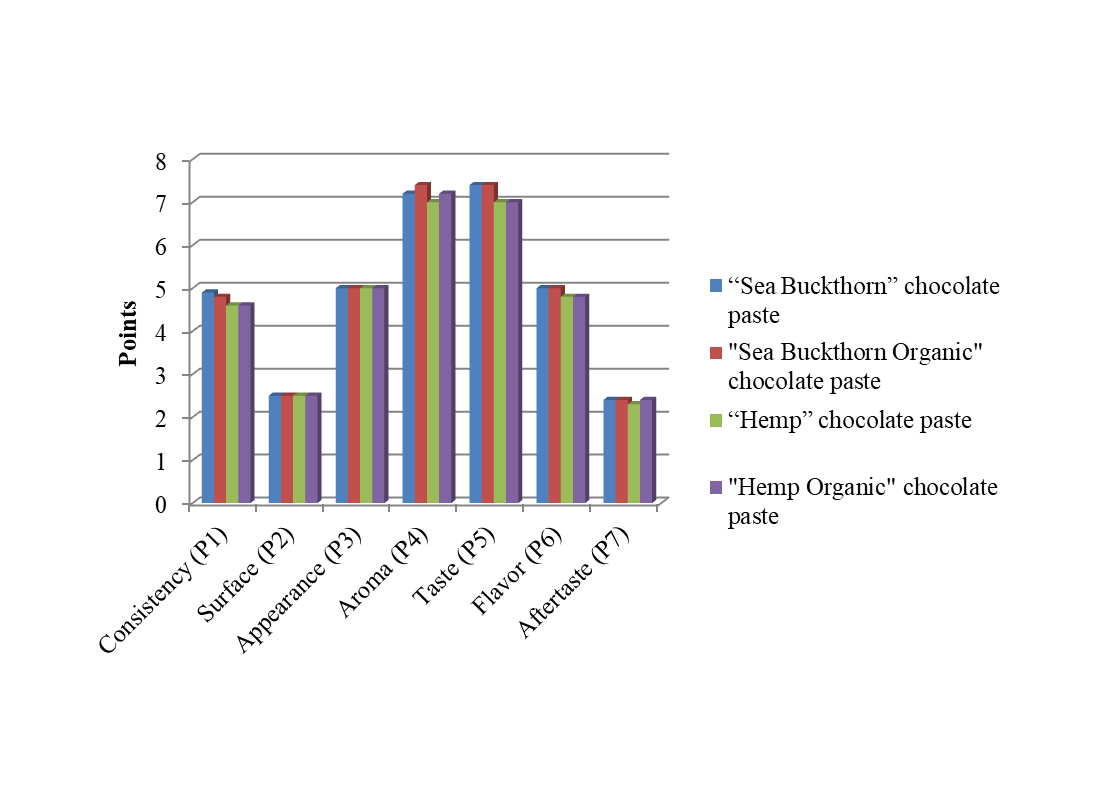
The object of the research is the developed chocolate spreads from organic raw materials. The problem to be solved is to compare the quality and safety indicators of organic and inorganic food products. The composition of the “Sea Buckthorn” chocolate paste includes almonds, natural cocoa powder, cocoa butter, cane sugar, sea buckthorn oil, powdered milk, and flax bran. The “Hemp” chocolate paste differs in that instead of sea buckthorn oil, it contains hemp oil. The organoleptic evaluation of the pastes was carried out using a 35-point scale developed. The mass fraction of moisture was determined by drying to constant mass. The fatty acid composition was determined by gas chromatography. The content of heavy metal salts was determined by the colorimetric method and the flameless atomic absorption method. Biological, chemical, and physical hazardous factors were analyzed at each stage of the production of chocolate pastes. The results of the organoleptic evaluation indicate that all samples meet the “excellent” quality level. No significant differences were found between organic and inorganic chocolate spreads made according to the same recipes. The mass fraction of moisture in the developed products was within the normal range and did not exceed 3%. More fats were found in organic chocolate spreads than in inorganic ones. In the “Sea Buckthorn Organic” chocolate spread – by 1.48 g / 100 g; in the “Hemp Organic” chocolate spread – by 1.86 g / 100 g. The results of the study show that the content of polyunsaturated fatty acids in chocolate spreads made from organic raw materials significantly exceeds the content of similar acids in inorganic chocolate spreads. The content of linolenic acid is higher by 0.58 g / 100 g in “Organic Sea Buckthorn Organic” paste and by 1 g / 100 g in “Organic Hemp” chocolate paste compared to similar pastes made from inorganic raw materials.The lead content is 2.77 times lower in “Organic Sea Buckthorn” oil; 2.45 times lower in “Organic Hemp” oil than in similar inorganic chocolate spreads. A very significant difference is noted in the cadmium content: 3 and 4.5 times lower, respectively. The critical control points of production are sterilization of containers and heat treatment of chocolate spreads.
References
- DSTU 7374:2013. Pasty shokoladni. Tekhnichni umovy (2014). Kyiv: Derzhspozhyvstandart Ukrainy, 23.
- Dyrektyva Yevropeiskoho Parlamentu i Rady 2000/36/IeS vid 23 chervnia 2000 roku pro produkty z kakao ta shokoladu, pryznacheni dlia spozhyvannia liudynoiu (2000). Yevropeiskyi parlament, Rada Yevropeiskoho Soiuzu. Available at: https://zakon.rada.gov.ua/laws/show/984_001-00
- Pro zatverdzhennia Vymoh do produktiv z kakao ta shokoladu (2016). Nakaz Ministerstva ahrarnoi polityky ta prodovolstva Ukrainy No. 157. 13.04.2016. Available at: https://zakon.rada.gov.ua/laws/show/z0688-16#Text
- Tkachenko, A. S. (2014). Formuvannia bezpechnosti ta yakosti orhanichnykh boroshnianykh kondyterskykh vyrobiv. [Doctoral dissertation; Derzhavnyi torhovelno-ekonomichnyi universytet].
- de Souza Correia Cozentino, I., Veloso de Paula, A., Augusto Ribeiro, C., Duran Alonso, J., Grimaldi, R., Luccas, V. et al. (2022). Development of a potentially functional chocolate spread containing probiotics and structured triglycerides. LWT, 154, 112746. https://doi.org/10.1016/j.lwt.2021.112746
- Tirgarian, B., Yadegari, H., Bagheri, A., Neshagaran, E., Mardani, M., Farmani, J. (2023). Reduced-fat chocolate spreads developed by water-in-oleogel emulsions. Journal of Food Engineering, 337, 111233. https://doi.org/10.1016/j.jfoodeng.2022.111233
- Amer, S. A., Barakat, H. A., Zaki, H. M. (2024). The development of a functional chocolate spread based on sweet potato and dried fruits. Egyptian Journal of Chemistry, 67 (11), 239–261. https://doi.org/10.21608/ejchem.2024.312157.10194
- Kondratiuk, N. V., Harkusha, I. M. (2016). The research and analysis of the chocolate nut butter with polyfunctional properties. Eastern-European Journal of Enterprise Technologies, 1 (10 (79)), 36–41. https://doi.org/10.15587/1729-4061.2016.59693
- DSTU 4910:2008. Vyroby kondyterski. Metody vyznachennia masovykh chastok volohy ta sukhykh rechovyn (2008). Kyiv: Derzhspozhyvstandart Ukrainy, 21.
- Tkachenko, A. S. (2015). Formuvannia spozhyvchykh vlastyvostei pechyva tsukrovoho pidvyshchenoi kharchovoi tsinnosti. [PhD dissertation; Lvivskyi torhovelno-ekonomichnyi universytet].
- Liu, K. (2011). Comparison of Lipid Content and Fatty Acid Composition and Their Distribution within Seeds of 5 Small Grain Species. Journal of Food Science, 76 (2). https://doi.org/10.1111/j.1750-3841.2010.02038.x
- Kotliar, Ye. (2022). Development of a technology of oil made from seeds of grapes cultivated in the Odessa region without losing the quality characteristics. Food Science and Technology, 16 (1). https://doi.org/10.15673/fst.v16i1.2291
- Morton-Bermea, O., Carrillo-Chávez, A., Hernández, E., González-Partida, E. (2004). Determination of Metals for Leaching Experiments of Mine Tailings: Evaluation of the Potential Environmental Hazard in the Guanajuato Mining District, Mexico. Bulletin of Environmental Contamination and Toxicology, 73 (4), 770–776. https://doi.org/10.1007/s00128-004-0492-z
- Rehlament Yevropeiskoho Parlamentu i Rady (IeS) No. 852/2004 vid 29 kvitnia 2004 roku pro hihiienu kharchovykh produktiv (2004). Yevropeiskyi parlament, Rada Yevropeiskoho Soiuzu. Available at: https://zakon.rada.gov.ua/laws/show/984_002-04
- Pro osnovni pryntsypy ta vymohy do bezpechnosti ta yakosti kharchovykh produktiv (2024). Zakon Ukrainy No. 771/97-VR. 18.12.2024. Available at: https://zakon.rada.gov.ua/laws/show/771/97-%D0%B2%D1%80#Text
- Pro zatverdzhennia Vymoh shchodo rozrobky, vprovadzhennia ta zastosuvannia postiino diiuchykh protsedur, zasnovanykh na pryntsypakh Systemy upravlinnia bezpechnistiu kharchovykh produktiv (NASSR) (2012). Nakaz Ministerstva ahrarnoi polityky i prodovolstva Ukrainy No. 590. 01.10.2012. Available at: https://zakon.rada.gov.ua/laws/show/z1704-12#Text
- Tkachenko, A. S., Basova, Yu. O., Horiachova, O. O.; Tkachenko, A. S. (Ed.) (2020). Vprovadzhennia systemy NASSR dlia operatoriv rynku kharchovykh produktiv. Poltava: PUET, 137.
- Zhao, D., Wang, P., Zhao, F.-J. (2024). Toxic Metals and Metalloids in Food: Current Status, Health Risks, and Mitigation Strategies. Current Environmental Health Reports, 11 (4), 468–483. https://doi.org/10.1007/s40572-024-00462-7
- Kuan, C.-H., Rukayadi, Y., Ahmad, S. H., Wan Mohamed Radzi, C. W. J., Thung, T.-Y., Premarathne, J. M. K. J. K. et al. (2017). Comparison of the Microbiological Quality and Safety between Conventional and Organic Vegetables Sold in Malaysia. Frontiers in Microbiology, 8. https://doi.org/10.3389/fmicb.2017.01433
- Szczech, M., Kowalska, B., Smolińska, U., Maciorowski, R., Oskiera, M., Michalska, A. (2018). Microbial quality of organic and conventional vegetables from Polish farms. International Journal of Food Microbiology, 286, 155–161. https://doi.org/10.1016/j.ijfoodmicro.2018.08.018
- Tkachenko, A. S. (2024). Formuvannia bezpechnosti ta yakosti orhanichnykh boroshnianykh kondyterskykh vyrobiv [Extended abstract of Doctoral thesis].
- Lairon, D. (2010). Nutritional quality and safety of organic food. A review. Agronomy for Sustainable Development, 30 (1), 33–41. https://doi.org/10.1051/agro/2009019
Downloads
Published
How to Cite
Issue
Section
License
Copyright (c) 2025 Alina Tkachenko, Inna Tiurikova, Oleksandra Horobets, Alina Geredchuk, Tetiana Lozova, Yulia Levchenko, Nataliya Palko, Oksana Davydovych, Khrystyna Kovalchuk, Ruslan Mariychuk

This work is licensed under a Creative Commons Attribution 4.0 International License.
The consolidation and conditions for the transfer of copyright (identification of authorship) is carried out in the License Agreement. In particular, the authors reserve the right to the authorship of their manuscript and transfer the first publication of this work to the journal under the terms of the Creative Commons CC BY license. At the same time, they have the right to conclude on their own additional agreements concerning the non-exclusive distribution of the work in the form in which it was published by this journal, but provided that the link to the first publication of the article in this journal is preserved.