Scenario-based modeling of human resource development transformation under macroeconomic uncertainty: problem-oriented approach
DOI:
https://doi.org/10.15587/2706-5448.2025.337773Keywords:
development, human resources, problem-oriented approach, scenario modeling, macroeconomic uncertainty, cognitive mapAbstract
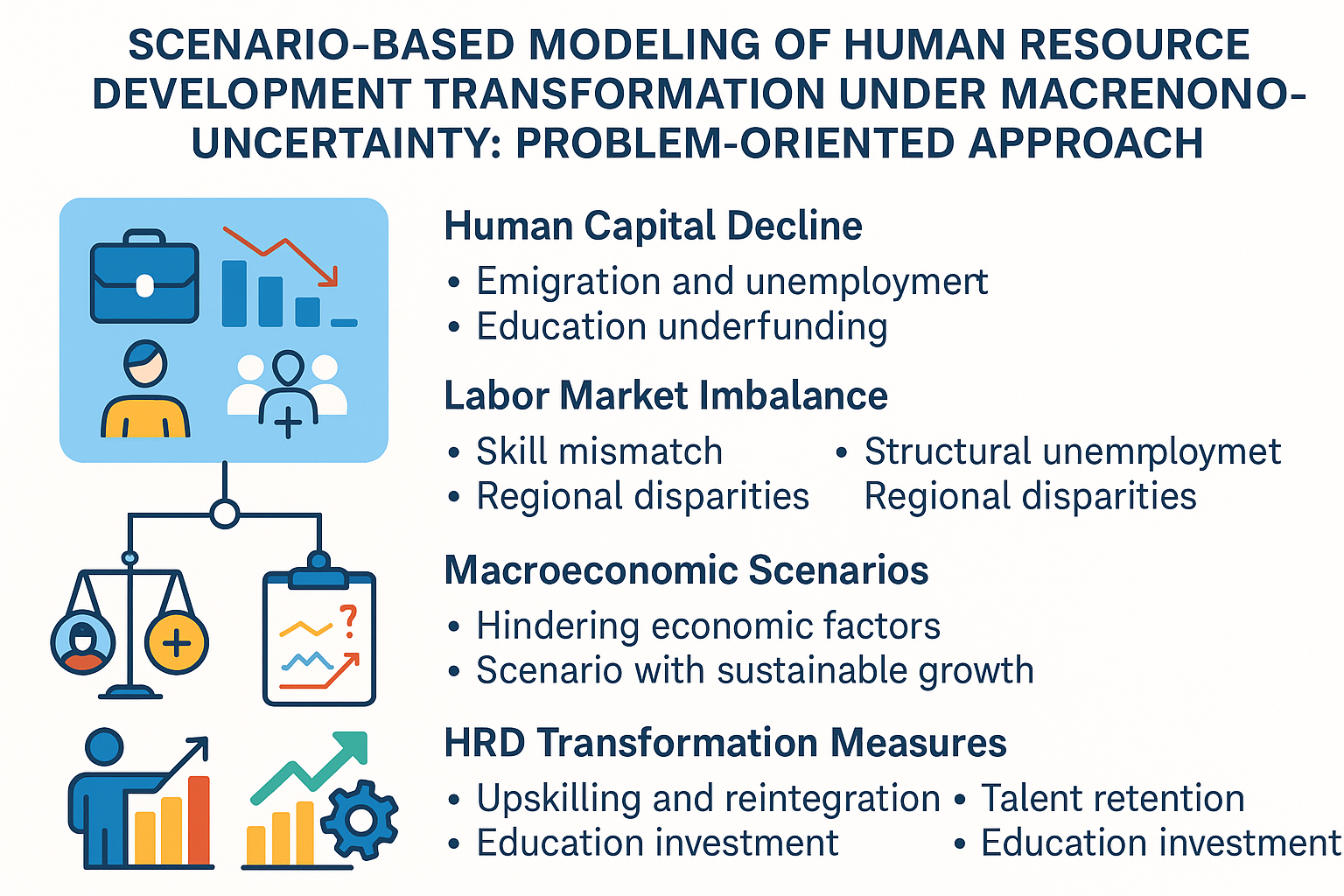
The object of research is the process of problem-oriented human resource development under macroeconomic uncertainty. The proposed scenario-based modeling approach integrates tools of cognitive mapping and system dynamics modeling to construct and evaluate alternative development scenarios. A problem-oriented human resource development model was constructed based on a scenario approach, incorporating indicators and instruments at three levels of governance (macro, meso, and micro). This model enables the formulation of a well-founded set of policies and measures, taking into account macroeconomic realities, wartime risks, and institutional constraints. Development scenarios-baseline, optimistic, and pessimistic- were elaborated. Key criteria for evaluating the effectiveness of human resource development and policy directions were identified, including macroeconomic effects (growth in GDP per capita, living standards), regional effects (growth in gross regional product, reduction of unemployment), microeconomic effects (increased productivity, reduced employee turnover, improved workforce qualification), and the extent to which priority problems are addressed (brain drain, skills mismatch, etc.). The proposed system of evaluation criteria enables the alignment of objectives across different governance levels and facilitates multidimensional policy assessment. According to these criteria, all three scenarios – especially the optimistic and synergistic ones – outperform the existing inertial trajectory of development. The results demonstrate a synergistic effect of coordinated investments in human resource development across all governance levels, providing a solid foundation for national human capital development policies. The impact of the full-scale war in Ukraine was taken into account in the formulation of challenges and scenarios, and state support measures for transforming human resource development during crisis and post-war recovery were substantiated.
References
- Cascio, W. F. (2009). Bruce E. Kaufman. (2008). Managing the Human Factor: The Early Years of Human Resource Management in American Industry. Ithaca, NY: Cornell University Press. 376 pages. Human Resource Management, 48 (4), 669–674. https://doi.org/10.1002/hrm.20306
- Libanova, E. (Ed.) (2021). Human development in Ukraine. Priorities of the national policy of minimizing the asymmetry of the Ukrainian labor market. Kyiv: PH “Akademperiodyka”, 210. https://doi.org/10.15407/akademperiodyka.452.210
- Becker, G. S. (1994). Human Capital: A Theoretical and Empirical Analysis with Special Reference to Education. Available at: https://www.nber.org/books-and-chapters/human-capital-theoretical-and-empirical-analysis-special-reference-education-third-edition
- Woodhall, M. (2001). Human Capital: Educational Aspects. International Encyclopedia of the Social & Behavioral Sciences, 6951–6955. https://doi.org/10.1016/b0-08-043076-7/02469-4
- Beztelesna, L. (2018). Ways of improving the quality of human capital formation at community level. Economic Forum, 1, 294–298. Available at: http://nbuv.gov.ua/UJRN/ecfor_2018_1_50
- Vaizey, J., Schultz, T. W. (1972). Investment in Human Capital. The Economic Journal, 82 (326), 787. https://doi.org/10.2307/2230051
- McGregor, D.; Leavitt, H. J., Pondy, L. R., Boje, D. M. (Eds.) (1980). The human side of enterprise. Readings in managerial psychology. University of Chicago Press, 310–321. Available at: https://web.mit.edu/curhan/www/docs/Articles/15341_Readings/Motivation/McGregor_The_Human_Side_of_Enterprise.pdf
- Vityk, B. (2024). Personnel security of the enterprise: theoretical fundamentals of security. Digital Есопоmу and Economic Security, 2 (11), 66–69. https://doi.org/10.32782/dees.11-10
- Zaloznova, Y., Azmuk, N. (2022). Human capital of Ukraine in the conditions of war: losses and gains. Economy and Society, 38. https://doi.org/10.32782/2524-0072/2022-38-59
- Demohrafichna ta sotsialʹna statystyka / Rynok pratsi / Zaynyatistʹ ta bezrobittya. (2022). Derzhavna sluzhba statystyky Ukrayiny. Available at: https://ukrstat.gov.ua/operativ/menu/menu_u/rp.htm
- Mihratsiya yak chynnyk rozvytku v Ukrayini (2019). Mizhnarodna orhanizatsiya z mihratsiyi. Available at: https://ukraine.iom.int/sites/g/files/tmzbdl1861/files/mom_migraciya_yak_chynnyk_rozvytku_v_ukrayini.pdf?ref=deepstateua.com
- Studennikova, I. (2024). Labor market in wartime: Demographic challenges for Ukraine. VoxUkraine. Available at: https://voxukraine.org/labor-market-in-wartime
- Ukraine – Public Spending on Education (2025). TRADING ECONOMICS. Available at: https://tradingeconomics.com/ukraine/public-spending-on-education-total-percent-of-gdp-wb-data.html
- Libanova, E. M., Pozniak, O. V., Tsymbal, O. I. (2022). Scale and Consequences of Forced Migration of the Population of Ukraine as a Result of Armed Aggression of the Russian Federation. Demography and Social Economy, 48 (2), 37–57. https://doi.org/10.15407/dse2022.02.037
- The Future of Jobs Report 2025 (2025). World Economic Forum. Available at: https://www.weforum.org/publications/the-future-of-jobs-report-2025/in-full/introduction-the-global-labour-market-landscape-in-2025/
- Pro profesiinyi rozvytok pratsivnykiv (2012). Zakon Ukrainy No. 4312-VI. 12.01.2012. Available at: https://zakon.rada.gov.ua/laws/show/4312-17#Text
- Kyzym, M. O., Ivanov, Yu. B., Zinchenko, V. A., Ivanova, O. Yu., Chechetova-Terashvili, T. M., Bielikova, N. V. et al.; Kyzym, M. O., Ivanova, Yu. B. (Eds.) (2014). Deregulation of economy: problems and prospects. Kharkiv: VD “INZhEK”, 288.
Downloads
Published
How to Cite
Issue
Section
License
Copyright (c) 2025 Viacheslav Laptiev, Olga Ivanova, Larysa Lisogor

This work is licensed under a Creative Commons Attribution 4.0 International License.
The consolidation and conditions for the transfer of copyright (identification of authorship) is carried out in the License Agreement. In particular, the authors reserve the right to the authorship of their manuscript and transfer the first publication of this work to the journal under the terms of the Creative Commons CC BY license. At the same time, they have the right to conclude on their own additional agreements concerning the non-exclusive distribution of the work in the form in which it was published by this journal, but provided that the link to the first publication of the article in this journal is preserved.