A privacy-preserving edge data aggregation for TinyML energy forecasting in households
DOI:
https://doi.org/10.15587/2706-5448.2025.339277Keywords:
energy management systems, energy efficiency, Internet of Things, smart gridAbstract
The object of this research is the use of tiny machine learning (ML) forecasting models and low-power edge processing as a part of a hybrid energy management system (HEMS) with a particular emphasis on ensuring end-user data privacy and trust. The research addresses the challenge of the collection, aggregation, and processing of sensitive data in smart grid operational modes decision-making tasks.
An in-depth literature review revealed that failing to meet user expectations for control and privacy often leads to dissatisfaction and disengagement. This study introduced a complex solution that tries to solve the indicated gap and proposes a prototype of a HEMS data aggregation subsystem designed to supply information to an energy consumption forecasting module based on mobile ML models.
The developed LSTM-based household energy consumption forecasting models were converted into CoreML and TensorFlow Lite formats, maintained accuracy with an RMSE of 0.211 kWh, inference time under 0.5 ms, 800 kB size on disk, and up to 20 MB RAM usage. These results confirm their feasibility for deployment in HEMS forecasting subsystems on low-power edge devices.
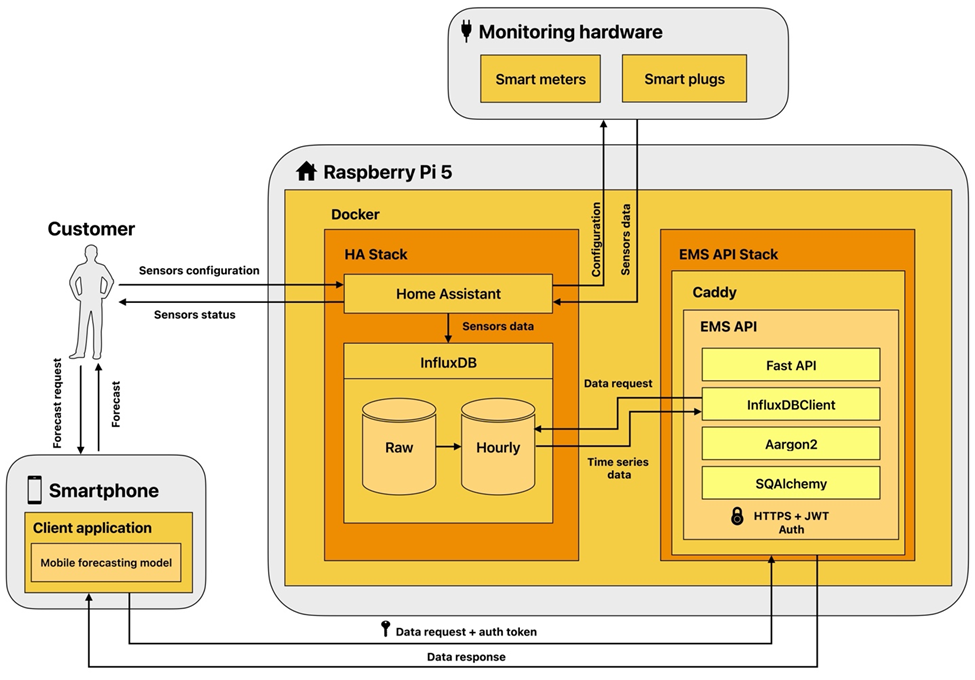
To supply these models with data, a prototype of the HEMS data aggregation system was developed. It uses open-source software (Home Assistant, InfluxDB) and a scalable, privacy-centered container architecture that keeps sensitive data at the edge. Tests on Raspberry Pi 5 (16 GB) showed 97.2% availability over 72 hours, with 12% RAM usage, 18% CPU load, and CPU temperatures of 44–51°C when processing 1440 records per sensor daily. This confirms reliable aggregation with low resource demands and good scalability.
Considering the results, the models and prototype can be considered as the sensing and edge computing layers of HEMS, providing the necessary data for operational mode selection in household microgrids.
Supporting Agency
- The research was partially conducted at the expense of state budget research funding “Intelligent information technology for proactive management of energy infrastructure under conditions of risks and uncertainty”, state registration number 0123U101852, which is being carried out at Sumy State University.
References
- Saleem, M., Shakir, M., Usman, M., Bajwa, M., Shabbir, N., Shams Ghahfarokhi, P., Daniel, K. (2023). Integrating Smart Energy Management System with Internet of Things and Cloud Computing for Efficient Demand Side Management in Smart Grids. Energies, 16 (12), 4835. https://doi.org/10.3390/en16124835
- Avancini, D. B., Rodrigues, J. J. P. C., Rabêlo, R. A. L., Das, A. K., Kozlov, S., Solic, P. (2020). A new IoT‐based smart energy meter for smart grids. International Journal of Energy Research, 45 (1), 189–202. https://doi.org/10.1002/er.5177
- Gumz, J., Fettermann, D. C. (2024). User’s perspective in smart meter research: State-of-the-art and future trends. Energy and Buildings, 308, 114025. https://doi.org/10.1016/j.enbuild.2024.114025
- Ji, W., Chan, E. H. W. (2020). Between users, functions, and evaluations: Exploring the social acceptance of smart energy homes in China. Energy Research & Social Science, 69, 101637. https://doi.org/10.1016/j.erss.2020.101637
- Boiko, O., Komin, A., Malekian, R., Davidsson, P. (2024). Edge-Cloud Architectures for Hybrid Energy Management Systems: A Comprehensive Review. IEEE Sensors Journal, 24 (10), 15748–15772. https://doi.org/10.1109/jsen.2024.3382390
- Loomans, N., Alkemade, F. (2024). Exploring trade-offs: A decision-support tool for local energy system planning. Applied Energy, 369, 123527. https://doi.org/10.1016/j.apenergy.2024.123527
- Parfenenko, Yu. V., Shendryk, V. V., Kholiavka, Ye. P., Pavlenko, P. M. (2023). Comparison of short-term forecasting methods of electricity consumption in microgrids. Radio Electronics, Computer Science, Control, 1, 14. https://doi.org/10.15588/1607-3274-2023-1-2
- Komin, A., Boiko, O. (2025). Mobile energy consumption forecasting in microgrids: evaluation of converted models. Visnyk of Kherson National Technical University, 2 (1 (92)), 84–92. https://doi.org/10.35546/kntu2078-4481.2025.1.2.12
- Elhanashi, A., Dini, P., Saponara, S., Zheng, Q. (2024). Advancements in TinyML: Applications, Limitations, and Impact on IoT Devices. Electronics, 13 (17), 3562. https://doi.org/10.3390/electronics13173562
- Neural network classifier. Updatable models. GitHub. Available at: https://apple.github.io/coremltools/docs-guides/source/updatable-neural-network-classifier-on-mnist-dataset.html
- On-Device Training with LiteRT. Available at: https://ai.google.dev/edge/litert/models/ondevice_training
- Understanding Home Energy Management. Home Assistant. Available at: https://www.home-assistant.io/docs/energy/
- Azlan, A. T. B. N. N., Mativenga, P. T., Zhu, M., Mirhosseini, N. (2023). Industry 4.0 energy monitoring system for multiple production machines. Procedia CIRP, 120, 613–618. https://doi.org/10.1016/j.procir.2023.09.047
- Energy Management for Home Assistant. Emhass. Available at: https://emhass.readthedocs.io/en/latest/index.html
- InfliuxDB OSS v2. Influxdata. Available at: https://docs.influxdata.com/influxdb/v2/
- Reference. FastAPI. Available at: https://fastapi.tiangolo.com/reference/
- Caddy. Available at: https://caddyserver.com/docs/
- Manuals. Docker. Available at: https://docs.docker.com/manuals/
- Telegraf. GitHub. Available at: https://github.com/influxdata/telegraf
- Raspberry Pi 5. Raspberry Pi. Available at: https://www.raspberrypi.com/products/raspberry-pi-5/
- Shelly Plus Plug S. Shelly. Available at: https://kb.shelly.cloud/knowledge-base/shelly-plus-plug-s-1
- Kastner, L., Langer, M., Lazar, V., Schomacker, A., Speith, T., Sterz, S. (2021). On the Relation of Trust and Explainability: Why to Engineer for Trustworthiness. 2021 IEEE 29th International Requirements Engineering Conference Workshops (REW). IEEE, 169–175. https://doi.org/10.1109/rew53955.2021.00031
- Alhandi, S. A., Kamaludin, H., Alduais, N. A. M. (2023). Trust Evaluation Model in IoT Environment: A Comprehensive Survey. IEEE Access, 11, 11165–11182. https://doi.org/10.1109/access.2023.3240990
- Aaqib, M., Ali, A., Chen, L., Nibouche, O. (2023). IoT trust and reputation: a survey and taxonomy. Journal of Cloud Computing, 12 (1). https://doi.org/10.1186/s13677-023-00416-8
- Junior, F. M. R., Kamienski, C. A. (2021). A Survey on Trustworthiness for the Internet of Things. IEEE Access, 9, 42493–42514. https://doi.org/10.1109/access.2021.3066457
- Stover, O., Karve, P., Mahadevan, S. (2023). Reliability and risk metrics to assess operational adequacy and flexibility of power grids. Reliability Engineering & System Safety, 231, 109018. https://doi.org/10.1016/j.ress.2022.109018
- Kelly, S., Kaye, S.-A., Oviedo-Trespalacios, O. (2023). What factors contribute to the acceptance of artificial intelligence? A systematic review. Telematics and Informatics, 77, 101925. https://doi.org/10.1016/j.tele.2022.101925
- Vanegas Cantarero, M. M. (2020). Of renewable energy, energy democracy, and sustainable development: A roadmap to accelerate the energy transition in developing countries. Energy Research & Social Science, 70, 101716. https://doi.org/10.1016/j.erss.2020.101716
- Martin, A., Agnoletti, M.-F., Brangier, É. (2021). Ordinary users, precursory users and experts in the anticipation of future needs: Evaluation of their contribution in the elaboration of new needs in energy for housing. Applied Ergonomics, 94, 103394. https://doi.org/10.1016/j.apergo.2021.103394
- Farhan, M., Reza, T. N., Badal, F. R., Islam, Md. R., Muyeen, S. M., Tasneem, Z. et al. (2023). Towards next generation Internet of Energy system: Framework and trends. Energy and AI, 14, 100306. https://doi.org/10.1016/j.egyai.2023.100306
- Puthal, D., Mohanty, S. P., Yeun, C. Y., Damiani, E., Pradhan, B. (2023). Pervasive AI for Secure and Scalable IoT- Edge-Cloud Continuum: A Big Picture. 2023 IEEE International Conference on High Performance Computing & Communications, Data Science & Systems, Smart City & Dependability in Sensor, Cloud & Big Data Systems & Application (HPCC/DSS/SmartCity/DependSys). IEEE, 566–573. https://doi.org/10.1109/hpcc-dss-smartcity-dependsys60770.2023.00083
- Qureshi, K. N., Alhudhaif, A., Hussain, A., Iqbal, S., Jeon, G. (2022). Trust aware energy management system for smart homes appliances. Computers & Electrical Engineering, 97, 107641. https://doi.org/10.1016/j.compeleceng.2021.107641
- Boomsma, M., Vringer, K., Soest, D. van. (2025). The impact of real-time energy consumption feedback on residential gas and electricity usage. Journal of Environmental Economics and Management, 132, 103163. https://doi.org/10.1016/j.jeem.2025.103163
- Hesselman, C., Grosso, P., Holz, R., Kuipers, F., Xue, J. H., Jonker, M. (2020). A Responsible Internet to Increase Trust in the Digital World. Journal of Network and Systems Management, 28 (4), 882–922. https://doi.org/10.1007/s10922-020-09564-7
- Dorahaki, S., MollahassaniPour, M., Rashidinejad, M. (2023). Optimizing energy payment, user satisfaction, and self-sufficiency in flexibility-constrained smart home energy management: A multi-objective optimization approach. E-Prime – Advances in Electrical Engineering, Electronics and Energy, 6, 100385. https://doi.org/10.1016/j.prime.2023.100385
- Vigurs, C., Maidment, C., Fell, M., Shipworth, D. (2021). Customer Privacy Concerns as a Barrier to Sharing Data about Energy Use in Smart Local Energy Systems: A Rapid Realist Review. Energies, 14 (5), 1285. https://doi.org/10.3390/en14051285
- Siitonen, P., Honkapuro, S., Annala, S., Wolff, A. (2022). Customer perspectives on demand response in Europe: a systematic review and thematic synthesis. Sustainability: Science, Practice and Policy, 19 (1). https://doi.org/10.1080/15487733.2022.2154986
- Pfeiffer, C., Hatzl, S., Fleiß, E., Posch, A. (2024). How end users perceive their energy data within the spectrum of personal information: A two-stage clustering approach. Energy Reports, 11, 2011–2022. https://doi.org/10.1016/j.egyr.2024.01.053
- Struminskaya, B., Toepoel, V., Lugtig, P., Haan, M., Luiten, A., Schouten, B. (2020). Understanding Willingness to Share Smartphone-Sensor Data. Public Opinion Quarterly, 84 (3), 725–759. https://doi.org/10.1093/poq/nfaa044
- Begier, B. (2014). Effective cooperation with energy consumers. Journal of Information, Communication and Ethics in Society, 12 (2), 107–121. https://doi.org/10.1108/jices-07-2013-0021
Downloads
Published
How to Cite
Issue
Section
License
Copyright (c) 2025 Anton Komin, Olha Boiko

This work is licensed under a Creative Commons Attribution 4.0 International License.
The consolidation and conditions for the transfer of copyright (identification of authorship) is carried out in the License Agreement. In particular, the authors reserve the right to the authorship of their manuscript and transfer the first publication of this work to the journal under the terms of the Creative Commons CC BY license. At the same time, they have the right to conclude on their own additional agreements concerning the non-exclusive distribution of the work in the form in which it was published by this journal, but provided that the link to the first publication of the article in this journal is preserved.