Конфіденційна периферійна агрегація даних для прогнозування енергоспоживання домогосподарствами з використанням TinyML
DOI:
https://doi.org/10.15587/2706-5448.2025.339277Ключові слова:
системи управління енергоспоживанням, енергоефективність, Інтернет речей, розумні енергомережіАнотація
Об'єктом цього дослідження є використання мобільних моделей прогнозування на основі машинного навчання (ML) і периферійних обчислень на малопотужних пристроях як частини гібридної системи енергоменеджменту (HEMS) з фокусом на конфіденційність і довіру кінцевих користувачів. Дане дослідження розглядає проблему збору, агрегації та обробки чутливих даних у завданнях прийняття рішень щодо режимів роботи мереж smart grid.
Детальний огляд літератури показав, що невиконання очікувань користувачів щодо контролю та конфіденційності часто призводить до незадоволення й втрати залученості. Це дослідження пропонує комплексне рішення, що намагається усунути цю проблему та реалізує прототип підсистеми агрегації даних HEMS, призначеної постачати дані для модуля прогнозування енергоспоживання на основі мобільних ML-моделей.
Розроблені LSTM-моделі прогнозування споживання енергії домогосподарством були конвертовані у формати CoreML та TensorFlow Lite і зберегли точність із RMSE 0,211 кВт · год, швидкістю надання прогнозу < 0,5 мс, розміром на диску у 800 кБ і використанням до 20 МБ RAM. Результати підтверджують їхню придатність для підсистем прогнозування HEMS на малопотужних периферійних пристроях.
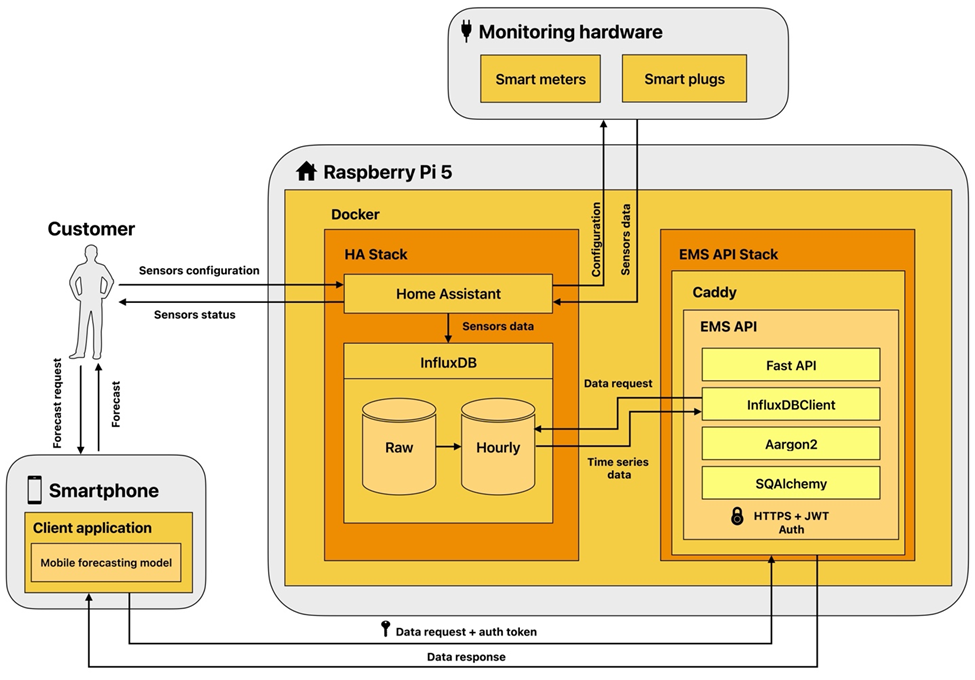
Для забезпечення цих моделей даними створено прототип підсистеми агрегації HEMS. Він використовує програмне забезпечення з відкритим кодом (Home Assistant, InfluxDB) і масштабовану контейнерну архітектуру, орієнтовану на конфіденційність, що зберігає дані на периферії. Тести на Raspberry Pi 5 16 Gb показали 97,2% доступності за 72 годин використання, стабільну роботу з середнім навантаженням у 12% RAM, 18% CPU та температурою 44–51°C при обробці 1440 записів щодня для кожного сенсора. Результати підтверджують надійну агрегацію даних в умовах обмежених ресурсів і гарні перспективи масштабування.
Отримані результати свідчать, що розроблені моделі та прототип можуть слугувати сенсорним і обчислювальним рівнями HEMS, забезпечуючи необхідні дані для вибору режимів роботи мікромереж домогосподарств.
Спонсор дослідження
- Дослідження частково проведено за рахунок державного бюджетного фінансування наукової роботи «Інтелектуальні інформаційні технології для проактивного управління енергетичною інфраструктурою в умовах ризиків та невизначеності», номер державної реєстрації 0123U101852, яка виконується в Сумському державному університеті.
Посилання
- Saleem, M., Shakir, M., Usman, M., Bajwa, M., Shabbir, N., Shams Ghahfarokhi, P., Daniel, K. (2023). Integrating Smart Energy Management System with Internet of Things and Cloud Computing for Efficient Demand Side Management in Smart Grids. Energies, 16 (12), 4835. https://doi.org/10.3390/en16124835
- Avancini, D. B., Rodrigues, J. J. P. C., Rabêlo, R. A. L., Das, A. K., Kozlov, S., Solic, P. (2020). A new IoT‐based smart energy meter for smart grids. International Journal of Energy Research, 45 (1), 189–202. https://doi.org/10.1002/er.5177
- Gumz, J., Fettermann, D. C. (2024). User’s perspective in smart meter research: State-of-the-art and future trends. Energy and Buildings, 308, 114025. https://doi.org/10.1016/j.enbuild.2024.114025
- Ji, W., Chan, E. H. W. (2020). Between users, functions, and evaluations: Exploring the social acceptance of smart energy homes in China. Energy Research & Social Science, 69, 101637. https://doi.org/10.1016/j.erss.2020.101637
- Boiko, O., Komin, A., Malekian, R., Davidsson, P. (2024). Edge-Cloud Architectures for Hybrid Energy Management Systems: A Comprehensive Review. IEEE Sensors Journal, 24 (10), 15748–15772. https://doi.org/10.1109/jsen.2024.3382390
- Loomans, N., Alkemade, F. (2024). Exploring trade-offs: A decision-support tool for local energy system planning. Applied Energy, 369, 123527. https://doi.org/10.1016/j.apenergy.2024.123527
- Parfenenko, Yu. V., Shendryk, V. V., Kholiavka, Ye. P., Pavlenko, P. M. (2023). Comparison of short-term forecasting methods of electricity consumption in microgrids. Radio Electronics, Computer Science, Control, 1, 14. https://doi.org/10.15588/1607-3274-2023-1-2
- Komin, A., Boiko, O. (2025). Mobile energy consumption forecasting in microgrids: evaluation of converted models. Visnyk of Kherson National Technical University, 2 (1 (92)), 84–92. https://doi.org/10.35546/kntu2078-4481.2025.1.2.12
- Elhanashi, A., Dini, P., Saponara, S., Zheng, Q. (2024). Advancements in TinyML: Applications, Limitations, and Impact on IoT Devices. Electronics, 13 (17), 3562. https://doi.org/10.3390/electronics13173562
- Neural network classifier. Updatable models. GitHub. Available at: https://apple.github.io/coremltools/docs-guides/source/updatable-neural-network-classifier-on-mnist-dataset.html
- On-Device Training with LiteRT. Available at: https://ai.google.dev/edge/litert/models/ondevice_training
- Understanding Home Energy Management. Home Assistant. Available at: https://www.home-assistant.io/docs/energy/
- Azlan, A. T. B. N. N., Mativenga, P. T., Zhu, M., Mirhosseini, N. (2023). Industry 4.0 energy monitoring system for multiple production machines. Procedia CIRP, 120, 613–618. https://doi.org/10.1016/j.procir.2023.09.047
- Energy Management for Home Assistant. Emhass. Available at: https://emhass.readthedocs.io/en/latest/index.html
- InfliuxDB OSS v2. Influxdata. Available at: https://docs.influxdata.com/influxdb/v2/
- Reference. FastAPI. Available at: https://fastapi.tiangolo.com/reference/
- Caddy. Available at: https://caddyserver.com/docs/
- Manuals. Docker. Available at: https://docs.docker.com/manuals/
- Telegraf. GitHub. Available at: https://github.com/influxdata/telegraf
- Raspberry Pi 5. Raspberry Pi. Available at: https://www.raspberrypi.com/products/raspberry-pi-5/
- Shelly Plus Plug S. Shelly. Available at: https://kb.shelly.cloud/knowledge-base/shelly-plus-plug-s-1
- Kastner, L., Langer, M., Lazar, V., Schomacker, A., Speith, T., Sterz, S. (2021). On the Relation of Trust and Explainability: Why to Engineer for Trustworthiness. 2021 IEEE 29th International Requirements Engineering Conference Workshops (REW). IEEE, 169–175. https://doi.org/10.1109/rew53955.2021.00031
- Alhandi, S. A., Kamaludin, H., Alduais, N. A. M. (2023). Trust Evaluation Model in IoT Environment: A Comprehensive Survey. IEEE Access, 11, 11165–11182. https://doi.org/10.1109/access.2023.3240990
- Aaqib, M., Ali, A., Chen, L., Nibouche, O. (2023). IoT trust and reputation: a survey and taxonomy. Journal of Cloud Computing, 12 (1). https://doi.org/10.1186/s13677-023-00416-8
- Junior, F. M. R., Kamienski, C. A. (2021). A Survey on Trustworthiness for the Internet of Things. IEEE Access, 9, 42493–42514. https://doi.org/10.1109/access.2021.3066457
- Stover, O., Karve, P., Mahadevan, S. (2023). Reliability and risk metrics to assess operational adequacy and flexibility of power grids. Reliability Engineering & System Safety, 231, 109018. https://doi.org/10.1016/j.ress.2022.109018
- Kelly, S., Kaye, S.-A., Oviedo-Trespalacios, O. (2023). What factors contribute to the acceptance of artificial intelligence? A systematic review. Telematics and Informatics, 77, 101925. https://doi.org/10.1016/j.tele.2022.101925
- Vanegas Cantarero, M. M. (2020). Of renewable energy, energy democracy, and sustainable development: A roadmap to accelerate the energy transition in developing countries. Energy Research & Social Science, 70, 101716. https://doi.org/10.1016/j.erss.2020.101716
- Martin, A., Agnoletti, M.-F., Brangier, É. (2021). Ordinary users, precursory users and experts in the anticipation of future needs: Evaluation of their contribution in the elaboration of new needs in energy for housing. Applied Ergonomics, 94, 103394. https://doi.org/10.1016/j.apergo.2021.103394
- Farhan, M., Reza, T. N., Badal, F. R., Islam, Md. R., Muyeen, S. M., Tasneem, Z. et al. (2023). Towards next generation Internet of Energy system: Framework and trends. Energy and AI, 14, 100306. https://doi.org/10.1016/j.egyai.2023.100306
- Puthal, D., Mohanty, S. P., Yeun, C. Y., Damiani, E., Pradhan, B. (2023). Pervasive AI for Secure and Scalable IoT- Edge-Cloud Continuum: A Big Picture. 2023 IEEE International Conference on High Performance Computing & Communications, Data Science & Systems, Smart City & Dependability in Sensor, Cloud & Big Data Systems & Application (HPCC/DSS/SmartCity/DependSys). IEEE, 566–573. https://doi.org/10.1109/hpcc-dss-smartcity-dependsys60770.2023.00083
- Qureshi, K. N., Alhudhaif, A., Hussain, A., Iqbal, S., Jeon, G. (2022). Trust aware energy management system for smart homes appliances. Computers & Electrical Engineering, 97, 107641. https://doi.org/10.1016/j.compeleceng.2021.107641
- Boomsma, M., Vringer, K., Soest, D. van. (2025). The impact of real-time energy consumption feedback on residential gas and electricity usage. Journal of Environmental Economics and Management, 132, 103163. https://doi.org/10.1016/j.jeem.2025.103163
- Hesselman, C., Grosso, P., Holz, R., Kuipers, F., Xue, J. H., Jonker, M. (2020). A Responsible Internet to Increase Trust in the Digital World. Journal of Network and Systems Management, 28 (4), 882–922. https://doi.org/10.1007/s10922-020-09564-7
- Dorahaki, S., MollahassaniPour, M., Rashidinejad, M. (2023). Optimizing energy payment, user satisfaction, and self-sufficiency in flexibility-constrained smart home energy management: A multi-objective optimization approach. E-Prime – Advances in Electrical Engineering, Electronics and Energy, 6, 100385. https://doi.org/10.1016/j.prime.2023.100385
- Vigurs, C., Maidment, C., Fell, M., Shipworth, D. (2021). Customer Privacy Concerns as a Barrier to Sharing Data about Energy Use in Smart Local Energy Systems: A Rapid Realist Review. Energies, 14 (5), 1285. https://doi.org/10.3390/en14051285
- Siitonen, P., Honkapuro, S., Annala, S., Wolff, A. (2022). Customer perspectives on demand response in Europe: a systematic review and thematic synthesis. Sustainability: Science, Practice and Policy, 19 (1). https://doi.org/10.1080/15487733.2022.2154986
- Pfeiffer, C., Hatzl, S., Fleiß, E., Posch, A. (2024). How end users perceive their energy data within the spectrum of personal information: A two-stage clustering approach. Energy Reports, 11, 2011–2022. https://doi.org/10.1016/j.egyr.2024.01.053
- Struminskaya, B., Toepoel, V., Lugtig, P., Haan, M., Luiten, A., Schouten, B. (2020). Understanding Willingness to Share Smartphone-Sensor Data. Public Opinion Quarterly, 84 (3), 725–759. https://doi.org/10.1093/poq/nfaa044
- Begier, B. (2014). Effective cooperation with energy consumers. Journal of Information, Communication and Ethics in Society, 12 (2), 107–121. https://doi.org/10.1108/jices-07-2013-0021
##submission.downloads##
Опубліковано
Як цитувати
Номер
Розділ
Ліцензія
Авторське право (c) 2025 Anton Komin, Olha Boiko

Ця робота ліцензується відповідно до Creative Commons Attribution 4.0 International License.
Закріплення та умови передачі авторських прав (ідентифікація авторства) здійснюється у Ліцензійному договорі. Зокрема, автори залишають за собою право на авторство свого рукопису та передають журналу право першої публікації цієї роботи на умовах ліцензії Creative Commons CC BY. При цьому вони мають право укладати самостійно додаткові угоди, що стосуються неексклюзивного поширення роботи у тому вигляді, в якому вона була опублікована цим журналом, але за умови збереження посилання на першу публікацію статті в цьому журналі.